An amended receipt is a second version of an issued document — and holding one raises the question of which version governs. This guide explains version references, amended-and-restated documents, and how auditors read amendment chains.
Amended Receipt
Add custom logo
Edit line items
Choose payment method
Add/remove elements
Customize business information
Choose font
An amendment creates a version problem
When a business reissues a receipt or invoice with corrected details, the world now contains two documents describing one transaction — and every downstream reader faces the same question: which version governs?
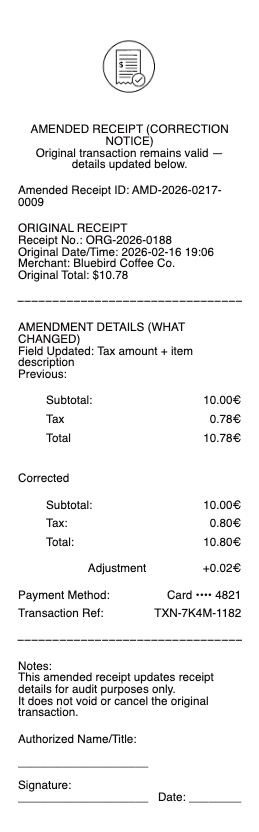
The answer is convention, and the convention is strict: the amended document governs, provided it declares itself. A proper amendment states that it amends, identifies its predecessor (by number and date), and says what changed. A second document that merely differs — same transaction, different figures, no cross-reference — is not an amendment; it is a contradiction, and contradictions are what auditors, banks, and courts treat as red flags.
The anatomy of a well-made amendment
A declaration — "Amended receipt" or equivalent, unmissable on the face.
The predecessor reference — the original's number and date, so the chain is explicit.
Its own identity — a new number or a revision suffix (R1, -A), and the amendment date distinct from the transaction date.
The change, identifiable — best practice states what was corrected; at minimum the changed fields are consistent with a stated reason.
Unchanged facts left unchanged — the transaction date, above all, is history and stays.
The pattern scales up: contracts use amended and restated documents — a full reissue incorporating all changes — precisely so readers never assemble the current state from a chain of fragments. A heavily corrected receipt is better reissued whole, on the same logic.
Keep both versions — always
The instinct on receiving a corrected document is to discard the wrong one. Resist it. The original plus the amendment is the record; the amendment alone is a loose end.
The reasons are practical: the amendment references a document you no longer hold; the original may already have entered systems (your expense report, the accountant's file, a tax return) and reconciling those entries requires knowing what they were based on; and the pair together demonstrates the correction was orderly rather than concealed. An audit that finds an amendment without its original does not assume innocence — it asks what the original said, and you want to be able to answer.
How third parties read amendment chains
Different readers apply different scrutiny to amended documents:
Auditors follow the chain — original, reason, amendment — and test whether the books moved in step. Clean chains pass in seconds; orphan amendments generate samples.
Expense systems need the original claim adjusted, not merely a new document filed — an amended receipt behind an already-reimbursed claim means correcting the claim.
Tax treatment follows the amendment's substance: a changed amount changes deductions and, where applicable, VAT — in step with the period rules.
Counterparties reconcile against their own copy — your amendment should match the version the issuer holds, which is why amendments come from the issuer, never from the holder's own pen.
Keeping amended records
File the amendment with its original, cross-referenced both ways, for the same retention period as the underlying transaction. Where the amendment changed anything already reported — an expense claim, a return, a reclaim — note the follow-through correction in the same file, closing the loop.
If a version is missing while the transaction genuinely happened, the issuer holds the document history and can reissue either version — the recovery route. Your bank statement establishes the payment itself, and a clear reconstructed record documents that real payment for your files, matching it exactly; the amendment chain, which only the issuer's records can restore, is the part worth actually retrieving, because it is the part that explains why two documents describe one transaction.
Frequently asked questions
Everything you need to know about the product and billing.
Which version of an amended receipt governs?
The amendment — provided it declares itself: states that it amends, references the original by number and date, and carries its own identity. A differing document without the cross-reference is a contradiction, not an amendment.
Should I throw away the original after receiving a correction?
No. The original plus the amendment is the record — the amendment alone references a document you no longer hold, and systems that already ingested the original can only be reconciled by knowing what it said.
What is an amended and restated document?
A full reissue incorporating all changes to date, so the current state reads in one document rather than a chain of fragments. Heavily corrected receipts are better reissued whole on the same logic.
Can I amend a receipt myself?
No — amendments come from the issuer, whose records must match the version you hold. A holder's own alteration is not an amendment; it is tampering, however honest the intent.
What stays unchanged in an amendment?
History — above all the transaction date. An amendment corrects erroneous fields; it does not move the transaction to a more convenient time.
How do auditors treat amended receipts?
By following the chain: original, reason, amendment, and whether the books moved in step. Clean chains pass quickly; amendments without their originals invite exactly the scrutiny they appear to avoid.