An annual subscription receipt documents a year-long commitment that renews on its anniversary. This guide explains the renewal-date trap, why mid-term refunds are rare, and the discount arithmetic against monthly billing.
Annual Subscription Receipt
Add custom logo
Edit line items
Choose payment method
Add/remove elements
Customize business information
Choose font
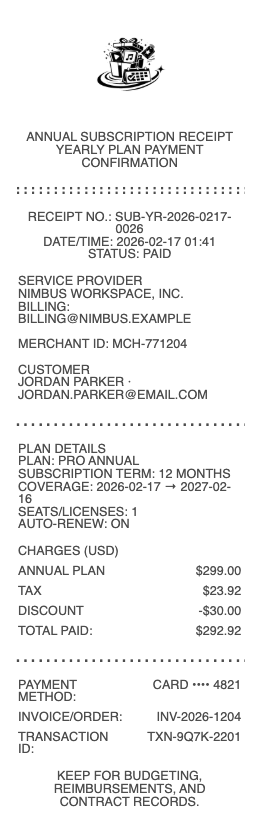
One charge a year is easy money to forget
An annual subscription differs from a monthly one in a way that sounds trivial and is not: the charge lands once a year, on the anniversary of the day you signed up — a date with no natural meaning. Not January, not the fiscal year: the random Tuesday you first subscribed.
Twelve months is exactly long enough to forget. The renewal arrives on a card you may have replaced, for a service you may have stopped using in March, at a price that may have risen since. The receipt is often the first and only notice you get that the year has rolled over — which is why the anniversary date on it is the single most useful field to actually record somewhere you will see it.
The refund problem: you already bought the whole year
The hard commercial fact of annual billing: once the renewal has charged, most providers do not refund pro-rata. Cancel in month two and you typically keep access until the anniversary — and keep paying nothing more — but the ten unused months are generally not returned. Some providers offer a short post-renewal grace window (14 or 30 days) as policy or under state law; most offer nothing.
The consequence is a discipline: the time to decide about an annual subscription is before the anniversary, not after the charge. A calendar reminder two weeks ahead of each renewal date — taken straight off the receipt — is worth real money, and it is the entire defence.
The discount is real, and so is the bet
Annual plans are typically priced at a meaningful discount to twelve months of monthly billing — commonly in the range of two months free. That discount is payment for two things you give up: flexibility (you cannot walk away mid-term for a refund) and float (the provider gets the year's cash on day one).
The honest arithmetic: an annual plan wins if you are confident you will use the service for most of the year. A monthly plan wins if there is any real chance you stop by spring — because two "free" months are worth less than eight cancelled ones. Your own receipt history is the evidence: if last year's annual renewal bought a service you barely opened, this year's decision makes itself.
What the receipt must show
The coverage period — the exact start and end dates of the paid year. This is the field that settles every renewal dispute.
The renewal date and the renewal price, where the provider states it — introductory annual prices frequently step up at first renewal.
The plan tier, the amount, and tax separately.
The payment method charged.
The cancellation route and any refund window.
Annual subscriptions in business records
For a business, an annual subscription paid in advance is a prepaid expense: the accountant may spread it across the months it covers rather than expensing it all in the month paid. The receipt's coverage period is precisely what makes that allocation possible — a receipt showing only a date and an amount cannot be spread correctly.
Keep each year's receipt for the retention period your jurisdiction requires. If one is missing while the charge genuinely happened, the provider's billing history can reissue it, and your card statement establishes the date, amount, and merchant — a clear reconstructed record from those details documents that real payment for your files, matching the statement exactly, with the coverage period taken from the provider's own record rather than guessed.
Frequently asked questions
Everything you need to know about the product and billing.
When does an annual subscription renew?
On the anniversary of the day you signed up — a date with no natural meaning, which is exactly why it gets forgotten. The receipt is where the date lives; a calendar reminder two weeks before it is the whole defence.
Can I get a refund if I cancel mid-year?
Usually not pro-rata. Once the renewal charges, most providers let you keep access until the anniversary but do not return the unused months. Some offer a short post-renewal grace window; many offer nothing — so decide before the charge, not after.
Is the annual discount worth it?
It is typically around two months free, paid for with flexibility and float. It wins if you will use the service most of the year; monthly wins if there is a real chance you stop early — two free months are worth less than eight cancelled ones.
Why did my renewal cost more than last year?
Introductory annual prices frequently step up at first renewal, and providers raise list prices between anniversaries. The receipt's renewal-price field — and last year's receipt — are how you spot the change.
What should an annual subscription receipt show?
The exact coverage period (start and end dates), the renewal date and price, the plan tier, the amount with tax separate, the card charged, and the cancellation route with any refund window.
How does a business account for an annual subscription?
As a prepaid expense, often spread across the months the payment covers. That allocation depends on the coverage period printed on the receipt — which is why a bare date-and-amount receipt is not enough.