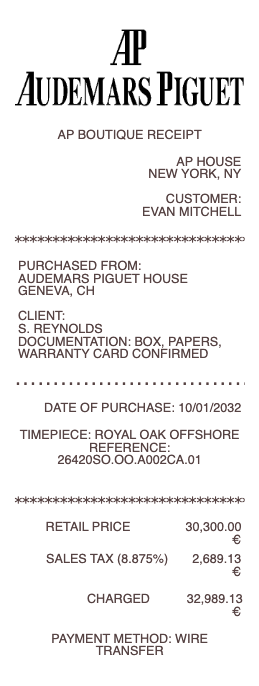
An AP boutique receipt documents an Audemars Piguet purchase made directly from the manufacture's own network. This guide explains boutique-exclusive models, AP's direct-retail approach, and the purchase file to keep.
AP Boutique Receipt
Add custom logo
Edit line items
Choose payment method
Add/remove elements
Customize business information
Choose font
Audemars Piguet sells increasingly on its own terms
Audemars Piguet — one of the great independent Swiss manufactures, maker of the Royal Oak, the Gérald Genta-designed steel sports watch that reshaped luxury watchmaking after 1972 — has moved deliberately toward direct retail: its own boutiques and AP House locations, with a shrinking role for third-party dealers.
An AP boutique receipt therefore documents something specific: a purchase from the brand itself. Warranty activation, service history, and the client relationship all live inside one network — which simplifies the paperwork question (one counterparty) and raises the stakes of the client record (the brand knows exactly what it has sold you, and allocation of sought-after references runs on that knowledge).
Boutique-exclusive references
Part of the direct-retail strategy is boutique exclusivity: certain references and editions sold only through the brand's own network, never through third parties. For the buyer, that exclusivity is on the receipt — the purchase location is part of the watch's story, and for exclusive editions it is the only legitimate first-sale channel.
The resale consequence is direct: a boutique-exclusive piece offered second-hand raises exactly one provenance question — where did it enter the market? — and the original boutique receipt is the answer. For limited editions, the receipt paired with the numbered piece is the provenance chain in miniature.
AP House: retail as hospitality
AP House is the brand's lounge-format retail concept — appointment-led, residential in feel, built around the client relationship rather than the display case. The purchase mechanics match the setting: advisor-led, allocation-driven for sought-after references, and documented in the brand's client systems.
The practical notes for a buyer are the same as all appointment retail, sharpened: the client account's accuracy matters (it is your standing), the purchase history is the currency of future allocation, and the paperwork of each purchase — receipt, warranty activation, certificate of origin where issued — should be captured completely at the moment of sale, when everything is easy.
What the AP purchase file contains
The boutique receipt — reference number, price, date, location.
Warranty documentation — activated at sale within the brand's system.
The certificate and packaging — the full set, whose completeness the secondary market prices.
Serial photographs — taken on purchase day.
Service records as they accrue — brand-network service history adds to value rather than merely maintaining it.
Collectors compress all of this into two words: box and papers. A watch accompanied by its original packaging, warranty documentation, and boutique receipt is a full set — and on the secondary market the same reference with and without its paperwork trades at visibly different money. The purchase file is not administrative residue; it is part of the asset.
Keeping the file, and recovering pieces of it
Keep everything, permanently — for insurance scheduling, for service, and for the eventual sale where full-set brand-network provenance sits at the top of the market. The single-network structure helps recovery: the boutique and the brand hold the sale and warranty records, and known clients can have documentation confirmed or reissued.
If a receipt is missing while the purchase genuinely happened, your card or bank statement establishes the payment, and a clear reconstructed record documents that real payment for your files, matching it exactly — while the brand's own client record and warranty registration remain the documents the watch world, and the brand's own service network, actually recognise.
Two practical uses recur. Insurance scheduling works from the receipt figure at purchase, then from updated appraisals as market values move — insurers cover the documented value, not the remembered one. And when a piece eventually changes hands, the buyer's first question is the paperwork: a complete file answers the authenticity, provenance, and service-history questions before they are asked.
Frequently asked questions
Everything you need to know about the product and billing.
What is special about buying from an AP boutique?
The purchase comes directly from Audemars Piguet's own network — warranty, service history, and the client relationship all live with the brand, and allocation of sought-after references runs on that documented history.
What are boutique-exclusive models?
References and editions sold only through the brand's own boutiques, never third parties. For those pieces the boutique receipt is the only legitimate first-sale document — the provenance answer a future buyer will ask for.
What is AP House?
Audemars Piguet's lounge-format, appointment-led retail concept — residential in feel, advisor-driven, and built around the client relationship. Purchase mechanics are allocation-based and fully documented in the brand's systems.
What should an AP purchase file contain?
The boutique receipt with reference and date, the warranty documentation activated at sale, the certificate and full packaging, serial photographs from purchase day, and service records as they accrue. Together with the original packaging this is what the market calls a full set — box and papers — and it follows the watch through every future sale.
Why does the Royal Oak matter here?
As the 1972 Gérald Genta design that defined the luxury steel sports watch, it anchors the brand's demand — and the allocation dynamics that make documented client history the currency of AP retail.
Can AP confirm an old purchase?
The single-network structure works in your favour: boutiques and the brand hold sale and warranty records, and known clients can have documentation confirmed or reissued — the recovery route for missing paperwork. For older pieces, the manufacture's own records are the deepest source — boutique purchase history first, and the archives for production details of vintage references.