An apartment rent receipt sits alongside a lease, a deposit, and often roommates. This guide explains joint and several liability, why the deposit is not rent, and what the receipt should record in a shared tenancy.
Apartment Rent Receipt
Add custom logo
Edit line items
Choose payment method
Add/remove elements
Customize business information
Choose font
Roommates: why 'my share' is not a thing
The most consequential fact about a shared apartment is one most tenants never read. On a standard joint lease, roommates are jointly and severally liable — which means each of you is responsible for the entire rent, not for a fraction of it.
If your roommate moves out, stops paying, or vanishes, the landlord is not obliged to pursue them for their share. They can pursue you for all of it, because that is what you signed. "I paid my half" is not a defence a joint lease recognises.
This is why receipts matter so acutely in a shared apartment. They are the only record of who actually paid what — which does not change your liability to the landlord, but is precisely the evidence you need when pursuing a roommate who left you carrying their share.
Pay in a way that leaves your name on it
The practical consequence: never hand cash to a roommate and trust that it reaches the landlord. If the landlord receives one payment from one person, the record shows one person paying — and if the rent is short, the tenant with no payment trail is the one with a problem.
Pay the landlord directly where the lease allows it, so your name is on the transaction.
Where one person must collect and forward, transfer your share by bank with a clear reference, never cash.
Ask for the receipt to name who paid, not merely that the unit's rent was received.
The deposit is not rent — and must not be treated as one
A security deposit is money held against damage and unpaid obligations, and it belongs, in most jurisdictions, in a distinct legal category from rent. Two rules follow that tenants break constantly:
You cannot generally use the deposit as your last month's rent unless the lease or state law explicitly permits it. Simply declining to pay the final month and telling the landlord to "use the deposit" is a breach — and it can cost you more than it saves.
The deposit receipt is a separate document. Many states require the landlord to hold deposits in a specific way and to give a receipt or written notice of where it is held.
Keep the deposit receipt filed apart from the rent receipts, because at move-out they answer different questions — one is about what you paid, the other about what you are owed back.
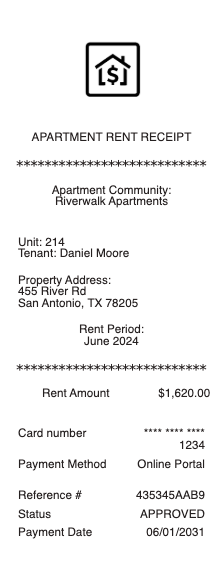
What an apartment rent receipt should record
The unit, not just the building address — apartment number included.
Who paid, by name, where the tenancy is shared.
The period covered, and whether the amount is the full rent or a share of it.
Any additional charges — parking, pet rent, utilities, amenity fees — itemised rather than folded into 'rent'.
The remaining balance for the month, if any.
That itemisation matters at move-out, where disputes turn on what was rent and what was a separate charge, and on which of them the deposit can be applied against.
For a step-by-step walkthrough, including whether your landlord is required to give you one, see our guide to writing a rent receipt.
Move-out: where the receipts finally get read
Nobody looks at rent receipts for years, and then everybody looks at once. At move-out the landlord reconciles the tenancy: rent paid, arrears, damage, deductions from the deposit — and the tenant who can produce a clean, complete run of receipts is in a categorically stronger position than the one who cannot.
Keep them, in order, with the lease, the deposit receipt, the move-in condition report, and photographs. If a receipt is missing for a payment that genuinely happened, your bank record establishes date, amount, and payee, and a clear reconstructed record documents that real payment for your files, matching the bank record exactly — and in a deposit dispute, your bank records and the landlord's ledger are what actually decide it.
Frequently asked questions
Everything you need to know about the product and billing.
What does 'jointly and severally liable' mean for roommates?
Each tenant on the lease is responsible for the entire rent, not just their share. If a roommate stops paying, the landlord can pursue you for the full amount — 'I paid my half' is not a defence a joint lease recognises.
How should I pay rent if I share an apartment?
In a way that leaves your name on the payment. Pay the landlord directly where permitted, or transfer your share by bank with a clear reference — never in cash to a roommate, which leaves you with no trail if the rent is short.
Can I use my security deposit as the last month's rent?
Generally not, unless the lease or state law explicitly allows it. Declining to pay the final month and telling the landlord to use the deposit is a breach and can cost more than it saves.
Is the deposit receipt the same as a rent receipt?
No, and they should be filed separately. Many states require landlords to hold deposits in a specific way and to give written notice of where. At move-out the two documents answer different questions — what you paid, versus what you are owed back.
What should an apartment rent receipt show?
The unit number, who paid (by name, in a shared tenancy), the period covered, whether it is full rent or a share, and any additional charges — parking, pet rent, utilities, amenity fees — itemised rather than folded into rent.
Why do rent receipts matter at move-out?
Because that is when the tenancy is reconciled: rent paid, arrears, damage, and deposit deductions. A tenant with a clean, complete run of receipts is in a far stronger position than one relying on memory.