A babysitting receipt records payment to a sitter. This guide covers the 2026 household employer threshold of $3,000, when a sitter is exempt, what a Dependent Care FSA claim needs, and how to fill out a receipt book for babysitting.
Babysitting Receipt
Add custom logo
Edit line items
Choose payment method
Add/remove elements
Customize business information
Choose font
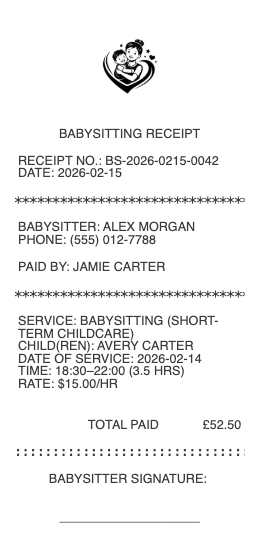
Babysitting sits in a tax grey zone — the receipt is how you stay out of it
Paying a sitter feels informal. Cash, a text to confirm the evening, done. But the moment that money adds up, or a parent wants to claim it, the informality becomes a problem — and the receipt is the only thing standing between a casual arrangement and an unprovable one.
Two different people need this document for two different reasons. The parent needs it to claim reimbursement or a tax credit. The sitter needs it because that income is, in the eyes of the tax authorities, income. A good babysitting receipt serves both at once.
The 2026 household employer threshold: $3,000
Here is the number that decides everything. For 2026, household employer obligations begin at $3,000 in cash wages paid to any single household employee in the calendar year — up from $2,800 in 2025. Cross it, and the family is expected to withhold and pay Social Security and Medicare (FICA), which runs a combined 15.3%, split evenly at 7.65% each between employer and employee. A W-2 is required for any household employee paid $3,000 or more.
Below that threshold, none of that machinery applies — which is where the overwhelming majority of babysitting sits. An occasional Friday-night sitter is nowhere near $3,000 a year; a regular after-school sitter three days a week may quietly cross it without anyone noticing.
The under-18 exemption most families don't know about
There is a significant carve-out. The household employment rules do not apply to an employee under age 18 unless providing household services is their principal occupation. A student who babysits on weekends is not in the principal-occupation category, so the threshold generally doesn't bite regardless of the amount.
The rules also exclude wages paid to a spouse, a parent, or your own child under 21. So the classic arrangements — the teenager down the street, a grandparent helping out — usually sit outside the household-employee regime entirely. The receipt still matters, because the parent may want to claim the expense and the sitter may still owe income tax on the earnings; it simply isn't a payroll situation.
What a Dependent Care FSA claim actually requires
This is where a vague receipt gets rejected. To be reimbursed from a Dependent Care FSA — where the 2026 limit rose to $7,500 for married couples filing jointly (and $3,750 for married filing separately) — the claim needs the provider's identifying details, not just an amount:
The sitter's full name and address.
The sitter's taxpayer identification number — an SSN for an individual, or an EIN for a business.
The dates of care, and the child cared for.
The amount paid, and the sitter's signature.
The TIN is the field that stops most claims. A sitter who doesn't want to provide an SSN is, in practice, refusing to let the parent claim — and that's a conversation to have before the arrangement starts, not at tax time.
How to fill out a receipt book for babysitting
A simple carbon-copy receipt book works perfectly and gives both sides a copy automatically. For each sitting session or pay period:
Date the receipt is issued, and the dates of care if they differ.
Received from — the parent's name.
Amount in figures and, in a receipt book, in words.
For — "babysitting, 12 & 13 July, 8 hours @ $18/hr". Hours and rate make the maths checkable.
Paid by — cash, transfer, or app.
Sitter's signature — the line that turns a note into a receipt.
Sitters: keep the carbon copies. That stack is your income record if you are ever asked, and it is also how you show a rate history when you raise your prices. If a paper record is lost and the payment genuinely happened, a clear reconstructed record from the transfer or app history documents a real payment — matching the actual transaction exactly.
Frequently asked questions
Everything you need to know about the product and billing.
Do I have to pay taxes on babysitting money?
The sitter's earnings are income and are generally reportable. Separately, the family only takes on household-employer obligations (FICA, W-2) once they pay a single household employee $3,000 or more in cash wages during 2026.
What is the 2026 nanny tax threshold?
$3,000 in cash wages to any single household employee in the calendar year, up from $2,800 in 2025. At or above it, the family withholds and pays Social Security and Medicare — a combined 15.3%, split 7.65% each — and issues a W-2.
Is a teenage babysitter exempt?
Generally yes. The household employment rules do not apply to an employee under 18 unless household work is their principal occupation. Wages to a spouse, a parent, or your own child under 21 are also excluded.
What does a Dependent Care FSA need on a babysitting receipt?
The sitter's full name and address, their taxpayer ID number (SSN for an individual, EIN for a business), the dates of care, the child's name, the amount paid, and the sitter's signature. The missing TIN is the most common reason claims are rejected.
How much can I put in a Dependent Care FSA in 2026?
$7,500 for married couples filing jointly, up from $5,000, and $3,750 for married filing separately. It is pre-tax money set aside through an employer's plan to cover care costs.
How do I fill out a receipt book for babysitting?
Enter the date, the parent's name under 'received from', the amount in figures and words, a description with hours and hourly rate, the payment method, and your signature. Keep the carbon copy — it is your income record.