A bike rental receipt covers the hire charge, a damage deposit, and the condition agreed at handover. This guide explains deposit holds versus charges, e-bike terms, and why handover photos protect both sides.
Bike Rental Receipt
Add custom logo
Edit line items
Choose payment method
Add/remove elements
Customize business information
Choose font
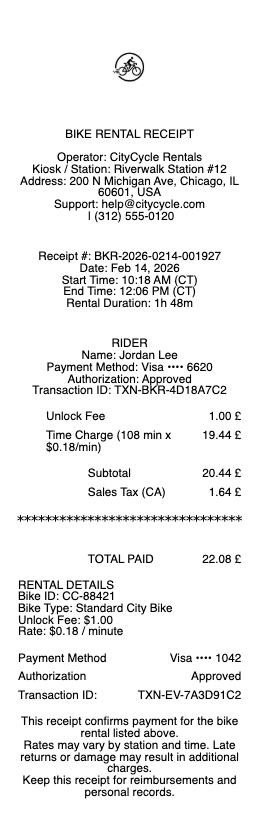
Two amounts leave your card, and only one is a price
A bike rental transaction typically involves two separate figures, and confusing them causes most rental disputes:
The rental charge — the price of the hire: hourly, daily, or weekly, often with helmet, lock, and accessories itemised.
The deposit — security against damage, loss, or late return. Crucially, this is usually a hold (pre-authorisation) on your card rather than a charge: the money is blocked, not taken, and the hold is released after return.
The receipt should state both amounts and, for the deposit, the mechanism — hold or charge — and the release timeline. A hold that has not dropped off days after return is the thing to chase, and the receipt with the stated terms is what you chase it with.
The handover condition is the whole dispute
Every bike rental dispute is ultimately about one question: was the damage there when you took it? The rental agreement answers it only if condition was recorded at handover.
Sixty seconds of photographs — frame, wheels, drivetrain, existing scratches, and for e-bikes the battery and display — timestamped by your phone, is the entire protection. Reputable shops do their own walk-around and note existing damage on the agreement; match their notes against your photos before riding off. At return, photograph again. Between those two sets of pictures, a damage claim has nowhere ambiguous to live.
E-bikes: the extra terms worth reading
Electric bikes carry rental terms ordinary bikes do not, and they appear on the receipt or agreement:
Battery and range — what charge level it left with, and whether recharging mid-rental is your job on multi-day hires.
Higher deposits — reflecting the replacement cost, particularly of the battery.
Liability caps or damage waivers — optional fees that cap your exposure, worth the price on expensive machines.
Speed-class and where you may ride — e-bike classes carry different rules by jurisdiction, and the renter typically bears fines.
What the receipt should show
The bike — model and frame or asset number, tying the paperwork to the machine.
The rental period — out and due-back times, and the late-return rate.
The rental charge with accessories itemised, and the deposit with its mechanism and release terms.
Recorded condition at handover.
Insurance or waiver taken, if any.
Three lines deserve a second look before you ride off. The deposit should be marked as a hold or pre-authorisation, not a charge — if it appears as a completed payment, query it on the spot. Accessories — helmet, lock, lights, child seat, pannier — should be itemised separately, because each carries its own replacement fee if lost, and a receipt that lumps them together makes any later accessory claim a negotiation instead of a lookup. And the damage waiver, if you took one, should state its excess: the amount you still owe even with the waiver, which is the number that actually matters in a dispute.
Keeping rental records
Keep the receipt, the agreement, and both photo sets until the deposit is released and the billing is final — that is the whole liability window. For expensed rentals (a work trip's transport), the receipt with dates and location substantiates the claim.
Shops and rental apps keep transaction records and can reissue receipts, which is the recovery route. If a record is missing while the rental genuinely happened, your card statement establishes the charge — and shows the deposit hold and its release, which is precisely the evidence a stuck-deposit dispute needs. A clear reconstructed record documents the real payment for your files, matching the statement exactly.
One timing quirk catches people: when the shop releases a deposit hold, the money does not reappear instantly — the release travels back through the card networks and the posting time depends on your issuer. If a hold lingers, ask the shop for its release confirmation first, then take that confirmation to your bank; the confirmation is what turns "still waiting" into a resolvable inquiry.
If you rent out other equipment, such as tools, party supplies or event gear, the general rental receipt example covers the same deposit and return-date fields.
Frequently asked questions
Everything you need to know about the product and billing.
Is a bike rental deposit charged or held?
Usually held — a pre-authorisation that blocks the amount without taking it, released after the bike returns undamaged. The receipt should state which mechanism applies and the release timeline; a hold that persists days after return is the thing to chase. When the hold is released, the reappearance time depends on your card issuer — ask the shop for a release confirmation if it lingers.
How do I protect myself against damage claims?
Photograph the bike at handover — frame, wheels, drivetrain, existing scratches, battery on e-bikes — with timestamps, and again at return. Between the two sets, a damage claim has no ambiguous ground.
What extra terms do e-bike rentals carry?
Battery and charge-level terms, higher deposits reflecting replacement cost, optional damage waivers that cap liability, and speed-class rules that vary by jurisdiction — with fines typically passed to the renter.
What should the rental receipt show?
The specific bike by asset number, the rental period with late-return rates, the charge with accessories itemised, the deposit with its mechanism and release terms, the recorded handover condition, and any waiver taken.
How long should I keep bike rental paperwork?
Until the deposit is released and billing is final — that is the liability window. Keep the photos with the receipt.
The shop claims damage I did not cause — what now?
Your handover photos, their own walk-around notes, and the return photos are the evidence. A claim inconsistent with the recorded handover condition fails on the paperwork. Ask for an itemised repair invoice rather than accepting a flat figure — a genuine damage claim can always be broken into parts and labour, and your timestamped handover photos answer the question of when the damage appeared.