A blank receipt is a ready-made receipt template you fill in by hand or on a computer — used for cash sales, markets, rent, and any time you need to give simple proof of payment without a POS system. This guide covers what fields a blank receipt should have, when to use one, the formats to print it in (PDF, Word, or a carbon-copy receipt book), and how to keep blank receipts accurate and above board.
Blank Receipt
Add custom logo
Edit line items
Choose payment method
Add/remove elements
Customize business information
Choose font
What's on a blank receipt
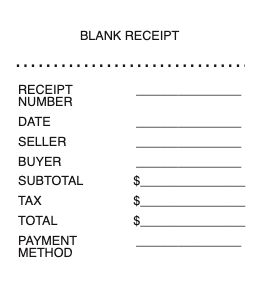
A good blank receipt leaves space for every detail that makes a payment provable. The fields to fill in are:
Receipt number & date — a sequential number and the date of the transaction.
Seller and buyer — who received the money and who paid, with contact details if relevant.
Itemized description — what was sold or paid for, with quantities and prices.
Subtotal, tax & total — the amount before tax, any sales tax, and the final total.
Payment method — cash, card, check, or transfer, and whether it's paid in full or partial.
Signature line — a space for the person issuing the receipt to sign.
When to use a blank receipt
Blank receipts shine wherever there's no cash register or POS. Common uses include cash sales at a market or flea stall, a private sale between individuals — selling a used bike, car, or furniture — collecting rent from a tenant, a small service business (cleaning, tutoring, lawn care, repairs) issuing proof of payment, a club or nonprofit acknowledging a cash contribution, or any one-off transaction where you still want a paper trail. In each case the blank receipt turns an informal payment into a documented one, which protects both the payer and the seller if the amount, the date, or the fact of payment is ever questioned. For recurring payments like rent, issuing one every time also builds a clean month-by-month history that's easy to reference later.
Blank receipt formats: PDF, Word, and receipt books
There are three practical ways to use a blank receipt. A printable PDF is the simplest — print a stack and fill them in by hand. A Word (or Google Docs) template lets you type the details and reprint, handy for repeat customers. A carbon-copy receipt book gives you an instant duplicate: the original goes to the customer and the copy stays bound in the book, which is why market vendors and landlords favor them. Whichever you choose, keeping your copy is what makes the receipt useful later.
Common types of blank receipts
The same skeleton adapts to different needs. A blank cash receipt emphasizes "paid in cash" and a signature. A blank sales receipt centers on itemized goods, quantities, and sales tax. A blank rent receipt records the tenant, property, rental period, and amount — often legally required when a tenant pays cash. A blank service or invoice receipt notes the work performed, hours, and rate. Travel-specific versions like a blank hotel receipt lay out the room rate, number of nights, and taxes for expense reports. Pick the type that matches the transaction so the finished receipt shows exactly the fields that matter — and none of the ones that don't.
Related receipt template receipts: see also our Itemized receipt guide and our Custom receipt guide.
Create and print a blank receipt
Our blank receipt templates and generator give you clean, printable layouts — cash, sales, rent, and more — with all the fields laid out and ready to fill in, in PDF or editable formats you can reuse.
Fill in blank receipts truthfully. A blank receipt is a tool for documenting a real payment that actually took place; completing one for a purchase that never happened, or to inflate an expense claim, is fraud. Use these templates only to record genuine transactions.
Frequently asked questions
Everything you need to know about the product and billing.
What is a blank receipt?
A blank receipt is a pre-formatted template with empty fields you fill in for a transaction — date, seller and buyer, items, amount, and payment method. It's used to give proof of payment when there's no cash register or POS system.
What should a blank receipt include?
A receipt number and date, the names of the seller and buyer, an itemized description of what was paid for, the subtotal, tax and total, the payment method, and a signature line for whoever issues it.
When would I use a blank receipt?
For cash sales at markets, private sales between individuals, collecting rent, small service businesses issuing proof of payment, or any transaction without a register where you still want a paper trail.
What formats can a blank receipt come in?
A printable PDF to fill in by hand, an editable Word or Google Docs template you type into and reprint, or a carbon-copy receipt book that produces an instant duplicate — the original for the customer and the copy for your records.
What is a carbon-copy receipt book?
A bound book of two-part receipts: when you write on the top sheet, a carbon or carbonless layer copies it to the sheet beneath. You hand the original to the customer and keep the duplicate in the book, which is why landlords and market vendors like them.
Is a blank rent receipt legally useful?
Yes. A filled-in rent receipt documents the tenant, property, rental period, and amount paid, and in many places a landlord must provide one when rent is paid in cash. It protects both tenant and landlord if a payment is ever disputed.