A Bob's Watches receipt documents a pre-owned Rolex purchase from the Newport Beach marketplace. This guide covers what the paperwork should show, why serial numbers and authenticity certification matter, and how provenance affects resale.
Bob’s Watches Receipt
Add custom logo
Edit line items
Choose payment method
Add/remove elements
Customize business information
Choose font
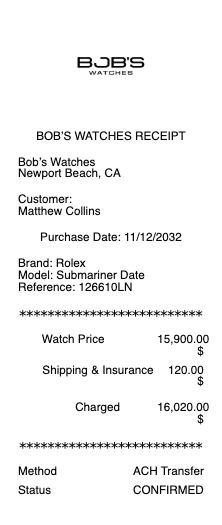
Buying pre-owned means the paperwork carries the value
Bob's Watches is an online marketplace for buying, selling, and trading used Rolex watches, based in Newport Beach, California, with more than twenty years in the pre-owned trade. Buying there is fundamentally different from buying at an authorized dealer: there is no factory warranty card issued fresh from Rolex, and the watch has a history.
That makes the transaction paperwork do double duty. It is not merely proof of payment — it is the first link in the watch's provenance chain, the documented record of who owned it and what it came with. For a resale asset, that chain is a meaningful share of the value.
What the receipt and accompanying documents should show
For a pre-owned Rolex purchase, the paperwork should carry more than a price:
Model and reference number — the specific Rolex reference, not just "Submariner."
Serial number — the individual identifier for that watch. This is the field that ties every other document to the physical object, and the one an insurer or future buyer will check first.
Condition and year — the production year and stated condition of the piece.
What was included — whether the sale was watch-only, or came with the original box and papers. "Box and papers" materially affect resale value and should be stated explicitly.
Purchase price and date — the cost basis you will need if you ever sell.
Authentication and the guarantees behind the sale
Bob's Watches certifies watches as genuine through third-party authentication and backs it with an authenticity guarantee, offering a full refund on any watch not found to be completely authentic. Watches listed for sale are serviced by a Rolex service provider using Rolex replacement parts before listing, and the company offers a three-day return window and a one-year service warranty. It holds an A+ Better Business Bureau accreditation.
Each of those promises is only enforceable if you can identify the specific watch and transaction — which loops back to the serial number on your paperwork. A warranty claim or authenticity dispute starts with matching document to object.
Why you keep this document for years, not weeks
A pre-owned Rolex purchase record earns its keep long after the return window closes:
Insurance. Scheduling a watch on a homeowner's or specialty policy requires documented value; insurers ask for the purchase record and the serial number.
Resale. A documented chain — purchase record, service history, box and papers — commands a premium over an undocumented watch of identical condition.
Theft and recovery. The serial number on your paperwork is what a police report and a stolen-watch registry are built around.
Cost basis. If the watch appreciates and you sell it, your purchase price is the starting point for any gain.
Keeping a clean record of your own purchase
Marketplace order confirmations arrive by email and generally remain retrievable from your account, so search there first for a missing document — and photograph the watch's serial number and any accompanying certificate the day it arrives, storing the images with the purchase record.
If an original record is lost but the purchase genuinely happened, you can reconstruct a clear record of your own transaction from your card statement and the order confirmation, for insurance files, personal records, or a cost-basis file. That documents a real payment you made — it is not a certificate of authenticity, does not substitute for the dealer's own authentication paperwork, and should match the underlying transaction exactly.
Frequently asked questions
Everything you need to know about the product and billing.
What should a pre-owned Rolex receipt include?
The model and reference number, the watch's serial number, the production year and condition, whether box and papers were included, and the purchase price and date. The serial number is the field that links every other document to the specific watch.
Is Bob's Watches legitimate?
It is an established Newport Beach marketplace for pre-owned Rolex watches with over twenty years in the trade, third-party authentication, an authenticity guarantee with a full refund on any watch found not to be authentic, and an A+ Better Business Bureau accreditation.
What does 'box and papers' mean and why does it matter?
It means the watch is sold with its original Rolex box and accompanying documentation. A watch with box and papers typically resells for more than an identical watch without them, so the receipt should state explicitly what was included.
Why does the serial number matter on the purchase document?
It is the unique identifier for that individual watch. Insurance scheduling, warranty and authenticity claims, theft reports, and resale verification all key off the serial number matching between the document and the object.
Does a pre-owned Rolex come with a warranty?
Bob's Watches services watches with a Rolex service provider before listing and offers a one-year service warranty plus a three-day return period. This is a dealer warranty, distinct from Rolex's own factory warranty on new watches.
Do I need the purchase record to insure a watch?
Generally yes. Insurers scheduling a valuable watch ask for documentation of value and the serial number, and both come from your purchase paperwork.