A breakfast receipt matters most on business travel, where the per diem allots a specific amount to breakfast. This guide explains the FY2026 breakfast rate, why a hotel's free breakfast can reduce your claim, and what the receipt must show.
Breakfast Receipt
Add custom logo
Edit line items
Choose payment method
Add/remove elements
Customize business information
Choose font
Breakfast has its own number in the per diem
On business travel, meals are not reimbursed as one lump. The federal per diem splits Meals and Incidental Expenses (M&IE) into named components, and breakfast has the smallest share of the three.
For fiscal year 2026, the standard CONUS M&IE rate is $68 per day, allocated as breakfast $16, lunch $19, dinner $28, and incidentals $5. Those are not suggestions — they are the amounts a claim is built from, and they explain why an expense system rejects a $40 breakfast while accepting a $40 dinner without comment.
The free hotel breakfast that costs you money
Here is the rule that catches travellers out, and it feels counterintuitive: if a meal is provided to you, the per diem for that meal is normally deducted from your claim.
A hotel rate that includes breakfast, a conference that serves it, a flight that feeds you — each can reduce the M&IE you may claim for that day by the breakfast component. The traveller who eats the free hotel breakfast and also claims the $16 has, in most systems, over-claimed.
This is precisely why the breakfast receipt matters when you do buy your own: it evidences that you paid for a meal that was not otherwise provided. And it is why the hotel folio matters too — it shows whether breakfast was bundled into the room rate or charged separately, which is the fact your expense team is actually checking.
Per diem versus actual expenses
Organisations reimburse meals one of two ways, and it determines whether you need the receipt at all:
Per diem. You receive the fixed daily allowance regardless of what you actually spent. Receipts for individual meals are typically not required — the rate is the reimbursement. Spend less and you keep the difference; spend more and you absorb it.
Actual expense. You are reimbursed what you really spent, up to a cap. Here every receipt matters, because the receipt is the claim.
Know which system you are on before the trip. Travellers who assume per diem and discard receipts, then discover they are on actual-expense reimbursement, cannot reconstruct a week of meals — and that is a genuinely expensive mistake.
What a breakfast receipt should show
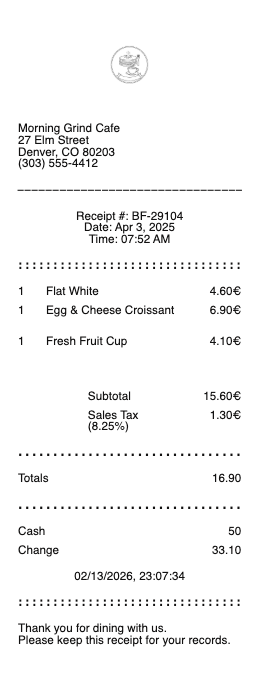
The venue name and location — a claim needs to show where you were, which should match the trip.
The date and time. Time matters here: an 08:00 timestamp supports a breakfast claim in a way a 15:00 one does not.
Itemisation — what was ordered, not just a total.
The number of covers, where you paid for others.
Any alcohol, listed separately — many employers reimburse food but not alcohol, and only an itemised receipt lets the two be separated.
First day, last day, and the receipts you keep
Travel days are usually reimbursed at a reduced rate — commonly 75% of the M&IE — because you are not away for all three meals. Whether breakfast is claimable on a departure day depends on your travel time, and the receipt with its timestamp is what settles the question.
Keep breakfast receipts for the duration of a trip even under per diem, because reimbursement policy is discovered, not assumed. Photograph them the same day: they are thermal, they fade, and they are small enough to lose. If a receipt is lost while the meal genuinely happened, a clear reconstructed record built from your card statement documents that real payment for your files — matching the actual charge exactly, never inflating it, and never inventing a meal that did not occur.
Frequently asked questions
Everything you need to know about the product and billing.
What is the per diem rate for breakfast in 2026?
Under the FY2026 standard CONUS rate, M&IE is $68 per day, allocated as breakfast $16, lunch $19, dinner $28, and $5 incidentals. Higher-cost locations use higher tiers, but breakfast is always the smallest meal share.
Do I have to deduct a free hotel breakfast from my claim?
Normally yes. If a meal is provided — bundled into the hotel rate, served at a conference, or given on a flight — the per diem for that meal is typically deducted from what you may claim. Eating the free breakfast and claiming the $16 as well is an over-claim in most systems.
Do I need receipts if I am on per diem?
Usually not for individual meals — the fixed daily rate is the reimbursement regardless of what you spent. But if you are on actual-expense reimbursement, every receipt is the claim. Confirm which system applies before the trip, not after.
What should a breakfast receipt show?
The venue and location, the date and time, itemised orders rather than just a total, the number of covers, and any alcohol listed separately. The timestamp matters — it is what supports the meal being breakfast.
Why does the receipt time matter?
Because a claim for breakfast is supported by an early timestamp. A receipt showing mid-afternoon does not evidence a breakfast, however genuine the expense was.
Are travel days reimbursed at the full rate?
Usually not — travel days are commonly reimbursed at a reduced rate, often 75% of M&IE, because you are not away for all three meals. Whether breakfast is claimable on a departure day turns on your travel time.