A buffet receipt charges per person, not per dish. This guide explains why that changes an expense claim, how banquet and event billing works, and what the receipt must show when you cannot itemise what was eaten.
Buffet Receipt
Add custom logo
Edit line items
Choose payment method
Add/remove elements
Customize business information
Choose font
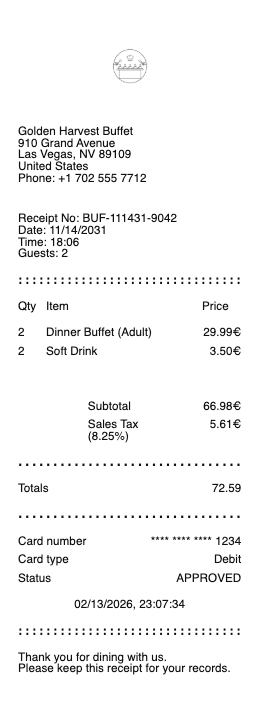
The receipt that cannot itemise what you ate
Every other meal receipt lists dishes. A buffet receipt cannot — the charge is per person, not per item, and nobody records what any individual took from the counter.
That creates a specific documentation problem, because the standard advice for meal claims is "keep the itemised receipt", and here no itemisation of food exists. What replaces it is the cover count: the number of people charged. On a buffet bill, the covers are the itemisation, and the receipt is only useful if it shows them.
What a buffet receipt must show instead
The number of covers, and the per-person rate — these two multiply to the food total and must be visible.
Any differentiated rates — children, seniors, or lunch versus dinner pricing, where they apply.
Drinks, charged separately, since buffets almost always exclude them. This is also where alcohol appears, and it is the line an employer excluding alcohol needs to see.
Service charge — buffets and large groups frequently attract an automatic one, which is a service charge and not a tip.
The venue, date, and time.
A buffet bill showing only a lump sum is a genuinely weak document: it does not establish how many people were fed, which is the one fact that makes the amount reasonable or unreasonable.
Banquets, events, and minimum spends
Buffet billing scales up into event catering, where the structure changes again and the paperwork gets more consequential:
A guaranteed minimum — you commit to a head count in advance and pay for it whether or not those people arrive. The guarantee, not the attendance, is what you are billed on.
A deposit, paid at booking and credited against the final invoice.
A service charge, often 18–22% on banquet business, sometimes alongside a separate gratuity line.
Room hire, which may be waived above a spend threshold.
The gap between the guaranteed count and the actual attendance is the most common billing dispute at events — and it is settled by the contract and the final invoice together, which is why both must be kept.
Buffets and business claims
The rules do not change because the format did. A buffet with a client is a business meal, deductible at 50%, subject to the same two tests: not lavish or extravagant, and you or an employee present. A buffet feeding your own staff is a work meal — and from 2026, employer-provided meals are nondeductible.
What the format changes is the evidence. With no dish-level itemisation, the cover count and the business purpose carry the whole substantiation. Write on the receipt who attended and why, exactly as you would for any other business meal — with a buffet, that annotation is not supplementary to the record, it substantially is the record.
Keeping the record
For an event, keep the chain: the quotation, the signed contract with the guaranteed count, the deposit receipt, and the final invoice. A dispute is almost always about the difference between what was quoted, what was guaranteed, and what was charged — and that can only be shown by holding all of it.
For an everyday buffet, photograph the receipt with the attendees noted. If a record is lost while the meal genuinely happened, a clear reconstructed record from your card statement documents that real payment for your files — matching the charge exactly. It cannot invent a cover count, and the honest number of people fed is the fact the claim ultimately rests on.
Frequently asked questions
Everything you need to know about the product and billing.
Why does a buffet receipt not list what I ate?
Because a buffet charges per person, not per dish — no record exists of what any individual took. The cover count and per-person rate replace the itemisation, which is why they must appear on the receipt.
What should a buffet receipt show?
The number of covers and the per-person rate, any differentiated rates (children, seniors, lunch versus dinner), drinks charged separately, any service charge, and the venue, date, and time.
Is a buffet with a client tax deductible?
It is treated like any other business meal — generally 50% deductible, provided the cost is not lavish or extravagant and you or an employee were present. A buffet feeding your own staff is a work meal, and from 2026 employer-provided meals are nondeductible.
What is a guaranteed minimum at a banquet?
A head count you commit to in advance and pay for whether or not those guests arrive. You are billed on the guarantee, not the attendance — which is the most common source of event billing disputes.
Is the service charge on a banquet a tip?
No. Like other automatic service charges, it is a mandatory fee rather than a discretionary gratuity — it is income to the venue, and some venues add a separate gratuity line on top.
How do I substantiate a buffet as a business meal?
The cover count plus the attendees and business purpose, written on the receipt. With no dish-level itemisation available, that annotation substantially is the record.