A Carrefour receipt comes from one of the world's largest hypermarket chains, with multi-rate VAT codes and loyalty pricing. This guide explains reading a European hypermarket receipt and recovering one via the loyalty account.
Carrefour Receipt
Add custom logo
Edit line items
Choose payment method
Add/remove elements
Customize business information
Choose font
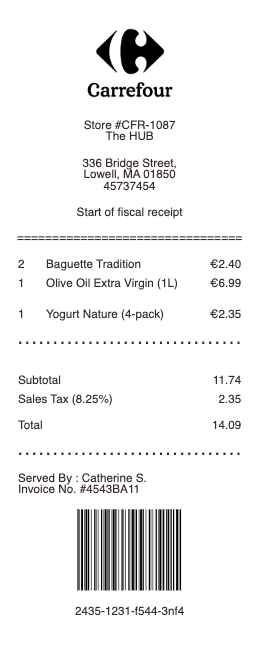
The hypermarket receipt: a supermarket slip at double length
Carrefour, the French retailer that pioneered the hypermarket format, sells groceries, electronics, clothing, and housewares under one roof — and its receipts show it. A single Carrefour slip can span food, a phone charger, and a saucepan: three categories with three different tax treatments and three different return policies, on one document.
That mix is the defining feature. The grocery half of the receipt behaves like any supermarket slip; the non-food half behaves like an electronics or clothing store receipt — warranty-relevant, return-window-relevant, and worth keeping far longer than the food lines it sits beside.
Reading the VAT codes on a European slip
In France and most Carrefour markets, VAT (TVA) applies at multiple rates on the same receipt — a standard rate for general goods, reduced rates for most food, and special rates for specific categories. The receipt marks each line with a rate code and prints a VAT summary block at the foot: each rate, the net amount taxed at it, and the tax.
For businesses, that summary block is the reclaim evidence: hospitality and food purchases at reduced rates reclaim differently from standard-rated goods, and the block does the splitting for you. For everyone else, it is the explanation of why the tax line looks smaller than expected — most of a grocery basket is taxed at the reduced rate, not the headline one.
Loyalty pricing and the two-column receipt
Carrefour's loyalty programme prices aggressively — card-holder discounts, cashback credited to the card, and periodic voucher printouts. On the receipt this appears as discount lines against specific items, a summary of loyalty savings, and sometimes cagnotte-style credit accrued rather than deducted.
Two practical consequences: the amount that matches your bank statement is the post-discount total (reconciliation trips over the pre-discount figure), and the loyalty account itself becomes a purchase history — most large chains, Carrefour included, can retrieve transactions against the card, which turns a lost paper slip from a dead end into a lookup.
Fuel and self-checkout lanes bolt two more receipt types onto the same loyalty account: Carrefour petrol stations print a compact fuel slip that still credits the card, and self-checkout receipts are identical to staffed-lane ones except for the register number — worth knowing when a store looks up a transaction, because the lane type narrows the search.
Returns across categories
Because the basket spans categories, so do the return rules: food returns are exceptional (quality complaints, recalls), while non-food items carry return windows and warranty rights — in the EU, consumer goods carry a legal guarantee of conformity measured in years, for which the receipt is the standard proof of purchase and purchase date.
The practical habit for hypermarket shopping: photograph any receipt containing a non-food purchase of consequence. The slip that proves a €300 appliance's warranty start date should not share the fate of the slip that proved a yoghurt.
Cross-border shoppers meet one more layout difference: Carrefour operates across Europe, the Middle East, and beyond through local entities, so slips differ by country — currency, tax lines, and return windows follow the local operation, not the French parent. The receipt that governs is the one from the till you actually used.
Recovering a Carrefour receipt
Three routes, in order: the loyalty account (transactions against the card, in-app or at customer service), the store's own systems (card-payment lookup at the till where supported), and your bank statement (date, amount, store — the anchor for any enquiry).
If a record is missing while the purchase genuinely happened, the statement establishes the payment, and a clear reconstructed record documents that real payment for your files, matching the charge exactly — with the item detail taken from the loyalty history where it exists, rather than from memory. For warranty claims on non-food goods, the retailer's own retrieved record or the reconstructed proof of the dated payment is what the process runs on.
Frequently asked questions
Everything you need to know about the product and billing.
What is a hypermarket receipt?
A slip spanning groceries, electronics, clothing, and housewares in one purchase — Carrefour pioneered the format. The categories carry different tax rates, return rules, and retention needs on a single document. The format also varies by country — Carrefour's local entities print local currency, local tax lines, and local return terms, so the governing slip is the one from the till you used.
What do the VAT codes on a Carrefour receipt mean?
Each line's letter marks its TVA rate — standard for general goods, reduced for most food, special rates for specific categories — with a summary block at the foot showing net and tax per rate. That block is what business reclaims are built from.
Why is the tax on my grocery receipt so low?
Because most food is taxed at a reduced rate, not the standard one. The VAT summary at the receipt's foot shows how the basket split across rates.
Can Carrefour retrieve a lost receipt?
Often, via the loyalty account — transactions are recorded against the card and retrievable in-app or at customer service. That lookup converts a lost slip into a findable record, which matters most for non-food warranty items. Note the lane too — fuel-station and self-checkout receipts sit under different register numbers, which narrows a store's transaction search.
How long is a warranty on non-food hypermarket goods?
In the EU, consumer goods carry a legal guarantee of conformity measured in years, with the receipt as standard proof of the purchase date. Photograph any slip containing an appliance or electronics.
Which total should match my bank statement?
The post-discount total, after loyalty deductions. Reconciliation errors usually come from reading the pre-discount figure or missing cashback credited to the card rather than deducted.