A clear receipt is a merchant's first defence against chargebacks. This guide explains the chargeback lifecycle, the monitoring-program thresholds that put a merchant at risk, and how the receipt and billing descriptor prevent disputes before they start.
Chargeback Receipt
Add custom logo
Edit line items
Choose payment method
Add/remove elements
Customize business information
Choose font
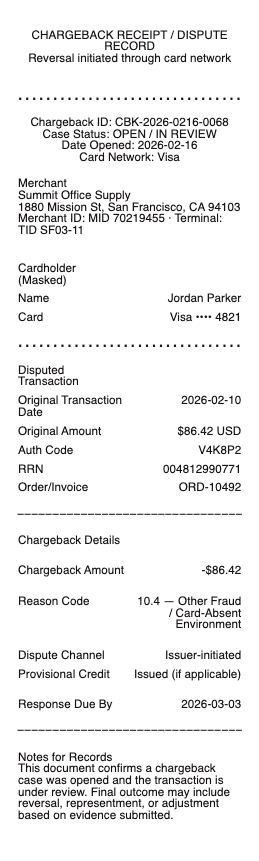
Most chargebacks start with a customer who doesn't recognise a charge
Before a chargeback is a dispute about goods, it is usually a failure of recognition. A cardholder scans a statement, sees an unfamiliar name against an unfamiliar amount, and calls the bank. The purchase may have been entirely legitimate — the record of it simply wasn't legible.
That is why the two most effective anti-chargeback tools are not fraud tools at all. They are the billing descriptor (the name that shows on the statement) and the receipt (the record the customer can find when they check). A descriptor that matches the trading name people know, and a receipt that lands in their inbox, prevent a large share of disputes from ever being filed.
The lifecycle: how a dispute actually escalates
A chargeback is not a single event but a sequence, and knowing the stages tells you when the receipt does its work:
Retrieval request — the issuer asks for the transaction record. Answering this quickly and completely can end the matter before it becomes a chargeback at all.
Chargeback — the funds are pulled from the merchant, along with a fee, and a reason code is assigned.
Representment — the merchant submits evidence that the transaction was valid: the receipt, the authorization, proof of delivery, the agreed terms.
Pre-arbitration and arbitration — where the parties still disagree, the card network decides, with fees rising at every step.
The merchant's evidence file is assembled almost entirely from records that must already exist. Nothing useful can be created after the notice arrives.
The thresholds that put a merchant's account at risk
Chargebacks cost more than the disputed sale, because the card networks monitor ratios and penalise merchants who exceed them:
Visa consolidated its older fraud and dispute monitoring programs into the Visa Acquirer Monitoring Program (VAMP) in April 2025. The excessive threshold is 1.5% effective 1 April 2026, and merchants above it can face fees of roughly $8 per disputed transaction.
Mastercard's Excessive Chargeback Merchant (ECM) program triggers at a 1.5% chargeback-to-transaction ratio combined with 100 or more chargebacks in a month. A higher tier (3% and 300+ chargebacks) carries steeper penalties.
Sustained breaches can end in the loss of card acceptance entirely — which is why chargebacks are a business-survival issue for high-volume merchants, not a cost of doing business.
What a chargeback-resistant receipt contains
The receipt is the spine of any representment file. To be worth anything months later it needs:
The authorization code and the entry method (chip, contactless, keyed, online).
Clear itemisation — what was sold, not merely a total.
The billing descriptor as it will appear on the statement, printed on the receipt itself, so the customer connects the two.
Delivery or fulfilment details, and the address goods were sent to.
Refund and cancellation terms, particularly for recurring billing.
Merchant contact details — a customer who can reach you asks you for a refund instead of asking their bank.
Prevention beats representment every time
Winning a chargeback still costs a fee, staff time, and a mark against your ratio. Preventing one costs nothing. The practical measures are unglamorous and effective: send an itemised receipt immediately by email; make the billing descriptor recognisable; state delivery dates honestly; make cancellation easy; and answer support requests fast, because an unanswered customer is a customer dialling their bank.
Keep every transaction record in a form that survives — thermal receipts fade, and a faded receipt is evidentially blank. Merchants who digitise at the point of sale keep cases they would otherwise concede, and customers who hold a clear record of their own purchases file far fewer disputes in the first place.
Frequently asked questions
Everything you need to know about the product and billing.
What is a chargeback?
A forced reversal of a card payment initiated by the cardholder's bank. The funds are pulled back from the merchant along with a fee, and a reason code is assigned explaining the basis of the dispute.
What is the chargeback ratio threshold?
Visa's Acquirer Monitoring Program sets an excessive threshold of 1.5% effective 1 April 2026, with fees around $8 per disputed transaction above it. Mastercard's Excessive Chargeback Merchant program triggers at a 1.5% ratio combined with 100 or more chargebacks in a month.
How does a receipt help prevent chargebacks?
Most disputes begin with a cardholder not recognising a charge. An itemised receipt sent immediately, showing the billing descriptor exactly as it will appear on the statement, lets the customer identify the purchase instead of calling their bank.
What is a billing descriptor and why does it matter?
It is the name that appears on the cardholder's statement. If it does not match the trading name the customer knows, they cannot recognise the charge — and unrecognised charges are the single largest source of disputes.
What is representment?
The stage where a merchant submits evidence that a disputed transaction was valid — the receipt, the authorization, proof of delivery, and the agreed terms. Almost all of that evidence must already exist; nothing useful can be created after the notice arrives.
What happens if a merchant exceeds the thresholds?
Escalating fees, mandatory remediation, and — for sustained breaches — the potential loss of card acceptance. This is why chargeback ratios are treated as a survival metric rather than an administrative one.