A charity donation receipt substantiates a gift for tax purposes. This guide explains the IRS thresholds donors must meet — $250 written acknowledgment, $75 quid pro quo disclosure, $500 and $5,000 for noncash gifts — and what is not deductible.
Charity Donation Receipt
Add custom logo
Edit line items
Choose payment method
Add/remove elements
Customize business information
Choose font
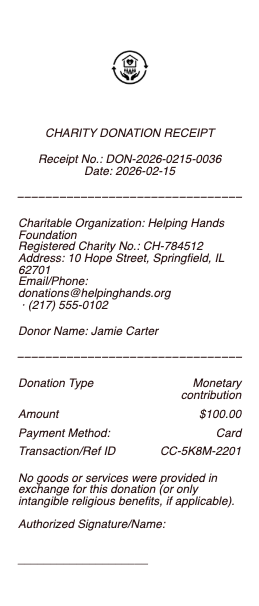
The thresholds that decide whether your gift is deductible
Charitable giving has a tiered documentation system, and each tier demands more paperwork than the last. Knowing which tier a gift falls into tells you exactly what you need to keep:
Under $250 — a bank record or a simple receipt from the charity is enough.
$250 or more — you can only deduct the gift if you hold a contemporaneous written acknowledgment from the charity. A cancelled cheque is not sufficient at this level.
Noncash over $500 (up to $5,000) — the written acknowledgment plus Form 8283, Section A, filed with your return.
Noncash over $5,000 — all of the above plus a qualified appraisal, with Section B of Form 8283 signed by the appraiser and the charity.
The $250 line is the one people trip over most, because it is where a receipt stops being a convenience and becomes a condition of the deduction.
Quid pro quo: when you get something back
If the charity gives you goods or services in return for your gift — a gala dinner, an auction item, a tote bag, event tickets — you have made a quid pro quo contribution, and you cannot deduct the whole amount. Only the portion above the value of what you received is deductible.
The charity carries a duty here. For a quid pro quo contribution over $75, the organisation must provide a written disclosure statement giving a good faith estimate of the value of the goods or services provided. Charities face a penalty for failing to make that disclosure — $10 per contribution, up to $5,000 per event or mailing.
So a $200 charity dinner ticket where the meal is valued at $60 yields a $140 deduction, not $200 — and the receipt should say so explicitly.
What 'contemporaneous' actually means
The written acknowledgment must be in your hands by the earlier of two dates: when you file your return for that year, or the due date (including extensions) for filing it. Get it later and it does not count — you cannot retrospectively paper the file if you are challenged.
The acknowledgment must state the amount of cash contributed (or describe any noncash property), and it must state whether the charity provided any goods or services in return, with a good-faith estimate of their value if it did. If nothing was given in return, the acknowledgment should say that explicitly — the standard wording is that no goods or services were provided.
What is not deductible, however generous it feels
A surprising number of well-intentioned gifts do not qualify, and no receipt can rescue them:
The value of your time or services. Volunteering a day of professional work worth $1,000 is not a $1,000 deduction — though unreimbursed out-of-pocket costs incurred while volunteering may be.
Raffle, lottery, and bingo tickets. These are purchases of a chance to win, not gifts.
Gifts to individuals, however deserving — including crowdfunding for a person's medical bills.
Gifts to organisations that are not qualified charities. Political groups and most foreign organisations do not qualify.
Keeping the record straight
Charities issue acknowledgments on their own schedule — many send a single year-end summary letter covering all your gifts, which is usually the cleanest document to keep. If yours has not arrived, ask: the organisation is well used to the request and can reissue.
For your own records, keep the acknowledgment with the bank record of the payment, so the two corroborate each other. If a specific acknowledgment is missing while the donation genuinely happened, your bank or card statement establishes the date, amount, and recipient, and a clean reconstructed record documents that real payment — but for a gift of $250 or more it does not replace the charity's written acknowledgment, which is a legal condition of the deduction. Only the charity can issue that.
Frequently asked questions
Everything you need to know about the product and billing.
Do I need a receipt to deduct a charitable donation?
For gifts under $250, a bank record or simple receipt is enough. At $250 or more you must have a contemporaneous written acknowledgment from the charity — a cancelled cheque alone is not sufficient.
What is a quid pro quo contribution?
A gift where the charity gives you something in return — a dinner, tickets, an auction item. Only the amount above the value of what you received is deductible, and the charity must disclose a good-faith estimate of that value for contributions over $75.
What does 'contemporaneous' mean for a donation acknowledgment?
You must have it by the earlier of the date you file your return or the due date (including extensions) for that return. Obtaining it afterwards does not satisfy the requirement.
What do I need for a noncash donation over $500?
A written acknowledgment plus Form 8283, Section A, filed with your return. Above $5,000 you also need a qualified appraisal, with Section B of Form 8283 signed by the appraiser and the charity.
Can I deduct the value of my volunteer time?
No. The value of donated time or services is not deductible, although unreimbursed out-of-pocket expenses incurred while volunteering may be.
Are raffle tickets a charitable donation?
No. Raffle, lottery, and bingo tickets are purchases of a chance to win rather than gifts, so they are not deductible even when the proceeds go to a charity.