A chauffeur receipt documents pre-booked private car service billed by the hour or the transfer. This guide explains hourly minimums, what the all-inclusive quote contains, and the extras that legitimately appear.
Chauffeur Receipt
Add custom logo
Edit line items
Choose payment method
Add/remove elements
Customize business information
Choose font
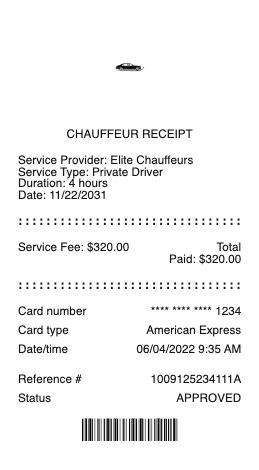
Chauffeur service is a booking, not a hail
A chauffeur engagement differs from every taxi and rideshare in one structural way: it is contracted in advance, at an agreed price, for a defined service — an airport transfer, an hourly charter, an event day. Nothing meters; the price was made before the car moved.
The billing splits into two shapes:
Transfers — a fixed price point-to-point, quoted from distance and time bands.
Hourly charter — the car and driver at your disposal, with an hourly minimum: two to four hours is standard, because dispatching a car and professional driver has fixed costs no half-hour booking covers.
The receipt should say which shape you bought — a transfer receipt with hourly overage lines, or a charter receipt showing the minimum, are both normal; a receipt ambiguous between them is where billing arguments start.
What the all-inclusive quote actually includes
Reputable operators quote all-inclusive — and the receipt should confirm the inclusion list rather than assume it:
Gratuity — very commonly built in as a stated percentage line. This is the field to check first, because tipping again on top of an included gratuity is paying service twice.
Tolls, parking, and airport fees — included in the quote or passed through at cost; either is fine, silently appearing is not.
Wait time — a grace period is included (longer for airport pickups tracked against the flight), then billed in increments.
Meet-and-greet — the driver inside the terminal with a name board is often a separately priced service.
The extras that legitimately move the total
The gap between quote and final charge, when it exists, should decompose into named events: wait time beyond the grace window, added stops, extended hours on a charter, route changes at the passenger's request, cleaning after an eventful evening. Each belongs on the receipt as its own line with its trigger.
Corporate accounts formalise this: negotiated rates, monthly consolidated invoicing, and per-ride detail feeding expense systems. For the individual traveller, the same principle applies at retail — the emailed receipt after the ride should reconcile to the quote plus named extras, and anything unnamed is a question for the operator while the ride is fresh.
What a chauffeur receipt should show
The service — transfer or hourly, with the route or the hours.
Date, times, and the vehicle class booked versus provided.
The quoted price, the inclusion list (gratuity, tolls, fees), and any extras with their triggers.
Wait time recorded, where charged.
The booking reference and operator identity.
Because the service is pre-booked, two identifiers belong on the paper that a taxi receipt never carries: the booking reference, tying the receipt to the confirmed quote, and the passenger name — which is what corporate billing reconciles against. The vehicle class matters as well: the receipt should show the class as booked, and if the operator sent a higher class at no charge, it should say so, or the invoice will look wrong at expense review.
Keeping car service records
For business travel, chauffeur receipts substantiate ground transport cleanly — date, route, and business context — and corporate portals export ride histories for expense systems. Keep receipts until claims settle; keep corporate account statements for the audit period.
Operators keep booking records and can reissue receipts against the reference, which is the recovery route. If a record is missing while the ride genuinely happened, your card statement establishes the date, amount, and operator, and a clear reconstructed record documents that real payment for your files, matching the charge exactly — with the service detail restored from the operator's booking record rather than memory.
The confirmation email is part of the record, not clutter — booked services carry cancellation terms, and a late cancellation is legitimately billable under them. The confirmation is what states the window; the receipt for a cancelled ride should reference it.
Frequently asked questions
Everything you need to know about the product and billing.
Why do chauffeur services have hourly minimums?
Dispatching a car and professional driver carries fixed costs no half-hour booking covers — so hourly charters carry two-to-four-hour minimums as standard. Transfers avoid the minimum by pricing point-to-point instead.
Is the tip included in a chauffeur quote?
Very commonly yes, as a stated gratuity percentage in an all-inclusive quote. Check the receipt before tipping on top — an included gratuity plus a cash tip is paying for service twice.
What extras can legitimately appear on the final bill?
Wait time beyond the grace window, added stops, extended charter hours, passenger-requested route changes, and cleaning — each as a named line with its trigger. Unnamed gaps between quote and charge are questions for the operator. A late-cancellation charge is also legitimate when the confirmation's cancellation terms allow it — which is why the confirmation email stays in the file.
How does airport wait time work?
Operators track the flight and include a longer grace period for airport pickups, then bill wait time in increments. Meet-and-greet inside the terminal is often a separately priced service.
What should a chauffeur receipt show?
The service shape (transfer or hourly), date and times, vehicle class booked versus provided, the quote with its inclusion list, extras with triggers, recorded wait time, and the booking reference. Plus the booking reference and passenger name — the two fields that tie a pre-booked service back to its quote and let corporate billing reconcile the ride.
How do corporate chauffeur accounts handle receipts?
Negotiated rates with monthly consolidated invoicing and per-ride detail exported into expense systems — the individual receipt's job done at account scale.