A Chrono24 receipt documents a watch purchase paid through escrow — money held for 14 days after delivery. This guide explains the escrow paper trail, the inspection window, and what to check before funds release.
Chrono24 Receipt
Add custom logo
Edit line items
Choose payment method
Add/remove elements
Customize business information
Choose font
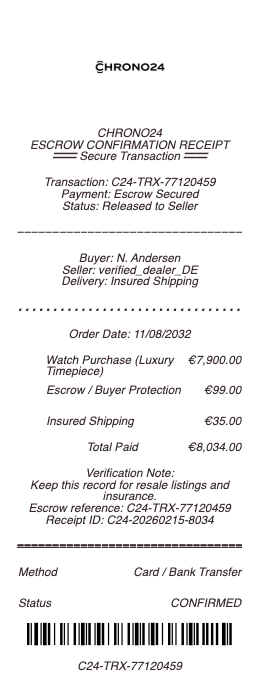
Buying through escrow changes what the receipt means
Chrono24, the largest online marketplace for luxury watches, runs purchases through an escrow model: you pay the platform, not the seller — and the money sits in an escrow account until 14 days after the watch is delivered. Only then does payment release to the dealer.
That structure produces a different paper trail from a normal purchase. There is the order confirmation, the payment receipt showing funds into escrow, the delivery record, and finally the release — and each stage protects you differently. The payment receipt proves you performed your side; the escrow status proves the seller has not yet been paid; the release marks the moment the transaction actually completes.
The 14-day window is an inspection period — use it
The escrow hold exists so you can inspect the watch while your money is still recoverable. Fourteen days after delivery is the working window, and the inspection worth doing in it:
Match the watch to the listing — reference number, serial, condition, and every included item (box, papers, links) against what was advertised.
Authenticate meaningfully — a local watchmaker's inspection costs little against the price of being wrong; Chrono24's Certified program adds an authenticity-guarantee layer on eligible listings.
Raise problems inside the window — support and resolution work entirely differently while funds sit in escrow than after release.
A problem raised on day 20 is a negotiation; a problem raised on day 10 is a protected claim. The calendar is the protection.
Dealer versus private seller on the same platform
Chrono24 hosts professional dealers and private sellers, and the paperwork differs. Dealers issue proper invoices — with business identity and, in the EU, the margin-scheme or VAT treatment used for second-hand goods — while private sellers produce simpler documents. The escrow protection wraps both, but the after-sale position differs: dealer sales carry business obligations and often a dealer warranty; private sales are as-is transactions between individuals.
The receipt from a dealer purchase should show which VAT treatment applied — margin-scheme invoices deliberately do not show deductible VAT, which matters to business buyers expecting a reclaim.
What the Chrono24 paper set should contain
The order confirmation with the listing details — reference, serial, condition grade, included items.
The escrow payment receipt — amount, date, and the order it secures.
Shipping and delivery records — the day delivery lands starts the 14-day clock.
The seller's invoice — dealer or private, with VAT treatment where relevant.
Any Certified/authenticity documentation attached to the listing.
Watch for the words that state the platform's own commitments: the buyer-protection or authenticity guarantee terms in force at your purchase date belong in the file, saved as they read that day — platform policies evolve, and the version that governs your purchase is the one that existed when you paid, not the one on the website later.
Keeping marketplace watch records
Keep the full set permanently — with the watch's serial photographed on arrival. The escrow receipts document what you paid and when protection applied; the listing snapshot documents what was promised; together they are the provenance file a future buyer or insurer will ask about.
The platform account retains order history and documents, which is the recovery route. If a record is missing while the purchase genuinely happened, your card or bank statement establishes the payment into escrow, and a clear reconstructed record documents that real payment for your files, matching it exactly — while the platform's own order record and the seller's invoice remain the documents the watch world recognises.
One more habit pays at resale: keep the seller's listing itself — screenshots of the photos, the description, and the condition grade. If the watch that arrives diverges from the listing, that saved copy is the inspection period's yardstick; and years later it documents the state the watch was in when it entered your hands.
Frequently asked questions
Everything you need to know about the product and billing.
How does payment work on Chrono24?
Through escrow: you pay the platform, and the money is held for 14 days after the watch is delivered before releasing to the dealer. Your payment receipt shows funds into escrow, not to the seller.
What is the 14-day period for?
Inspection while your money is still protected. Match the watch to the listing (reference, serial, condition, included items), have it authenticated if in doubt, and raise any problem inside the window — a day-10 claim is protected, a day-20 one is a negotiation. Measure the watch against the saved listing — the photos and condition grade you bought against are the yardstick for whether what arrived is what was sold.
Is buying from a dealer different from a private seller?
Yes. Dealers issue business invoices — in the EU often under the second-hand margin scheme, which shows no deductible VAT — and frequently add a dealer warranty. Private sales are simpler, as-is transactions. Escrow wraps both.
What documents should a Chrono24 purchase produce?
Order confirmation with full listing details, the escrow payment receipt, delivery records (they start the clock), the seller's invoice with VAT treatment, and any Certified or authenticity documentation. Save the buyer-protection terms as they read on your purchase date too — the version in force when you paid is the one that governs your order.
What is Chrono24 Certified?
The platform's authentication program adding an authenticity guarantee on eligible listings — an extra documentation layer worth keeping with the purchase set.
Why keep the delivery record?
Because the 14-day escrow window runs from delivery. The delivery date defines exactly when your protected inspection period ends.