A clothing store receipt is mostly about one thing: the return. Apparel is returned and exchanged more than almost any retail category — for fit, second thoughts, or gifts — so the receipt and the store’s return rules matter more than the purchase itself. This page explains what a clothing receipt shows, the return-policy details that decide whether you get a refund or store credit, and how gift receipts and exchanges work.
Clothing Store Receipt
Add custom logo
Edit line items
Choose payment method
Add/remove elements
Customize business information
Choose font
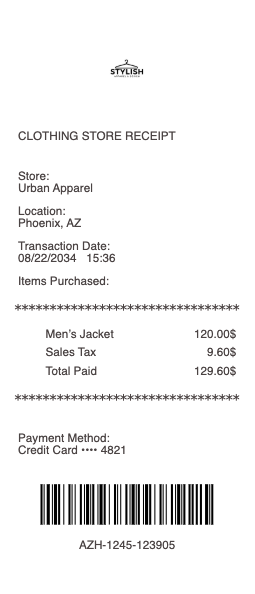
What’s on a Clothing Store Receipt
The store and purchase date and time
Itemized garments — description, size, color, and SKU
Price per item, any discount, and sale markdowns
Subtotal, tax, and total
Payment method and last four digits, for card payments
The return-policy summary and window, often printed on the receipt
A barcode or transaction number for lookups and returns
The Return Policy — Tags, Window, and Refund vs Store Credit
Clothing returns turn on a few conditions the receipt and policy spell out. Most stores require items to be unworn and unwashed with tags attached, returned within a window (commonly 30 to 90 days), and — for a full refund to the original payment — accompanied by the receipt. Without a receipt, many stores offer only store credit at the current (often lowest, sale) price, if they accept the return at all. Final-sale, clearance, and often intimate apparel or swimwear are frequently non-returnable, which the receipt or tag notes. Some retailers can look up a receiptless return by the card used or a loyalty account, since the purchase is in their system. This is exactly why keeping the clothing receipt matters: it’s the difference between a refund to your card and store credit at a markdown, and it’s the proof of the return window. Reading the policy before the window closes avoids a common disappointment.
Gift Receipts and Exchanges
Two apparel-specific situations lean heavily on the receipt. Gift receipts are near-universal for clothing: a gift receipt proves the item was purchased and allows a return or exchange without showing the price to the recipient, usually for store credit or an even exchange. If you’re giving clothing, requesting a gift receipt is what lets the recipient swap a size without awkwardness — and it’s worth including. Exchanges are the most common clothing “return” — swapping for a different size or color — and with the receipt an even exchange is typically simple, sometimes even outside a strict refund window. Because fit is unpredictable, apparel retailers generally make exchanges easy, and the receipt (or gift receipt) is what smooths it. Keeping the receipt until you’re sure something fits — and passing a gift receipt along with any clothing gift — covers the two ways apparel most often goes back.
Records, Loyalty, and Getting a Copy
Beyond returns, a clothing receipt has a few uses. For expenses — uniforms or required work clothing may be deductible for some workers or businesses, and the itemized receipt substantiates it. For budgeting and warranty-like issues (a seam that fails quickly, a defect), proof of purchase supports a claim even though clothing rarely carries a formal warranty. Many stores tie purchases to a loyalty account, which both stores your history for easier returns and earns rewards — and often lets you retrieve a digital receipt. To get a copy, check your email for a digital receipt, your online account order history for online purchases, or ask the store to reprint an in-store transaction by card or date. For most people the receipt’s working life is the return window, but the itemized record — store, items, sizes, and total — is the reference for any question about a purchase.
Related apparel receipts: see also our Nike receipt guide and our Adidas receipt guide.
Create a Clothing Store Receipt
Our generator produces a clean clothing store receipt — store, itemized garments with size and price, tax, and total — as a PDF when you need a legible copy for a return, an exchange, an expense record, or a gift receipt.
Use it responsibly: recreate only real purchases you actually made, with their true items and amounts. Fabricating a clothing receipt to support a false return or refund, claim an expense you didn’t incur, or misrepresent a purchase is fraud — the store’s own sales records, tied to the transaction and card, are authoritative and can be verified. This tool is for legitimate record-keeping only.
Frequently asked questions
Everything you need to know about the product and billing.
What does a clothing store receipt show?
The store and date, itemized garments with description, size, color, and SKU, the price per item and any discount, subtotal, tax, and total, the payment method and card last four, often a return-policy summary and window, and a barcode or transaction number for returns.
Do I need a receipt to return clothing?
For a full refund to your original payment, usually yes — along with tags attached, unworn condition, and returning within the window. Without a receipt, many stores offer only store credit at the current (often lowest) price, if they accept the return at all.
What are the typical conditions for a clothing return?
Most stores require items unworn and unwashed with tags attached, returned within a window (commonly 30–90 days), with the receipt for a full refund. Final-sale, clearance, and often intimate apparel or swimwear are frequently non-returnable, which the receipt or tag notes.
How does a gift receipt work for clothing?
A gift receipt proves the item was purchased and allows a return or exchange without showing the price to the recipient, usually for store credit or an even exchange. Requesting one when giving clothing lets the recipient swap a size without awkwardness.
Can I exchange clothing for a different size?
Yes — exchanges are the most common clothing “return,” and with the receipt an even exchange for a different size or color is typically simple, sometimes even outside a strict refund window. Retailers generally make exchanges easy because fit is unpredictable.
How do I get a copy of a clothing store receipt?
Check your email for a digital receipt, your online account order history for online purchases, or ask the store to reprint an in-store transaction by card or date. Many stores also tie purchases to a loyalty account, which stores your history for easier returns.