A conference ticket receipt documents a business event registration — often tiered, bundled, and expensed. This guide explains early-bird pricing, what registration actually includes, and how conference costs split for claims.
Conference Ticket Receipt
Add custom logo
Edit line items
Choose payment method
Add/remove elements
Customize business information
Choose font
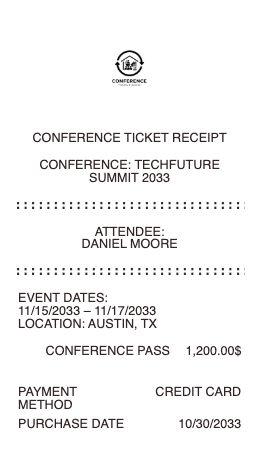
Conference pricing is a countdown, and the receipt timestamps it
Professional conferences sell registration in time-based tiers: super early bird, early bird, standard, late/on-site — the identical badge often doubling in price between the first tier and the door. The receipt records which tier you caught, and that timestamp matters beyond bragging rights: budget approvals, team bookings, and cancellation terms frequently key off the registration date and rate.
Alongside tiers run registration classes — member versus non-member rates, academic and student rates, speaker and exhibitor registrations, group discounts. Each class carries its own price and sometimes its own terms, and the receipt should name the class explicitly: an audit of a membership-rate registration will ask for the membership that earned it.
What the ticket actually includes — and what it does not
"Registration" is a bundle, and its edges are where surprise costs live:
Included, typically: session access, exhibition floor, conference materials, and often lunches and coffee breaks.
Frequently extra: pre-conference workshops and training days, certification exams, gala dinners and social events, and recorded-session access afterwards.
The receipt should itemise what your rate bought. That itemisation also matters for the expense claim: included meals interact with per-diem rules (a conference that feeds you lunch reduces a lunch allowance), and a bundled gala dinner may need separating from the deductible registration.
The full conference cost is a file, not a ticket
The registration is usually the smallest part of what a conference costs. The complete expense file assembles:
Registration receipt — the ticket itself, itemised.
Travel and lodging — booked separately, governed by your travel policy.
Meals not provided — per diem or actuals.
Incidentals — ground transport, printing, roaming.
For the self-employed, conference registration for maintaining or improving professional skills is an ordinary business expense — and the receipt plus the agenda substantiates the business purpose. For employees, the pre-approval email plus the receipts is the clean claim.
Teams add one more layer: group registration. Multi-seat bookings usually price below the individual tier and arrive as a single receipt naming several attendees — which is convenient at purchase and inconvenient at accounting, where each attendee's cost centre needs its share. Ask for per-attendee itemisation at booking; splitting one lump receipt across five expense reports afterwards is the harder path.
Cancellation, substitution, and the option nobody uses
Conference cancellation terms are tiered like the pricing: full refund far out, partial refund closer in, no refund near the date — with a fee at each stage. But almost every conference offers the alternative that gets forgotten: substitution. A colleague attends in your place, usually free or for a small admin fee, up to days before the event.
When plans collapse inside the no-refund window, substitution converts a written-off registration into a colleague's opportunity — and the receipt plus the substitution confirmation is the paperwork. Some registrations also roll to the next year's event as credit, which beats forfeiting entirely.
Keeping conference records
Keep the registration receipt, the agenda, and any substitution or cancellation correspondence until the expense claim settles and the tax year closes. The agenda is underrated: months later, it is the document that proves the event was professional rather than recreational — which is precisely what a challenged deduction turns on.
Organisers keep registration records and can reissue receipts and attendance confirmations, which is the recovery route. If a record is missing while the registration genuinely happened, your card statement establishes the date, amount, and organiser, and a clear reconstructed record documents that real payment for your files, matching the charge exactly.
One post-event document is worth actively collecting: the attendance or CPE certificate. For regulated professions the conference receipt proves what was paid, but the certificate proves participation — continuing-education credit stands on the pair, and the certificate is far harder to obtain a year later than the receipt.
Frequently asked questions
Everything you need to know about the product and billing.
Why do conference prices change over time?
Registration sells in time-based tiers — super early bird through on-site — with the same badge often doubling between first tier and the door. The receipt records which tier and rate class you bought, which approvals and audits key off.
What does conference registration usually include?
Typically session access, the exhibition floor, materials, and often catering — while workshops, certification exams, gala dinners, and post-event recordings are frequently extra. The receipt should itemise your rate's bundle. Group bookings price differently again — multi-seat registrations discount below the individual tier, and per-attendee itemisation at booking saves the accounting split later.
Can I get a refund if I can't attend a conference?
Terms tier down with time: full, partial, then no refund near the date. The forgotten alternative is substitution — a colleague attends in your place, usually free or for a small fee, even inside the no-refund window.
Is a conference tax deductible?
For the self-employed, registration that maintains or improves professional skills is ordinarily deductible — with the receipt and agenda substantiating the business purpose. Employees claim through their employer's policy with pre-approval.
How do conference meals interact with per diem?
Provided meals reduce the corresponding allowance — a conference lunch means the lunch component of that day's per diem generally can't also be claimed. The registration receipt's itemisation is what shows which meals were provided.
What conference records should I keep?
The registration receipt, the agenda (it proves professional purpose), and any substitution or cancellation correspondence — until the claim settles and the tax year closes. For regulated professions, add the attendance or CPE certificate — credit claims stand on the receipt and certificate together.