A course payment receipt often documents one instalment of a larger tuition plan. This guide explains instalment plans, cooling-off periods, and what happens to access and certificates when payments stop.
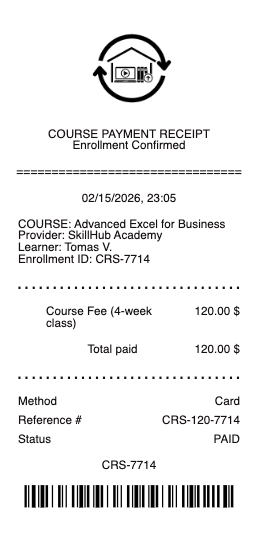
Course Payment Receipt
Add custom logo
Edit line items
Choose payment method
Add/remove elements
Customize business information
Choose font
Course tuition is increasingly a payment plan, not a payment
Private courses — coding bootcamps, professional certifications, language schools, trade training — are routinely sold on instalment plans: a deposit, then monthly payments across the course. Each instalment produces its own receipt, and the set of them, not any single one, is the record of your tuition.
That structure changes what to keep and check. The receipt should identify which instalment it is (3 of 8), the remaining balance, and the plan reference — because tuition disputes are almost never about whether you paid something, they are about which payments were made, which were missed, and what the schedule said. A single confirmation email does not evidence a series; the numbered receipts do.
Cooling-off: the exit that expires quickly
Course contracts commonly carry a cooling-off period — a short window after enrollment (in many jurisdictions a statutory right for distance and off-premises sales) during which you can withdraw for a full refund. After it closes, the refund ladder takes over: partial refunds scaling down as the course progresses, often reaching zero once a stated portion has been delivered.
Two details decide real cases:
Starting the course can waive the cooling-off — accessing materials or attending the first session sometimes counts as consuming the service. The terms say; read them before logging in.
The clock runs from enrollment, not from when you first attended. A course bought in November for a January start can have its cooling-off long expired before the first lesson.
What happens when payments stop
Stopping an instalment plan is not the same as cancelling a subscription, because the plan is usually a contract for the whole course price. The typical consequences, per the agreement:
Access suspends — materials and sessions lock until payments resume.
The debt survives — remaining instalments can be pursued as owed, because you bought the course, not a month of it.
The certificate is withheld — completion documents are routinely conditional on the account being settled in full.
That last one bites hardest: finishing the coursework does not produce the credential until the balance is cleared, and the receipts are how you evidence the account is, in fact, settled.
What a course payment receipt should show
The course — name, cohort or start date, and provider.
The plan position — instalment number, amount, remaining balance.
What the payment covers — tuition, registration, materials, exam fees, separately.
The student's name and the plan or student reference.
The refund and withdrawal terms in force at enrollment.
Two audiences may later read these receipts, and each needs a different field. An employer reimbursing tuition needs the provider, the course name, and the amounts as paid — reimbursement programs pay against receipts, not against enrollment promises. And where the study qualifies for tax relief, the receipts plus the completion documentation are what the claim stands on — the rules vary by country and situation, but the paperwork requirement never does.
Keeping tuition records
Keep every instalment receipt plus the enrollment agreement until the course completes, the certificate is issued, and any refund window is closed — and keep the final settled-in-full evidence permanently with the credential, since employment verification years later can ask about the qualification behind it.
Providers keep student accounts and can reissue statements, which is the recovery route. If a receipt is missing while the payment genuinely happened, your card or bank statement establishes the date, amount, and provider, and a clear reconstructed record documents that real payment for your files, matching it exactly — while the provider's student-account statement remains the authoritative ledger of the plan.
Providers disappear more often than universities do — bootcamps close, platforms get acquired, login portals go dark. Download every receipt and the certificate itself out of the provider's portal while it exists; a credential you can only display inside a dead website is a credential you no longer hold.
Paying in installments? The partial payment receipt shows how to record each payment against the full course fee, and the receipt of payment page covers what every payment receipt needs.
Frequently asked questions
Everything you need to know about the product and billing.
What should each course instalment receipt show?
Which instalment it is (3 of 8), the amount, the remaining balance, the plan reference, and what the payment covers — tuition, registration, materials, or exam fees separately. Disputes are about the series, not any single payment. If an employer reimburses the tuition, the receipts must show provider, course, and amounts as paid — programs reimburse against receipts, not enrollment promises.
What is a cooling-off period on a course?
A short window after enrollment — statutory in many jurisdictions for distance sales — allowing withdrawal with a full refund. Accessing materials can waive it, and the clock runs from enrollment, not from the first lesson.
What happens if I stop paying my course instalments?
Typically access suspends, the remaining balance survives as a debt (the plan is a contract for the whole price), and the completion certificate is withheld until the account settles.
Can I get a refund after starting a course?
Per the refund ladder in your agreement: partial refunds scale down as the course is delivered, often reaching zero at a stated point. The terms in force at your enrollment are the ones that bind.
Why is my certificate being withheld?
Most providers condition completion documents on full settlement of the account. Your instalment receipts are the evidence the balance is cleared.
How long should I keep course payment records?
Until completion, certification, and refund windows close — and keep the settled-in-full evidence permanently with the credential, since qualification checks can come years later. And download everything out of the provider's portal while it exists — private providers close, and a certificate locked inside a dead website is lost.