A designer store receipt governs stricter return rules than ordinary retail — tags, markdown final sales, and alterations that end returns. This guide explains mainline versus outlet receipts and the seasonal sale cycle.
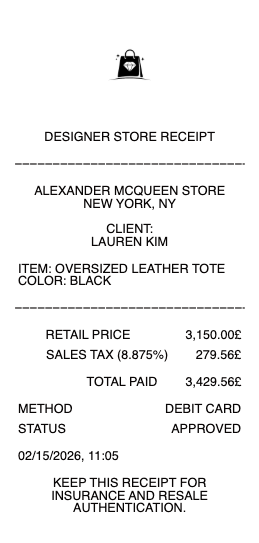
Designer Store Receipt
Add custom logo
Edit line items
Choose payment method
Add/remove elements
Customize business information
Choose font
Designer retail returns are a narrower door
Fashion at designer price points runs return rules noticeably stricter than mass-market retail, and the receipt is where they bind:
Shorter windows — 14 days is common where department stores allow 30 or more.
Tag discipline — returns require original tags attached, security seals intact; a detached hangtag can end the conversation.
Condition scrutiny — makeup traces, perfume, wear marks are checked at the counter.
Refund-versus-credit splits — full-price purchases often refund; discounted ones often return for store credit only.
None of this is negotiable after the fact, which makes the receipt's statement of the applicable policy — printed or referenced at purchase — the term sheet of the transaction.
The markdown ladder: why sale items go final
Designer fashion moves through a rigid seasonal cycle — full price, first markdown, second markdown, clearance — and return rights typically narrow at each step, reaching final sale at the deeper cuts. The receipt marks the regime: full-price lines return normally, markdown lines say final sale or credit-only.
The logic is inventory: a returned seasonal piece re-enters a season that has ended. The practical rule for buyers is symmetrical — the discount is payment for certainty, so the decision standard rises as the price falls. A final-sale receipt is a completed transaction; there is no changing your mind at that price.
Alterations: the service that ends the return
Designer stores offer in-house or partnered alterations, and the interaction with returns is absolute: altered garments do not return. Cutting to fit customises the piece to you, and no store restocks a hemmed trouser.
The sequencing discipline: complete the return decision before the alteration appointment. Where alterations are paid, they appear as their own receipt line or separate slip — a service purchase attached to the garment, itself non-refundable once performed. For made-to-measure and personalised pieces, the same logic applies from the moment of order: customisation converts the purchase to final sale at order time, usually with a deposit structure on the receipt.
Appointment retail adds names to the paper: a personal shopper or styling appointment often precedes the purchase, and the advisor's name on the receipt is the thread back into the store's client book — for sourcing a size from another branch, for aftercare, for the exchange handled gracefully because the relationship exists on record.
Mainline versus outlet: two different receipts
The designer outlet receipt looks similar and documents a different product world. Outlet stock splits between diverted mainline goods (past-season pieces moved out of primary stores) and made-for-outlet lines (produced to lower specs specifically for outlet sale, often marked with distinct label codes).
The receipt consequences: outlet purchases are commonly final sale or outlet-only returns (mainline boutiques do not take outlet goods back), warranties and repairs may route differently, and — for resale later — the receipt's store identification tells a future buyer which world the piece came from. Nothing wrong with outlet goods; much wrong with paying mainline resale prices for made-for-outlet pieces, which the paperwork exposes.
Keeping designer purchase records
Keep receipts for the return window at minimum; keep them permanently for pieces with resale potential — the dated receipt from an identifiable boutique is provenance, the thing that distinguishes an authentic resale listing from an unsupported one, and repair or care services at the brand often ask when and where the piece was bought.
Boutiques keep client purchase histories — designer retail is clienteling retail — and can usually retrieve transactions for known customers, which is the recovery route. If a record is missing while the purchase genuinely happened, your card statement establishes the date, amount, and store, and a clear reconstructed record documents that real payment for your files, matching the charge exactly; for provenance purposes, the boutique's own retrieved record carries the weight.
One resale-era habit completes the file: keep the tags, the dust bag, and the receipt together per piece. Designer resale platforms price condition and completeness — a garment with its original tags and purchase record is a different listing from the same garment bare — and the receipt is the one element that cannot be re-acquired later.
Frequently asked questions
Everything you need to know about the product and billing.
Why are designer store return windows shorter?
Stricter regimes are standard at designer price points: commonly 14 days, tags attached and seals intact, condition checked at the counter, and refunds often limited to full-price purchases with discounted lines returning for credit only.
What does final sale mean on a designer receipt?
No returns, no exchanges except defects. It typically applies from the deeper markdowns onward — the discount is payment for certainty, and the receipt marks which regime your purchase carried.
Can I return a garment after alterations?
No. Altered garments are customised to you and do not restock — complete the return decision before the alteration appointment. Made-to-measure and personalised pieces are final sale from the moment of order.
Are outlet purchases returnable at mainline boutiques?
Generally not — outlet goods return, if at all, through outlet channels. Outlet stock also splits between diverted mainline pieces and made-for-outlet lines produced to different specs, which the labels and receipt reveal.
Why keep a designer receipt permanently?
Provenance. A dated receipt from an identifiable boutique supports authenticity at resale and answers the when-and-where questions brand repair services ask. It is part of the piece's file. Resale completes the argument — platforms price completeness, and the receipt is the one element of a full set that cannot be re-acquired later.
Can a boutique retrieve my old purchase?
Often yes — designer retail keeps client purchase histories, and known customers can have transactions retrieved. That clienteling record is the recovery route for a lost receipt. Naming the advisor helps — a personal shopper's name on the record is the thread back into the client book for sourcing, aftercare, and graceful exchanges.