A digital product receipt documents the purchase of software, a download, or online content. This guide explains why digital goods have no delivery proof, where the licence key fits, and how VAT is charged on the buyer's location.
Digital Product Receipt
Add custom logo
Edit line items
Choose payment method
Add/remove elements
Customize business information
Choose font
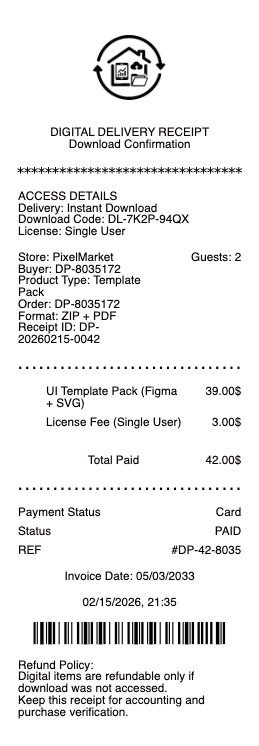
Digital goods break the usual proof chain
Every other kind of purchase leaves a physical trail. Goods are shipped and signed for; services are performed somewhere. A digital product has none of that — there is nothing to deliver, nothing to sign, and nothing to photograph on a doorstep.
That absence changes what the receipt has to do. For a physical order, the receipt is one document among several (order, dispatch note, delivery confirmation). For a digital product, the receipt plus the access credential — the licence key, the download link, the account entitlement — is very nearly the entire record that the transaction ever happened.
The licence key is part of the receipt
Keep them together, because separately they are each worth much less:
The receipt proves you paid.
The licence key or activation code proves what you are entitled to use.
A key without a receipt is hard to defend if a vendor questions it. A receipt without the key means reinstalling software you have paid for but cannot activate — the single most common digital-purchase headache, years later, when a laptop dies and the original email has been deleted.
The practical habit: archive the purchase email with the key intact, not a screenshot of the key alone. And note what you actually bought — a perpetual licence (yours indefinitely) and a subscription (yours while you pay) look identical on a receipt and are entirely different assets.
VAT on digital products follows the buyer, not the seller
Digital services are taxed on the customer's location rather than the seller's — the place-of-supply rule that governs digital sales across the EU and many other jurisdictions. This has two visible consequences on your receipt:
The VAT rate applied is your country's, which is why the same download costs different amounts to buyers in different countries.
The seller collects evidence of where you are — billing address, IP, card issuer country — because they must justify the rate they charged.
If you are a VAT-registered business buying digital services, this is why supplying your VAT number at checkout matters: it can change the tax treatment of the sale entirely, and it must be done at purchase, not afterwards.
Refunds and disputes without a delivery to point to
Digital sales are unusually exposed to disputes, because a merchant defending one cannot produce a courier signature. Their evidence is instead access and usage: download logs, activation records, login history, IP data.
For buyers, this cuts the other way. Refund rights on digital goods are frequently limited once the content has been downloaded or the key revealed — many sellers explicitly withdraw the right to cancel at the moment of access, and it is lawful for them to do so where the buyer has been told and has agreed. The receipt and the terms you accepted are what determine whether a refund is owed, which is a good reason to read the cancellation terms before clicking rather than after.
Keeping the record for the long term
Digital purchase records need to outlive the device they were bought on. The failure mode is mundane and extremely common: the licence was bought years ago, the email account has changed, the vendor's site has been redesigned, and the key is gone.
Archive the purchase email, the key, and the receipt together, somewhere that is not tied to a single machine. Most vendors also keep an order history against your account — which is the first place to look, and the reason to buy while signed in rather than as a guest. If a record is missing while the purchase genuinely happened, your card statement establishes the date, amount, and vendor, and a clear reconstructed record documents that real payment for your files — but it cannot recreate a licence key, so contact the vendor, who usually can.
Frequently asked questions
Everything you need to know about the product and billing.
What should a digital product receipt include?
The product and version, the licence type (perpetual or subscription), the licence key or access credential, the price and tax, the date, and the account the purchase is tied to. Keep the receipt and the key together — separately, each is worth much less.
Why is VAT on a digital product based on my country?
Digital services are taxed on the customer's location under place-of-supply rules, not the seller's. That is why the same download costs different amounts in different countries, and why sellers record evidence of where you are.
What is the difference between a perpetual licence and a subscription?
A perpetual licence is yours indefinitely; a subscription lasts while you keep paying. They can look identical on a receipt but are entirely different assets, so note which one you bought.
Can I get a refund on a digital product?
Often only before download or before the key is revealed. Many sellers lawfully withdraw the right to cancel at the moment of access, provided you were told and agreed — so the terms you accepted, alongside the receipt, determine whether a refund is owed.
How do merchants prove a digital sale in a dispute?
With access and usage evidence — download logs, activation records, login history, IP data — because there is no delivery signature to produce.
I lost my licence key. Can a receipt recover it?
The receipt proves you paid but does not recreate the key. Check the vendor's order history against your account first; most can reissue. This is why buying while signed in, rather than as a guest, is worth the extra step.