A dinner receipt is the largest meal claim on any trip and the one most scrutinised. This guide explains the FY2026 dinner rate, why entertainment is now fully nondeductible, and the line between a client dinner and a night out.
Dinner Receipt
Add custom logo
Edit line items
Choose payment method
Add/remove elements
Customize business information
Choose font
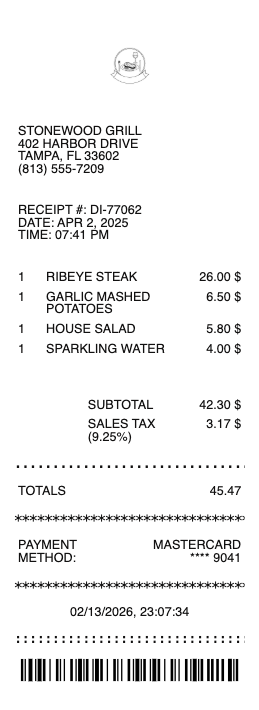
Dinner is the biggest claim — and the most scrutinised
Dinner takes the largest share of any travel meal allowance. Under the FY2026 standard CONUS rate, the $68 daily M&IE allots $28 to dinner, against $19 for lunch and $16 for breakfast — and dinner holds roughly the same 41% share at every rate tier.
It is also the meal where expense claims most often go wrong, because dinner is where the business day blurs into the evening: the client meal that becomes drinks, the working dinner that becomes a night out. The receipt is where that line is drawn, and it is drawn far more sharply than most people realise.
Entertainment is no longer deductible at all
This is the change that still catches businesses out. The Tax Cuts and Jobs Act made business entertainment entirely nondeductible from 2018 — not reduced, not halved. Nothing. Meanwhile qualifying business meals remained deductible at 50%.
So the same evening can contain both treatments:
Dinner with a client, discussing business — a business meal, 50% deductible, provided it is not lavish and you were present.
Tickets to the game afterwards — entertainment, 0% deductible.
Food and drinks bought at the game — potentially deductible as a meal if they are separately stated on their own receipt or invoice, rather than bundled into the ticket price.
That last point is the practical heart of it: a bundled bill loses the deduction. Where food is invoiced together with entertainment, the whole amount can fall on the nondeductible side. Ask for the catering to be separately stated — the request is routine, and it is worth real money.
What a dinner receipt has to show
Itemisation — dishes and drinks, not a single total. This is what distinguishes a meal from entertainment and food from alcohol.
Alcohol shown separately, because employer policies frequently exclude it even where the tax code does not.
The number of covers — a claim for a dinner for six should be evidently a dinner for six.
Date, venue, and location.
The tip and the final total.
And on the receipt itself, written at the table: who was there and why. Those two facts are the substantiation, and they are irrecoverable months later.
Employer-provided meals: the 2026 change
A significant rule change lands in 2026 that businesses should not discover by accident. Meals a company provides for its own convenience — the company cafeteria, food brought in so staff keep working, occasional de minimis meals — had been 50% deductible under the TCJA's transitional treatment. From 2026, that deferred change takes effect and those employer-provided meals become nondeductible.
This is a different category from taking a client to dinner, which remains a 50%-deductible business meal. But it means the pizza bought for a late-working team and the client dinner now sit on opposite sides of the line — so keep their receipts, and their coding, apart.
Keeping dinner receipts defensible
Dinner claims are the ones most likely to be examined, precisely because they are the largest and most easily abused. That makes clean documentation less a chore than a protection.
Get the itemised receipt, not just the card slip. Write the attendees and business purpose on it before you leave the table. Photograph it that night. And keep any separately stated food invoice from an entertainment venue, because it may be the only thing standing between a 50% deduction and none.
If a receipt is lost while the meal genuinely happened, a clear reconstructed record from your card statement documents that real payment for your files — matching the actual charge exactly. It never converts entertainment into a meal, never invents attendees, and never changes an amount; the underlying facts must be true, and they are what a deduction ultimately rests on.
Frequently asked questions
Everything you need to know about the product and billing.
What is the per diem for dinner in 2026?
Under the FY2026 standard CONUS rate, dinner is allotted $28 of the $68 daily M&IE — the largest share, against $19 for lunch and $16 for breakfast. Dinner holds roughly a 41% share at every rate tier.
Is business entertainment deductible?
No. The Tax Cuts and Jobs Act made business entertainment entirely nondeductible from 2018 — not reduced but eliminated. Qualifying business meals remain 50% deductible.
Can I deduct food bought at a sporting event?
Potentially, as a meal — but only if the food and drink are separately stated on their own receipt or invoice. If they are bundled into the ticket price, the whole amount can fall on the nondeductible entertainment side.
What changed for employer-provided meals in 2026?
Meals provided for the employer's convenience — company cafeteria food, meals brought in so staff keep working, occasional de minimis meals — were 50% deductible under the TCJA's transitional treatment. From 2026 that deferred change takes effect and they become nondeductible.
What should a client dinner receipt show?
Itemised dishes and drinks with alcohol separated, the number of covers, the date, venue and location, and the tip and final total — plus, written on the receipt at the table, who was present and the business purpose.
Why is a bundled bill a problem?
Because where food is invoiced together with entertainment, the deduction for the food can be lost entirely. Asking for catering to be separately stated is a routine request and it is worth real money.