A doctor visit receipt matters most for self-pay patients — where the No Surprises Act's Good Faith Estimate applies. This guide explains cash-pay pricing, the $400 dispute threshold, and deductible tracking.
Doctor Visit Receipt
Add custom logo
Edit line items
Choose payment method
Add/remove elements
Customize business information
Choose font
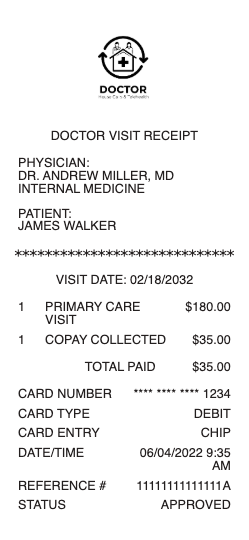
Self-pay medicine has its own price list — and its own paperwork
Paying a doctor directly — no insurance, or choosing not to use it — puts you in the cash-pay lane, and it runs differently: many practices maintain self-pay prices below their billed-to-insurance rates, direct primary care operates on flat memberships, and the paperwork is a direct receipt rather than a claim.
The receipt's job in this lane is heavier, because there is no insurer's paper trail behind it. It is your record of what was done and paid — for taxes (medical expense deductions), for HSA and FSA reimbursement, for any later coordination with insurance — and it needs the detail that a card slip lacks: the provider, the date, the services rendered, and the amounts.
The Good Faith Estimate: self-pay patients' price protection
Under the No Surprises Act, uninsured and self-pay patients are entitled to a Good Faith Estimate (GFE) — a written estimate of expected charges, provided before scheduled care. It is not a courtesy; it is a compliance document with teeth:
Providers must supply it for scheduled services, and on request.
If the final bill exceeds the GFE by $400 or more, the patient can take the bill to the federal patient–provider dispute resolution process.
The paperwork pairing is the protection: keep the GFE with the final receipt. A bill $400+ over the estimate is not a negotiation opener — it is a disputable document, and the GFE is the evidence the dispute runs on.
Copays, deductibles, and the receipt's tracking job
For insured visits, the at-the-counter receipt documents the copay — but the accounting that matters happens against the deductible: what you have paid out-of-pocket toward the year's threshold. Insurers track it, and insurers also make errors; the stack of visit receipts is the audit trail that catches a deductible mis-credit.
The reconciliation habit: match each visit receipt against the insurer's Explanation of Benefits when it arrives. The receipt says what you paid; the EOB says what the insurer processed; disagreements between them — a payment not credited, a service double-billed — are found exactly at that join, and found early they are one phone call instead of a year-end forensic project.
Ask the front desk for a superbill when insurance is involved at arm's length: it is the itemised statement carrying the diagnosis and procedure codes an out-of-network claim needs. The counter receipt proves you paid; the superbill is what the insurer's claim form actually wants — and practices produce them routinely on request.
What a doctor visit receipt should show
The provider and practice, with address — and the provider's NPI where offered.
The patient and the date of service.
The services rendered — itemised, ideally with procedure codes; "office visit" supports far less than a coded line.
Amounts — charged, paid, and how (copay, self-pay, balance).
Payment method.
For HSA/FSA claims, that itemisation decides eligibility — administrators reimburse against documented qualified expenses, and the coded receipt is the document that qualifies.
Keeping medical payment records
Keep visit receipts for the tax year plus the retention period where deductions or HSA claims touch them — and keep GFEs with their final bills for the dispute window and beyond. Practices maintain billing records and patient portals reprint receipts, which is the recovery route.
If a receipt is missing while the visit genuinely happened, the practice's billing office can reissue an itemised statement, and your card statement establishes the payment; a clear reconstructed record documents that real payment for your files, matching the charge exactly — while the itemised statement, which only the practice can issue, is what HSA administrators and tax records actually need.
One filing habit ties the medical year together: keep visit receipts with the insurer's explanation of benefits for the same encounter. The pair reconciles what the office charged, what insurance recognised, and what you actually paid — and a mismatch between them, caught early, is a billing-office phone call instead of a collections letter.
Frequently asked questions
Everything you need to know about the product and billing.
What is a Good Faith Estimate?
A written estimate of expected charges that uninsured and self-pay patients are entitled to under the No Surprises Act, before scheduled care. If the final bill runs $400 or more above it, the patient can use the federal patient–provider dispute resolution process.
Do self-pay patients get different prices?
Frequently yes — many practices maintain cash-pay rates below billed-to-insurance prices, and direct primary care runs flat memberships. The receipt is the whole paper trail in this lane, so it needs full itemisation.
Why keep visit receipts if I'm insured?
Deductible tracking. Insurers mis-credit payments, and your receipts matched against each Explanation of Benefits are what catch it early — one phone call instead of a year-end reconstruction. Pair each receipt with the explanation of benefits for the same visit — reconciling the two early turns billing mismatches into a phone call rather than a collections letter.
What makes a receipt HSA or FSA eligible?
Itemised documentation of a qualified medical expense: provider, patient, date of service, coded services, and amounts. A card slip saying 'office visit' supports far less than a coded line. For out-of-network claims, ask for a superbill — the itemised statement with diagnosis and procedure codes that the insurer's claim form requires.
What should I do with the GFE after the visit?
Staple it to the final bill, literally or digitally. A bill $400+ over the estimate is disputable, and the GFE is the document the dispute runs on.
How do I replace a lost medical receipt?
The practice's billing office or patient portal can reissue an itemised statement — the document HSA administrators and tax records need. Your card statement evidences the payment itself.