An ecommerce receipt documents an online purchase. This guide explains the difference between an order confirmation and a receipt, why the shipping address matters in a dispute, and how to retrieve a copy from an online store.
E-commerce Receipt
Add custom logo
Edit line items
Choose payment method
Add/remove elements
Customize business information
Choose font
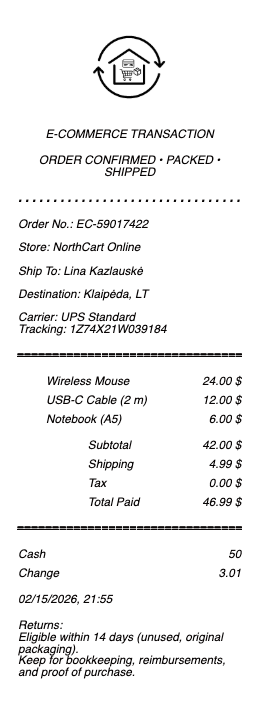
An order confirmation is not a receipt
The most common documentation mistake in online shopping is treating the first email you receive as proof of purchase. It usually isn't.
An order confirmation says: we have received your order and intend to fulfil it. It arrives instantly, and it may precede any money actually moving — many merchants only authorize the card at checkout and capture the payment when the item ships. A receipt or invoice says something different: this amount was charged, on this date, for these items.
The gap between them explains a lot of confusion — the pending charge that vanishes and reappears, the order that is cancelled with no refund appearing (because nothing was ever captured), and the expense claim that gets rejected because a confirmation email is not evidence of payment.
The addresses are two different things, and both matter
An ecommerce receipt carries a billing address (where the card is registered) and a shipping address (where the goods went). They are frequently different, and the difference is load-bearing:
Fraud screening uses the billing address — the AVS check compares what you typed against what your bank holds.
Chargeback defence uses the shipping address. A merchant proving delivery must show it went to an address associated with the cardholder; a delivery to an unrelated address is very hard to defend.
Tax is frequently calculated on the shipping destination, which is why the same basket costs different amounts to different addresses.
What a complete ecommerce receipt shows
Order number — the reference for every subsequent conversation with the merchant.
Itemised lines with quantities and unit prices, not just a total.
Shipping cost and tax, shown separately.
Discounts or promo codes applied.
Payment method and the last four digits of the card.
Both addresses, and the date of the order and of the charge.
The itemisation is the part expense policies care about. A total tells your employer you spent money; the lines tell them what on — and where a basket mixes business and personal items, only the itemised version lets you claim honestly.
Digital goods, subscriptions, and marketplace sellers
Three cases behave differently from a straightforward physical order:
Digital goods have no delivery to prove, so the merchant's evidence in a dispute is access and download logs rather than a courier signature. Keep the licence key or access email with the receipt.
Marketplaces — the seller of record may not be the platform. Your receipt shows which, and it determines who you pursue for a refund and who issues the tax document.
Recurring charges begun as a one-off purchase (a trial that converts) are documented by the subsequent receipts, not the first one.
Getting a copy after the fact
Almost every online purchase is recoverable, because the merchant necessarily has a record of it. Check, in order: your email (search the merchant name plus "order"), your account order history on the store, and — where you checked out as a guest — the merchant's support, who can usually find an order from the email address and approximate date.
If a merchant has closed and the record is genuinely gone while the purchase happened, your card statement establishes the date, amount, and merchant, and a clear reconstructed record of your own transaction documents that real payment for your files. It must match the charge exactly, and where the merchant still exists their own invoice remains the better document — ask them first.
Frequently asked questions
Everything you need to know about the product and billing.
Is an order confirmation the same as a receipt?
No. A confirmation says the order was received and may precede any money moving — many merchants authorize at checkout and only capture payment when the item ships. A receipt states that an amount was actually charged, on a date, for specific items.
Why do I have a pending charge that disappeared?
It was an authorization rather than a capture. The merchant reserved the funds at checkout and takes them when the order ships. If the order is cancelled before shipping, the authorization simply drops off — no refund is issued because no money was taken.
Why does my ecommerce receipt show two addresses?
The billing address is where the card is registered and is used for fraud screening; the shipping address is where the goods went and is what a merchant relies on to defend a chargeback. Tax is often calculated on the shipping destination.
Do I need an itemised receipt for an expense claim?
Usually yes. A total shows you spent money; the itemised lines show what on. Where an order mixes business and personal items, only the itemised receipt lets you claim the correct portion.
Who issues the receipt on a marketplace purchase?
It depends on who the seller of record is — the platform or the individual seller. Your receipt shows which, and that determines who you pursue for a refund and who issues any tax document.
How do I find a receipt for an old online order?
Search your email for the merchant name plus 'order', then check your account's order history on the store. For guest checkouts, merchant support can usually locate an order from your email address and approximate date.