An electronics store receipt is your warranty. This guide explains why the purchase date starts the manufacturer's cover, why the serial number matters, and how store protection plans differ from the maker's warranty.
Electronics Store Receipt
Add custom logo
Edit line items
Choose payment method
Add/remove elements
Customize business information
Choose font
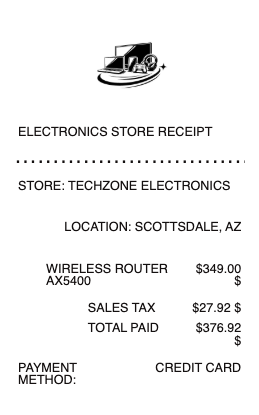
The receipt is the warranty
For most purchases, a receipt is proof of payment. For electronics, it is something more consequential: it is the document that starts and proves the warranty.
A manufacturer's warranty runs from the date of purchase — not the date of manufacture, and not the date you first switched the device on. Without a dated proof of purchase, a manufacturer will typically fall back on the production date, which can silently cost you months of cover on a device that sat in a warehouse before you bought it. The receipt is what closes that gap, and it is why electronics receipts should be filed rather than pocketed.
The serial number ties the paper to the object
A receipt saying "laptop, $1,200" identifies a category, not a device. What links your paperwork to the specific machine in front of you is the serial number — and it is the field that matters in every situation where the stakes are real:
Warranty claims — the manufacturer looks up the device by serial.
Insurance — a scheduled item or a home-contents claim needs the identifier.
Theft — a police report and any recovery database are built on the serial.
Resale — a buyer verifying a device is not stolen or blacklisted checks the serial.
If the receipt does not record it, photograph the serial from the device and the box, and store the image with the receipt on the day you buy.
Store protection plans versus the manufacturer's warranty
These are sold together and are entirely different products:
The manufacturer's warranty covers defects in materials and workmanship, comes free with the device, and is honoured by the maker regardless of which shop sold it.
A store protection plan or extended warranty is an additional product you pay for. It often covers things the maker's warranty never did — accidental damage, drops, liquid — and is administered by the retailer or a third party.
Read what you are actually buying. An extended warranty that merely repeats the manufacturer's cover for the first year adds nothing during that year. And note who administers it: a plan is a contract with whoever sold it, so a retailer going out of business can take the plan with it, in a way the manufacturer's warranty is not affected.
Return windows are shorter on electronics
Electronics almost always carry a shorter return window than the rest of a store's stock — commonly around 30 days against 90 for general merchandise — and the conditions are stricter: original packaging, all accessories, and sometimes an unopened seal.
Restocking fees on opened electronics are common and lawful where disclosed, and the return window for a faulty device is not the same thing as the warranty: a fault appearing in month four is a warranty claim, not a return, and the two go to different places. Knowing which one you are making determines who you should be talking to.
Keeping the record for the life of the device
Electronics receipts need to survive years, and thermal paper does not — a receipt for a five-year warranty will very likely be unreadable before the warranty expires. Photograph or scan it the day you buy, and store the image with the serial number and the model.
Many retailers now attach purchase history to a loyalty or online account, which is the first place to look for a missing record. If an original is gone while the purchase genuinely happened, a clear reconstructed record built from your card statement documents that real payment for your files — matching the charge exactly. For a manufacturer warranty claim, expect the maker to want a dated proof of purchase and the serial, so ask the retailer to reissue from their transaction record first: they usually can.
Frequently asked questions
Everything you need to know about the product and billing.
When does a manufacturer's warranty start?
On the date of purchase, not the date of manufacture. Without a dated proof of purchase, a manufacturer will often fall back on the production date — which can quietly cost you months of cover on a device that sat in a warehouse.
Why does the serial number matter?
It is what ties your paperwork to the specific device. Warranty claims, insurance, police reports for theft, and resale verification all key off the serial matching between the document and the object.
What is the difference between a store protection plan and a manufacturer's warranty?
The manufacturer's warranty is free, covers defects, and is honoured by the maker regardless of retailer. A protection plan is a paid product, often covering accidental damage, and is a contract with the retailer or a third party — which means a retailer's collapse can take it with them.
Why is the return window shorter for electronics?
Retailers commonly allow around 30 days for electronics against 90 for general merchandise, with stricter conditions on packaging and accessories. Restocking fees on opened items are common where disclosed.
Is a faulty device a return or a warranty claim?
It depends on timing. Within the return window it is a return, handled by the retailer. After it, a fault is a warranty claim, handled by the manufacturer — different process, different counterparty.
How should I store an electronics receipt?
Scan or photograph it the day you buy, together with the serial number and model. Thermal receipts commonly fade to blank long before a multi-year warranty expires.