An event ticket receipt shows face value plus fees that can add 30% or more. This guide explains the fee breakdown, the crucial difference between a cancelled and a postponed event, and what your refund rights are.
Event Ticket Receipt
Add custom logo
Edit line items
Choose payment method
Add/remove elements
Customize business information
Choose font
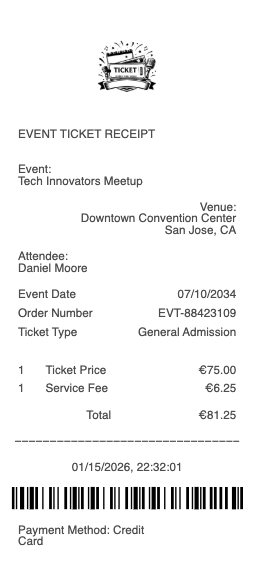
The face value is rarely what you pay
The gap between the advertised ticket price and the amount that leaves your account is one of the most reliably infuriating experiences in consumer spending — and the receipt is where it is finally itemised.
A US Government Accountability Office study found that primary and secondary ticketing companies charged total fees of roughly 30% of each ticket's price, with individual cases ranging from 13% to 58%. Those fees typically appear as some combination of a service fee, a facility or venue fee, an order processing fee, and sometimes a delivery fee — even for a ticket delivered as a PDF.
Keep the itemised receipt rather than the confirmation email alone: for an expense claim, or a dispute, the breakdown is the part that matters.
Cancelled and postponed are not the same word
This is the single most valuable thing to understand about event tickets, and it decides whether you get your money back:
Cancelled — the event is not happening, with no replacement date. This normally triggers a full refund, and major platforms commit to it.
Postponed — the event is rescheduled. Refunds are frequently not offered at all; your ticket is simply valid for the new date, whether or not you can attend it.
The asymmetry is deliberate and it is where consumers lose money: a postponement can leave you holding a ticket for a date you cannot make, with no right to a refund. Some jurisdictions go further — in California, a postponed or rescheduled show gives you the right to request a full refund or a credit, with a 30-day clock starting once you make the request. But that is a state protection, not a universal one.
Buying on the resale market
Resale carries risks the primary market does not, and two are worth knowing by name:
Speculative ticketing — a seller lists a ticket they do not own, intending to acquire it later if someone buys. When they cannot, the buyer receives a last-minute cancellation instead of a seat. It is a known practice and the target of proposed federal legislation.
Bots — despite the Better Online Ticket Sales (BOTS) Act of 2016 restricting automated bulk purchasing, tickets still get vacuumed up at onsale and reappear at a markup.
On resale, the platform's buyer guarantee is the thing you are actually paying the fee for — it is what stands behind a ticket that turns out to be invalid, duplicated, or never delivered. That guarantee is claimed with the order confirmation and the receipt, which is why they must be kept until you are through the door.
What the receipt must show
The event, date, time, and venue — and for a resale, whether the seat is specified or a "zone" listing.
The face value and each fee, separately named.
The order number — the reference every support conversation will require.
The seat details, or the ticket type.
The seller, for a resale — the platform is often not the seller of record.
The refund and transfer terms that applied at purchase.
Keeping the record until you are through the door
Digital tickets have made the receipt more important, not less: a transfer that fails, an account you cannot access at the gate, or a ticket that never arrives is resolved with the order number, and nothing else.
Keep the receipt and confirmation until the event has happened — and afterwards too, if you are expensing it or if a refund may still be in play. Platforms retain order history in your account, which is the first place to look for a missing document.
If a record is lost while the purchase genuinely happened, your card statement establishes the date, amount, and platform, and a clear reconstructed record documents that real payment for your files, matching the charge exactly. It is not a ticket, it cannot admit you to anything, and it does not replace the platform's order record for a refund claim.
Frequently asked questions
Everything you need to know about the product and billing.
How much are ticket fees?
A GAO study found primary and secondary ticketing companies charged total fees of roughly 30% of the ticket price, ranging in individual cases from 13% to 58%. They typically appear as service, facility, and order processing fees.
What is the difference between a cancelled and a postponed event?
A cancelled event — not happening, no replacement date — normally means a full refund. A postponed event is rescheduled, and refunds are frequently not offered at all: your ticket is valid for the new date whether or not you can attend.
Can I get a refund if an event is postponed?
Often not, as a matter of platform policy. Some states go further — in California a postponement gives you the right to request a full refund or a credit, with a 30-day clock from your request — but that is a state protection, not a universal right.
What is speculative ticketing?
When a reseller lists a ticket they do not actually own, planning to acquire it if someone buys. If they cannot, the buyer gets a last-minute cancellation rather than a seat. It is the target of proposed federal legislation.
What does a resale platform's buyer guarantee cover?
It is what stands behind a ticket that turns out to be invalid, duplicated, or never delivered — effectively what the buyer fee is buying. It is claimed using the order number and receipt.
What should an event ticket receipt show?
The event, date, time and venue; the face value and each fee named separately; the order number; the seat or ticket type; the seller (for resale, often not the platform); and the refund and transfer terms at purchase.