An exhibition or trade show ticket receipt differs by which side of the booth you stand on. This guide explains visitor versus exhibitor costs, badge classes, and why expo paperwork feeds lead follow-up and expense claims.
Exhibition Ticket Receipt
Add custom logo
Edit line items
Choose payment method
Add/remove elements
Customize business information
Choose font
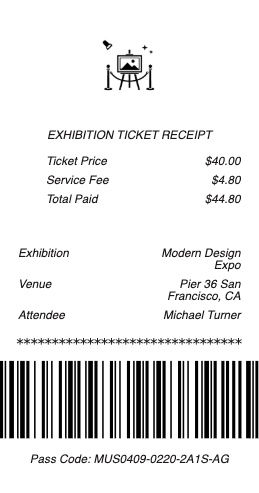
Two different customers walk through the same doors
An exhibition receipt means different things depending on which side of the booth you occupy:
Visitors buy admission — often free or cheap for trade days if pre-registered, priced higher on the door or for public days.
Exhibitors buy presence — booth space, and a long tail of costs behind it.
The visitor's receipt is a simple admission record. The exhibitor's paperwork is a project file: space rental, stand construction, services, staff badges, and marketing — routinely one of the largest line items in a B2B marketing budget, and the reason expo receipts get scrutinised at budget review.
Badge classes and the pre-registration price gap
Trade shows price admission by who you are and when you registered: trade visitor versus general public, pre-registered versus on-site, single day versus all days, delegate (with conference access) versus expo-only. The gaps are deliberate — organisers want qualified trade visitors registered early, so pre-registration is cheap or free while the same badge on the door costs real money.
The receipt should show the badge class, because access disputes at the hall ("this badge doesn't include the conference track") are resolved from it — and because an expensed delegate pass needs to look like one on the paperwork.
The exhibitor's cost stack
Behind an exhibitor's presence sits a stack of separately invoiced costs, each with its own receipt:
Space rental — per square metre/foot, priced by location in the hall.
Stand build or shell scheme — construction, furniture, graphics.
Show services — electricity, internet, cleaning, lead-scanner rental, all booked through the organiser's portal and priced with notorious on-site premiums for late orders.
Staff badges beyond the allocation, parking, and drayage/material handling.
The budgeting discipline: order services early (the early/late price gap is large), and keep every receipt against the show's cost centre — the post-show ROI review divides pipeline generated by exactly this documented total.
Two cost-stack behaviours are worth knowing in advance. Show services are priced on a deadline curve — advance-order rates are meaningfully below floor rates for the same electricity, furniture, or internet, so the date on each services receipt is itself a cost decision. And material handling is billed by weight and movement, invoiced by the show contractor separately from anything you paid the venue — the receipt arrives from a company you may not remember hiring, which is normal and worth expecting.
Leads, follow-up, and why the dates matter
For businesses, the expo receipt file has a second life after the show: it anchors the lead follow-up and ROI accounting. The show dates on the receipts tie captured leads to the event source; the badge and scanner receipts evidence who worked the stand; the total cost against closed pipeline is the number that decides next year's booking.
For visitors, the receipt plus the show guide substantiates the business purpose of the trip — the same role a conference agenda plays — and matters for the travel claim wrapped around attendance.
Keeping expo records
Visitors: keep the admission receipt and the travel file until claims settle. Exhibitors: keep the full stack — space contract, services invoices, staffing costs — for the budget cycle and the tax year, organised per show; comparative cost history across years is also your negotiation position for rebooking.
Organisers keep registration and exhibitor billing records and can reissue, which is the recovery route. If a record is missing while the payment genuinely happened, your card or bank statement establishes the date, amount, and organiser, and a clear reconstructed record documents that real payment for your files, matching the charge exactly.
Cancellation runs on different rules for the two customers. Exhibitor space contracts typically carry a sliding cancellation schedule — the closer to the show, the larger the share of the space fee retained — so the booking receipt and its dated terms decide what a withdrawal costs. Visitor tickets are commonly non-refundable but transferable: the practical remedy for a missed show is a colleague's name on the badge, not a refund request.
Frequently asked questions
Everything you need to know about the product and billing.
Why was my exhibition ticket free online but expensive at the door?
Organisers want qualified trade visitors registered early, so pre-registration is cheap or free while on-site admission costs real money. The receipt records the badge class and registration timing.
What is the difference between a delegate pass and expo-only admission?
A delegate pass includes the conference programme; expo-only covers the exhibition floor. Access disputes at the hall are resolved from the badge class on your receipt.
What does exhibiting at a trade show actually cost?
Space rental plus a stack: stand build, electricity and internet, cleaning, lead scanners, extra badges, and material handling — each separately invoiced, with heavy on-site premiums for late service orders.
Why order show services early?
Because organisers price the same electricity, furniture, and internet dramatically higher for late and on-site orders. The early-order discount is one of the few controllable costs in exhibiting. The same items cost meaningfully more at floor rates than at advance-order rates — the deadline calendar in the exhibitor manual is a price list in disguise.
How do expo receipts feed ROI accounting?
The receipts date-stamp and total the show investment; leads captured are tied to the event source; pipeline closed against documented cost is the number that decides rebooking.
What should I keep after visiting a trade show?
The admission receipt and the show guide — together they substantiate the business purpose of the trip for the travel claim around it. If plans change, check the dated cancellation schedule on the space contract early — the retained share grows as the show approaches.