An export fee receipt covers the costs of shipping goods out of a country — forwarder fees, filings, and documentation. This guide explains why export paperwork also protects the seller's tax position, and what to keep.
Export Fee Receipt
Add custom logo
Edit line items
Choose payment method
Add/remove elements
Customize business information
Choose font
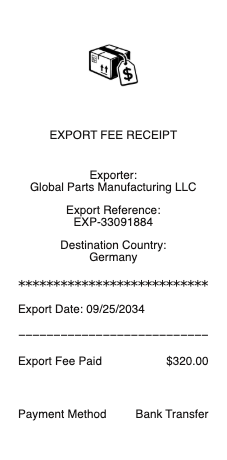
Exporting costs money before the goods even move
An export transaction generates its own stack of fees, distinct from freight itself:
Freight forwarder charges — the fee for arranging carriage, consolidating, and handling documentation.
Export filing fees — in the US, shipments generally valued over $2,500 per commodity require an Electronic Export Information (EEI) filing, and someone charges for making it.
Documentation fees — certificates of origin, inspection certificates, legalisation where the destination requires it.
Licence costs, for controlled goods.
Terminal, handling, and security surcharges at the port or airport.
Each fee should arrive itemised on the forwarder's invoice. Exporters price these into margins — which only works if the receipts make visible what exporting actually costs per shipment.
The tax reason export paperwork is precious
Here is the part that makes export receipts more than cost records: in VAT systems, exports are typically zero-rated — the seller charges no VAT on goods leaving the tax territory. But zero-rating is conditional: the seller must be able to prove the goods actually left, within the time limits, with evidence of export.
Fail to hold that evidence and the sale can be retrospectively treated as domestic — with the seller owing the VAT out of their own margin, plus interest. So the export documentation (the customs export declaration, the transport evidence, the forwarder's paperwork) is not administrative residue: it is what stands between a zero-rated sale and an unexpected tax bill. Exporters keep these files for years because tax authorities ask for exactly this, years later.
Incoterms decide who pays which fee
Whether a given export cost is yours or your buyer's is not a matter of habit — it is set by the Incoterm on the sale. EXW puts nearly everything on the buyer; DDP puts nearly everything, including the destination country's import duty, on the seller; FOB and CIF split at the ship's rail and at insurance respectively.
The receipt implication: your export fee receipts should match your Incoterm. A seller on EXW terms paying origin handling fees, or a buyer on DDP terms being charged import duty, is paying the other party's costs — and the invoice trail is how that gets noticed and corrected.
What export fee receipts should show
The shipment reference — booking number, waybill, or container.
Each fee itemised: forwarding, filing, documentation, handling, surcharges.
The filing reference where an export declaration was made (e.g. the EEI/ITN in the US).
The Incoterm applicable to the sale.
Who was charged — the exporter of record.
Two time-based charges deserve their own vigilance because they grow while paperwork stalls: demurrage — the port's daily charge for a container sitting past its free days — and detention, the carrier's charge for holding equipment too long. Both arrive as invoices tied to the shipment reference, and both are the direct cost of every day a document in this file was late.
Keeping the export file
The complete export file for one shipment is: the commercial invoice, the packing list, the export declaration, the transport document (bill of lading or air waybill), the forwarder's fee invoice, and any certificates. Keep them together per shipment, for the retention period your tax jurisdiction requires — the zero-rating evidence requirement makes this a tax file, not just a logistics one.
Forwarders and carriers keep records against the shipment reference and can reissue documents, which is the recovery route. If a fee record is missing while the payment genuinely happened, your bank statement establishes the amount, date, and payee, and a clear reconstructed record documents that real payment for your files, matching it exactly — while the customs declaration and transport documents, which only the filing parties hold, remain the evidence that the export happened at all.
The file's afterlife is longer than the shipment's: origin-country audits ask for it to verify the zero-rating, destination-side buyers ask for pieces of it for their import clearance, and freight-cost disputes settle against the itemised fee receipts. One shipment reference across every document is what makes the file answer instead of you.
Frequently asked questions
Everything you need to know about the product and billing.
What fees does exporting involve?
Freight forwarder charges, export filing fees (in the US, an EEI filing is generally required for shipments over $2,500 per commodity), documentation and certificate fees, licence costs for controlled goods, and terminal or handling surcharges — each of which should be itemised. Plus the time-based pair — demurrage and detention — which accrue daily when containers overstay free days, usually because a document somewhere was late.
Why do exporters keep export paperwork for years?
Because zero-rating depends on it. In VAT systems, exports carry no VAT only if the seller can prove the goods left the territory — and without that evidence the sale can be retrospectively taxed as domestic, out of the seller's margin.
What are Incoterms and why do they matter for fees?
The standard trade terms (EXW, FOB, CIF, DDP and others) that allocate costs and risk between buyer and seller. They determine who legitimately pays each export and import fee — and your receipts should match the term on the sale.
What is an EEI filing?
Electronic Export Information — the US export declaration, generally required when a shipment exceeds $2,500 per commodity. The filing produces a reference (ITN) that should appear in your shipment paperwork.
What should an export fee receipt show?
The shipment reference, each fee itemised, the export filing reference where one was made, the applicable Incoterm, and who was charged as exporter of record.
What makes up a complete export file?
Commercial invoice, packing list, export declaration, transport document (bill of lading or air waybill), the forwarder's fee invoice, and any certificates — kept together per shipment for the tax retention period. Its value outlives the shipment — zero-rating audits, the buyer's import clearance, and freight-cost disputes all read from the same file.