A festival ticket receipt covers a multi-day pass, often with tiered pricing, payment plans, and a wristband. This guide explains tier pricing, why wristbands cannot usually be replaced, and what happens when a festival is cancelled.
Festival Ticket Receipt
Add custom logo
Edit line items
Choose payment method
Add/remove elements
Customize business information
Choose font
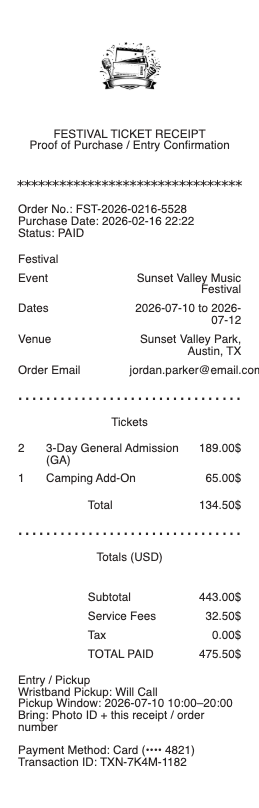
Festival pricing rewards buying early — and punishes deciding late
Festivals almost universally sell in tiers: Early Bird, then Tier 1, Tier 2, and so on, each releasing at a higher price as the previous tier sells out. Unlike a concert, where the price is the price, a festival ticket's cost is a function of when you committed.
That structure makes the receipt a record of a decision as much as a purchase — and it is why festival tickets are so often bought months ahead, with everything that implies: plans change, lineups change, and the ticket bought in November may no longer suit the person you are in July.
Many festivals now sell via payment plans, splitting the cost across instalments. Each instalment generates its own receipt, and you will want all of them: a dispute over a plan is a dispute about which payments were taken, and a single confirmation email does not evidence a series.
The wristband is the ticket — and it is not replaceable
Here is where festivals differ sharply from other events. Your ticket is exchanged, on arrival or in advance, for a wristband — and that wristband, once fitted, is your admission for the entire event.
Wristbands are typically non-transferable and non-replaceable. Cut it off, lose it, damage the closure, and you may have lost your festival — the receipt does not admit you, because the wristband has already been issued against it. Many are RFID-enabled and tied to your registration, which helps identify a lost band but does not guarantee replacement.
The practical rules follow: photograph the wristband and its serial number when it goes on, register it if the festival offers registration, and keep your order confirmation accessible — it is what a customer service tent will ask for, even though it is not itself an entry pass.
Cancellation, weather, and the refund you may not get
Festivals are cancelled more often than most events, and for reasons ordinary insurance and policy language treat harshly:
Full cancellation normally triggers a refund — though for a festival that has already spent your money on production, actually collecting it can take months, and an insolvent promoter may not pay at all.
Partial cancellation — a day washed out, a headliner dropping out — is where policies get restrictive. Lineups are almost always stated as subject to change, and a changed lineup is generally not grounds for a refund.
Weather stoppages frequently fall under force majeure clauses, which commonly exclude refunds entirely.
Read what you bought. The receipt and the terms attached to it are what determine your position, and for a festival they are unusually one-sided.
What the receipt should show
The festival, dates, and pass type — day pass, weekend, VIP, camping.
The tier purchased and the price paid.
Any add-ons — camping, parking, lockers, shuttle — itemised separately.
Booking and service fees, named.
The payment plan schedule, where applicable, and which instalment this receipt covers.
The order number and the name the ticket is registered to.
Keeping the record
Keep every instalment receipt, the order confirmation, and the terms — and keep them until after the festival, because a refund dispute or an insurance claim can outlive the event by months.
Ticket insurance, where offered, is worth reading rather than assuming: it typically covers named circumstances (illness, injury, travel disruption) and not simply changing your mind — and a claim will require the receipt and the order number as a matter of course.
If a record is lost while the purchase genuinely happened, your card statement establishes the date, amount, and seller, and a clear reconstructed record documents that real payment for your files, matching the charge exactly. It does not admit you, it does not replace a wristband, and for a refund or insurance claim the organiser's own order record remains the document that counts.
Frequently asked questions
Everything you need to know about the product and billing.
Why do festival tickets get more expensive?
Festivals sell in tiers — Early Bird, then Tier 1, Tier 2 and so on — with each tier priced higher as the previous one sells out. The cost is a function of when you committed, not just what you bought.
Can a lost festival wristband be replaced?
Usually not. Wristbands are typically non-transferable and non-replaceable, and once one has been issued against your ticket, the receipt alone will not admit you. Photograph it and its serial when it goes on, and register it if the festival allows.
Do I get a refund if the lineup changes?
Generally no. Lineups are almost always stated as subject to change, and a headliner dropping out is not usually grounds for a refund — a hard rule that catches out people who bought for one act.
What if the festival is cancelled?
A full cancellation normally triggers a refund, though collecting it can take months and an insolvent promoter may not pay at all. Weather stoppages frequently fall under force majeure clauses that exclude refunds.
What if I am paying in instalments?
Keep every instalment receipt. A dispute about a payment plan is a dispute about which payments were actually taken, and a single order confirmation does not evidence a series.
Does ticket insurance cover changing my mind?
Typically not. It usually covers named circumstances such as illness, injury, or travel disruption — and any claim will require the receipt and order number.