A fine dining receipt often carries a service charge rather than a tip, plus tasting menu and corkage lines. This guide explains the legal difference between a service charge and a gratuity, and why it changes what you should tip.
Fine Dining Receipt
Add custom logo
Edit line items
Choose payment method
Add/remove elements
Customize business information
Choose font
A service charge is not a tip — and the difference is legal
The single most misunderstood line on an upscale restaurant bill is the one marked service charge. It looks like a tip, it is sized like a tip, and it is not a tip.
The distinction rests on discretion. Under labour law, a tip is a sum a customer freely chooses to give in recognition of service. A service charge is a mandatory fee set by the restaurant — a charge for service, not a gift in recognition of it. The customer's choice is what separates them.
The consequences follow from that. A service charge is income to the restaurant, even where it is later paid out to staff. It is reported as wages on payroll rather than as tips, and it is subject to the restaurant's withholding obligations. And under federal labour law, the restaurant may in principle direct it as it chooses.
Automatic gratuity on a large party
The same rule governs the auto-gratuity that appears on bills for larger tables — commonly around 18%, applied to parties of six or more. Despite the name, the IRS treats automatic gratuity as a service charge, not a tip.
It is lawful, and in some states the restaurant must disclose it on the menu or tell you before the bill arrives. But knowing what it is changes what you should do with the tip line: an auto-gratuity has already charged you for service. Adding a further 20% on top means paying twice — which is precisely what a lot of diners do without noticing, because the line is buried among taxes and fees.
Read the bill before you tip. If service is already on it, the tip line is genuinely optional.
The lines that only appear on an upscale bill
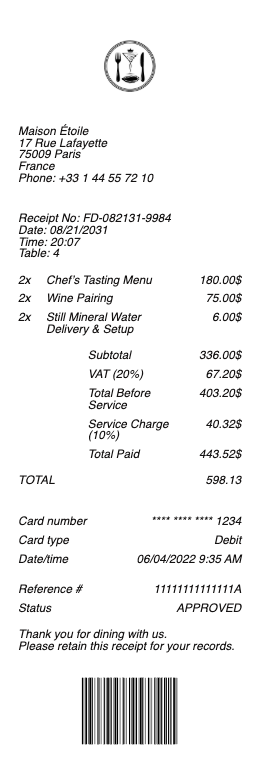
Tasting menu, per person — often with a compulsory whole-table participation rule, and a separate wine pairing charged per cover.
Corkage — the fee for drinking wine you brought, charged per bottle. It exists because the restaurant would otherwise have sold you that bottle.
Service charge, as above, typically 18–20%.
Cover or bread charge, in some establishments.
Cancellation or no-show charge, where a card was held at booking — increasingly common, and legitimate where disclosed.
Each of these should be a distinct, named line. A bill that presents a single total with no breakdown is one you are entitled to question, and an itemised version is one you will need if you are claiming the meal at all.
Why itemisation matters more here than anywhere
Fine dining produces the largest per-head meal bills, which makes them the most likely to be examined and the most likely to be partly non-reimbursable. Two specific reasons the itemised receipt matters:
Alcohol. Wine can easily exceed the food on an upscale bill, and employer policies commonly reimburse food while excluding alcohol. Only the itemisation separates them — a card slip cannot.
The "lavish or extravagant" test. A deductible business meal must not be lavish or extravagant in the circumstances. A restaurant bill that cannot be broken down is much harder to defend as reasonable than one that shows exactly what was ordered.
Keeping the record
Ask for the itemised bill, not just the card slip — at this end of the market, the two are routinely separate documents, and the card slip alone is the weaker one. Write the attendees and the business purpose on it before leaving the table, because a large dinner bill with no context is exactly the claim that gets queried.
Photograph it that evening. If a receipt is lost while the meal genuinely happened, a clear reconstructed record from your card statement documents that real payment for your files — matching the actual charge exactly. It never converts a service charge into a tip, never removes the alcohol, and never restates an amount; the underlying bill is what it is, and the record should say so.
Frequently asked questions
Everything you need to know about the product and billing.
What is the difference between a service charge and a tip?
A tip is discretionary — a sum a customer freely chooses to give. A service charge is a mandatory fee set by the restaurant. That difference in discretion is what separates them legally, and it means a service charge is income to the restaurant, reported as wages rather than tips.
Is automatic gratuity a tip?
No. The IRS treats automatic gratuity as a service charge, not a tip — even though it is often labelled 'gratuity'. It is commonly around 18% and applied to parties of six or more.
Should I tip on top of a service charge?
Generally not — the service charge has already charged you for service. Adding a further 20% means paying for service twice, which many diners do without noticing because the line is buried among taxes and fees. Read the bill before you tip.
Is automatic gratuity legal?
Yes. No legislation prohibits it, and the IRS has ruled it is a service charge. In some states the restaurant must disclose it on the menu or tell you before presenting the bill.
What is a corkage fee?
A per-bottle charge for drinking wine you brought yourself. It exists because the restaurant would otherwise have sold you that bottle, and it should appear as its own named line on the bill.
Why do I need an itemised bill at an expensive restaurant?
Because alcohol can exceed the food, and employer policies commonly reimburse food but not alcohol — only itemisation separates them. A deductible business meal also must not be lavish or extravagant, which is far harder to defend from an unbroken total.