A foreign currency receipt should show the local amount, the rate, and any conversion markup. This guide explains dynamic currency conversion, why you should always pay in the local currency, and what your rights are.
Foreign Currency Receipt
Add custom logo
Edit line items
Choose payment method
Add/remove elements
Customize business information
Choose font
The question at the terminal that costs you money
You are abroad, the card machine is in your hand, and it asks: would you like to pay in your home currency instead? It sounds like a courtesy. It is a sales pitch, and the correct answer is almost always no.
This is dynamic currency conversion (DCC) — the merchant, their bank, or the ATM operator converts the transaction at their exchange rate rather than letting your card network do it at theirs. The convenience is real: you see the amount in a currency you understand. The cost is also real, and it is hidden inside the rate.
What DCC actually costs
DCC providers typically build a margin of 3% to 5% above interbank rates, with markups commonly landing in the 3–7% range — and in the worst documented cases as much as 18%.
Compare that with declining DCC: your own card network converts at its rate, and your bank may add a foreign transaction fee, often around 0–3%. In almost every case, paying in the local currency is cheaper — frequently by several percent of the entire transaction.
The reason the offer feels helpful is precisely why it works: seeing "$47.20" instead of "€43.10" feels like clarity, and the markup is invisible because it lives in a rate you have no way of checking at the counter.
Your rights — DCC must be a genuine choice
The card networks impose real obligations here, and they are worth knowing because they are frequently breached:
DCC cannot be automatic. Visa and Mastercard prohibit it without your consent.
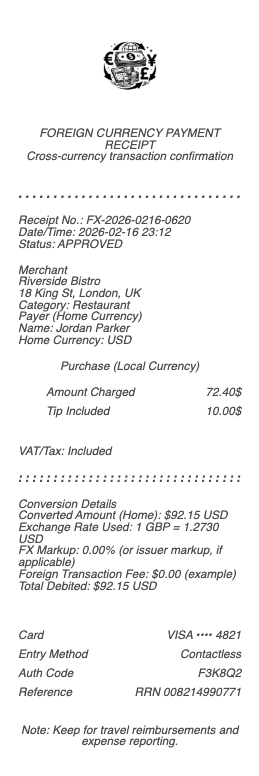
The rate and the margin must be disclosed before you confirm, and the receipt must show the amount in both the local and your own currency.
The options must be presented neutrally — the terminal must not preselect DCC or present it as the better deal.
If you do not explicitly choose your home currency, the transaction must be processed in the local one.
In Europe, providers must show the markup over the ECB reference rate before you confirm.
And if you were denied that choice, there is a remedy: Visa chargeback reason code 76 explicitly covers a cardholder who was not told DCC would occur, or who was refused the option to pay in the merchant's local currency. The receipt is your evidence.
What a foreign currency receipt must show
The amount in the local currency — the real transaction.
The amount in your billing currency, where DCC was applied.
The exchange rate used, and the margin or markup over the reference rate.
A clear indication that DCC was chosen — receipts commonly carry a line confirming you accepted conversion.
Date, merchant, and location.
Check the receipt before you leave the counter. If it shows conversion you did not agree to, that is the moment to have it corrected — and the document you will need if it cannot be.
Expenses and bookkeeping across currencies
For an expense claim, the amount that matters is generally the one that hit your account in your own currency — that is what you actually spent, and it is what your card statement shows. Keep the foreign receipt alongside the statement line: the receipt evidences the purchase, the statement evidences the cost.
For accounting, a foreign transaction is normally recorded at the exchange rate on the transaction date, with any difference at settlement recognised as a foreign exchange gain or loss. This is why the receipt's date and original-currency amount both matter — they are the inputs to that calculation.
If a receipt is lost while the purchase genuinely happened, your card statement establishes the date, amount, and merchant, and a clear reconstructed record documents that real payment for your files — matching the settled charge exactly, and never restating a rate or an amount.
Frequently asked questions
Everything you need to know about the product and billing.
Should I pay in my home currency or the local currency abroad?
Almost always the local currency. Choosing your home currency triggers dynamic currency conversion, where the merchant's provider sets the rate — typically adding 3–7% over interbank, and in the worst cases as much as 18%.
What is dynamic currency conversion?
DCC is where the merchant, their bank, or an ATM operator converts a transaction into your home currency at their exchange rate, instead of letting your card network convert it at theirs. It is presented as a convenience and priced as a product.
Is DCC allowed to be automatic?
No. Visa and Mastercard prohibit automatic DCC — it requires your consent, the rate and margin must be disclosed before you confirm, and the options must be presented neutrally without preselecting DCC.
What if I was not given the choice?
Visa chargeback reason code 76 explicitly covers a cardholder who was not advised DCC would occur, or who was refused the option to pay in the merchant's local currency. Your receipt is the evidence.
What must a foreign currency receipt show?
The amount in the local currency, the amount in your billing currency where DCC applied, the exchange rate used and the margin over the reference rate, and confirmation that conversion was chosen.
Which amount do I claim on expenses?
Generally the amount that hit your account in your own currency — what you actually spent, as shown on your card statement. Keep the foreign receipt with the statement line: one evidences the purchase, the other the cost.