A FREE NOW receipt documents an app-hailed licensed taxi ride, common across European cities. This guide explains how taxi-app receipts differ from rideshare ones, metered versus fixed fares, and where receipts live.
Free Now Receipt
Add custom logo
Edit line items
Choose payment method
Add/remove elements
Customize business information
Choose font
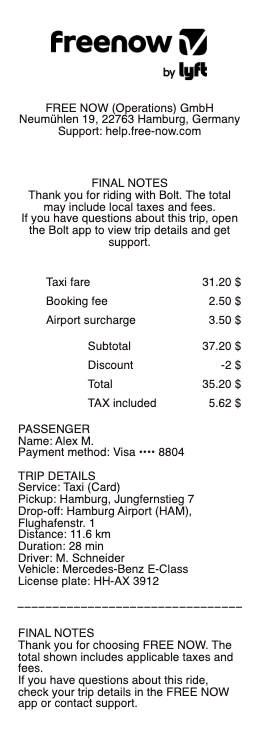
An app that hails real taxis, not rideshare cars
FREE NOW belongs to a category that confuses people who know only rideshare: it is a taxi-hailing app. The vehicle that arrives is a licensed taxi — the same regulated cab you could flag on the street — booked, tracked, and paid through an app.
The hybrid matters for the receipt. Depending on the city and the booking type, the fare may be the regulated taximeter fare (the meter runs exactly as it would for a street hail) or an upfront fixed price agreed in the app. The receipt reflects whichever applied — and understanding which you had explains why two identical routes can produce differently structured receipts.
Metered or fixed: reading which fare you got
Metered rides — the receipt shows the meter total, built under local tariff rules (base, distance, time, night or weekend tariffs). The app adds its booking context but the price is the regulated one.
Fixed-price rides — the receipt shows the agreed amount from booking, which holds regardless of traffic, plus any legitimate extras (tolls, airport fees).
City regulation decides what is available where — some cities mandate meter fares for taxis, others allow app-agreed prices. The practical consequence: on a metered ride, a fare complaint is a tariff question referencing local taxi rules; on a fixed ride, it is a quote question referencing the booking screen. Different arguments, same app.
Where taxi-app receipts live
The paper receipt printer in the cab still exists — but for app bookings, the receipt is digital: emailed after the ride and stored in the app's booking history. That is a genuine upgrade over street-hail taxis, where the thermal slip is the only record and its loss is final.
For business travellers, the app history is the expense file: per-ride receipts with date, route, fare, and payment method, exportable without chasing paper. Business accounts add central billing and monthly statements — the same machinery rideshare platforms offer, applied to licensed taxis.
What the receipt should show
Date, time, and the route — pickup and destination.
The fare type — metered or fixed — and the amount, with extras (tolls, airport surcharges, booking fees) itemised.
The driver and licensed vehicle identifiers — for a regulated taxi, the licence details are part of what you paid for.
Payment method, and any tip.
The booking or trip reference.
The licence identifiers are the line most riders skip and most disputes need. Taxis answer to a local licensing authority, and a complaint — about the fare, the route, or the driver — is made to that authority using the vehicle and driver licence numbers. On a paper receipt from the cab you would have to note them yourself; the app receipt captures them automatically, which is quietly one of its best features. Surcharges — airport pickup fees, booking fees, waiting time — should each appear as their own line, because each exists under a tariff rule that can be checked.
Keeping and recovering taxi-app records
The booking history holds every ride and can resend any receipt — the recovery route for a missing record while the account exists. Export what you need for expenses monthly rather than annually.
If a record is missing while the ride genuinely happened, your card statement establishes the date, amount, and platform, and a clear reconstructed record documents that real payment for your files, matching the charge exactly. The ride detail — route, fare structure, vehicle licence — lives in the app's history, which is why capturing the digital receipt at the time beats reconstructing later.
For work travel, a separate business profile in the app keeps personal and business rides apart at the source: business rides are paid on the work payment method and their receipts route to the work email automatically, which beats sorting a mixed ride history at expense time.
Frequently asked questions
Everything you need to know about the product and billing.
Is FREE NOW a rideshare service?
No — it is a taxi-hailing app. The car that arrives is a licensed taxi, booked and paid through the app. Depending on the city, the fare is either the regulated taximeter fare or an upfront fixed price agreed at booking.
Why do two identical routes have different receipts?
One was likely metered (regulated tariff: base, distance, time, night rates) and the other a fixed app price. The receipt reflects whichever applied, and complaints work differently: tariff questions for metered rides, quote questions for fixed ones.
Where is my taxi-app receipt?
Emailed after the ride and stored in the app's booking history, from which any receipt can be resent. That history is also the expense file — exportable per ride, without paper slips.
What should the receipt show?
Date, time and route; the fare type (metered or fixed) with extras itemised; the driver and licensed vehicle identifiers; the payment method and tip; and the booking reference.
Why do the vehicle licence details matter?
Because a licensed taxi is a regulated service — the licence is part of what you paid for, and it is the identifier a complaint to the taxi authority runs on. They are also how a complaint is filed — taxi fares and conduct are regulated by the local licensing authority, and the licence numbers on the receipt are what the authority asks for.
Can I use taxi apps for business travel?
Yes — business accounts add central billing, monthly statements, and per-ride receipts with route and fare detail, the same expensing machinery rideshare platforms offer, applied to licensed taxis. A business profile in the app pays work rides on the work card and routes those receipts to your work email — the separation happens at booking time instead of at expense time.