A government fee receipt documents payment for a specific service — a licence, a filing, a certified copy. This guide explains how a fee differs from a tax or a fine, and why these small receipts anchor bigger processes.
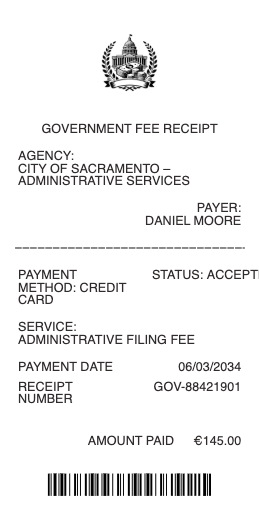
Government Fee Receipt
Add custom logo
Edit line items
Choose payment method
Add/remove elements
Customize business information
Choose font
A fee is not a tax, and neither is a fine
Governments take money three ways, and the receipt means something different in each case:
A fee is not a tax — it is payment for a specific service or privilege: a passport issued, a business registered, a certified copy produced. You pay it by choosing to use the service.
A tax funds government generally and is owed by rule, not in exchange for a particular service.
A fine is a penalty for a violation.
The distinction has practical edges: fees are frequently deductible as business costs where the underlying service is business-related (an LLC filing fee, a professional licence), fines are almost never deductible, and the receipt is what shows which one you paid.
The small receipt that anchors a large process
Government fee receipts are usually for modest amounts attached to disproportionately important outcomes. The pattern to notice: the receipt is often the only immediate evidence that a process has started.
A court filing fee receipt proves the document was filed that day — which is what a statute of limitations cares about.
A records-request fee receipt anchors the clock on a response deadline.
A licence renewal fee receipt is the interim proof of renewal while the new licence is printed and mailed.
In each case the thing you eventually receive replaces the receipt — but in the gap between paying and receiving, the receipt is the status.
Exact amounts, limited methods, and the money order habit
Government payment counters run on rules that feel archaic and exist for cash-control reasons:
Exact amounts — many offices cannot make change or accept overpayment; a wrong amount is a rejected transaction, and for mailed filings, a rejected filing.
Restricted methods — some offices take cards with a processing surcharge, others only cheques or money orders. The money order's own stub is a receipt of purchase and worth keeping alongside the fee receipt itself.
Payee precision — cheques made out to the wrong entity name are returned unprocessed.
Check the office's current requirements before paying, especially by mail, where an error costs a full round-trip.
What a government fee receipt should show
The agency and office that took the payment.
What the fee was for — the specific service, filing, licence, or copy, with any case, application, or file number.
The amount, date, and method.
A receipt or transaction number of the office's own.
Any reference to what happens next — processing times, collection details.
The file number is the crucial field: government offices retrieve by their own identifiers, and a receipt bearing the file number connects your payment to your matter in their system, not just in your records.
Keeping civic receipts
Keep fee receipts until the underlying process completes and the resulting document is in hand — and permanently where the fee itself evidences something durable (original filing dates, registrations, licences that renew).
Government offices keep payment records against their file numbers and can usually confirm or reissue proof of payment, though slowly. If a receipt is lost while the payment genuinely happened, your bank record establishes the amount, date, and agency, and a clear reconstructed record documents that real payment for your files, matching it exactly — with the agency's own file number attached, since that is the identifier their systems will recognise when you need them to find the payment.
Frequently asked questions
Everything you need to know about the product and billing.
What is the difference between a government fee, a tax, and a fine?
A fee pays for a specific service or privilege you chose to use; a tax funds government generally and is owed by rule; a fine is a penalty. Business-related fees are often deductible, fines almost never are — and the receipt shows which you paid.
Why does the filing date on a fee receipt matter?
Because for court filings and applications, the receipt is proof the document was filed that day — which is what limitation periods and deadlines turn on. In the gap before the resulting document arrives, the receipt is the status.
Why do government offices demand exact amounts?
Cash-control rules: many offices cannot make change or accept overpayment, so a wrong amount is a rejected transaction. For mailed filings that means a full round-trip lost — verify the current fee and accepted methods first.
Why do some offices only take money orders?
Payment-control policy. If you pay by money order, keep its purchase stub as well — it is a receipt of the payment instrument itself, separate from the office's fee receipt.
What should a government fee receipt show?
The agency and office, the specific service or filing paid for with its file or case number, the amount, date, and method, and the office's own receipt or transaction number. The file number is what lets their system connect the payment to your matter.
How long should I keep government fee receipts?
Until the process completes and the resulting document is in hand — and permanently where the fee evidences something durable, like an original filing date or a registration.