A Graff receipt for high jewellery travels with something weightier: the stone's grading certificate. This guide explains how the receipt and the diamond certificate work together, and why the pairing is the provenance.
Graff Receipt
Add custom logo
Edit line items
Choose payment method
Add/remove elements
Customize business information
Choose font
At the top of the diamond trade, the paperwork doubles
Graff — the London high jeweller built by Laurence Graff and famous for handling some of the most significant diamonds ever sold — operates at a tier where the purchase document is only half the paperwork. The other half belongs to the stone itself: the grading certificate.
Significant diamonds are graded by independent laboratories — the GIA (Gemological Institute of America) foremost — which certify the famous four Cs: carat weight, colour, clarity, and cut, and assign the stone a report number. At Graff's level, important stones arrive certificated as a matter of course, and the certificate is as much a part of the purchase as the jewel.
The receipt and the certificate do different jobs
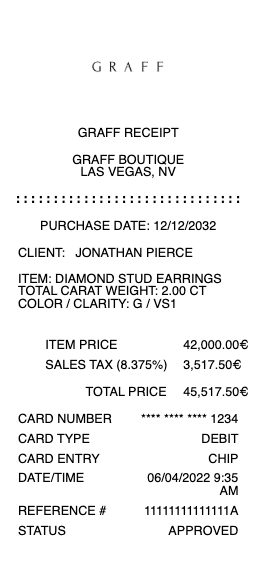
The receipt proves the transaction: this piece, from Graff, on this date, at this price.
The certificate proves the stone: its measured, graded identity, independent of who owns or sells it.
Neither substitutes for the other. A certificate without a purchase record says nothing about ownership; a receipt without the certificate leaves the stone's identity unverified. Together they close the loop: this documented stone, in this documented transaction — and for pieces with multiple significant stones, each may carry its own report, all of which belong in the purchase file.
The link between them is physical: certificates carry report numbers, and significant stones are often laser-inscribed with theirs on the girdle, readable under magnification. Receipt, certificate, inscription — three anchors of one identity.
Why the pairing is the provenance
High jewellery's value concentrates in the stones, and stones — unlike watches — can be remounted, recut, and moved between settings. That mobility is precisely why the certificate-plus-receipt pairing matters: it fixes what was bought, in what mounting, with which certified stones, at a point in time.
Every later event — insurance scheduling, a claim, a resale, an estate valuation — reconstructs from that fixed point. An heir or executor handling an important jewel without its papers faces re-certification and valuation from scratch; one holding the file holds the piece's identity intact.
What the Graff purchase file contains
The receipt — piece, price, date, boutique.
The grading certificate(s) — laboratory, report number, the four Cs.
The house's own documentation — certificates of authenticity and piece descriptions as issued.
Photographs — the piece, its marks, and any laser inscription.
The insurance appraisal — replacement value, updated periodically as markets move.
Alongside what the boutique hands over, one document the owner commissions: the insurance appraisal. Insurers schedule high jewellery against a current appraised value, not the historic receipt figure — and at this level the two diverge quickly, so the appraisal gets renewed periodically while the receipt stays what it always was: proof of the original transaction.
Keeping and safeguarding the file
Keep the originals somewhere that is not with the jewel — the classic loss scenario takes the safe with everything in it — and digital copies distributed sensibly. Laboratories can verify and replace certificates from their report numbers (the GIA's records are precisely the point of the system), and the house can confirm its own sales to known clients: both are recovery routes.
If a receipt is missing while the purchase genuinely happened, your bank record establishes the payment, and a clear reconstructed record documents that real payment for your files, matching it exactly — while the certificate, verifiable by its report number against the laboratory's records, remains the stone's identity document, and the house's client record remains the sale's.
Photograph the piece and its inscription details when it arrives and after any service. Jewellery leaves its owner's hands more often than watches do — cleaning, remounting checks, valuation — and a dated photographic record of the piece with its paperwork is what ties each return to the same stones that left.
Frequently asked questions
Everything you need to know about the product and billing.
What is a diamond grading certificate?
An independent laboratory's report — the GIA's foremost — certifying a stone's carat weight, colour, clarity, and cut under a unique report number. At high-jewellery level, significant stones arrive certificated as standard.
What is the difference between the receipt and the certificate?
The receipt proves the transaction — piece, seller, date, price. The certificate proves the stone's graded identity, independent of ownership. Provenance is the pairing: this documented stone in this documented transaction.
What is a laser inscription?
Many significant stones carry their certificate's report number laser-inscribed on the girdle, readable under magnification — a physical link between the stone and its paper identity.
Why does jewellery provenance depend so heavily on paperwork?
Because stones can be remounted and moved between settings. The certificate-plus-receipt pairing fixes what was bought, with which certified stones, at a point in time — the reference every later valuation, claim, or sale reconstructs from. An insurance appraisal joins the file from the owner's side — insurers schedule against current appraised value, which drifts from the receipt figure over time.
Can a lost diamond certificate be replaced?
Laboratories can verify and reissue reports from their numbers — the GIA's records exist precisely for this. The house can likewise confirm its own sales to known clients.
How should a high-jewellery file be stored?
Originals separate from the jewel itself — the classic loss takes the safe with everything inside — with digital copies distributed. The file is the piece's identity; treat it with the same care as the piece. Add dated photographs of the piece and its inscription details — refreshed after any service — so every return from a workshop is checkable against what left.