A grey market watch is authentic but sold outside the brand's authorized dealer network. This guide explains what that means for the warranty card, why the dealer's own receipt becomes your only cover, and what paperwork to demand.
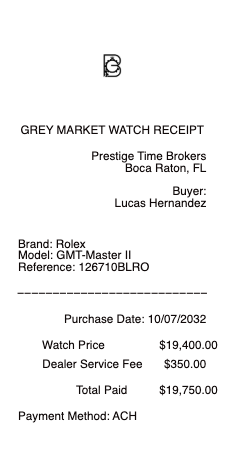
Grey Market Watch Dealer Receipt
Add custom logo
Edit line items
Choose payment method
Add/remove elements
Customize business information
Choose font
Grey market means authentic — but outside the network
The term sounds shady and mostly isn't. A grey market watch is a genuine watch sold outside the brand's authorized dealer network. It is not a counterfeit and it is not stolen; it simply travelled to you through an unofficial channel — a dealer who is not an AD, sourcing from someone who was.
The watch itself is real. What you are giving up is not authenticity but the manufacturer's relationship with it — and that relationship is expressed almost entirely through paperwork. This is why, of all watch purchases, a grey market one is the transaction where the documentation matters most.
The warranty card is the whole game
Here is the mechanism, stated plainly: no card, no warranty. A manufacturer's warranty is activated by a warranty card stamped and dated by an authorized dealer at the point of sale. A grey market dealer, by definition, cannot stamp one.
So a grey market watch arrives in one of two states, and neither gives you factory cover:
No warranty card at all. The dealer sells the watch without it.
A blank or unstamped card. It looks like the real document, and it is — but an unstamped card confers nothing.
The consequence is concrete. Send the watch to a brand service centre with a problem, and you will typically be quoted for a paid repair rather than covered under warranty, even within what would have been the warranty period. Brands can generally trace a watch's origin, so the paperwork does not merely evidence the purchase — it is the entitlement.
The dealer's own warranty is what you're actually buying
Reputable grey market dealers respond by offering their own warranty in place of the manufacturer's. This is a genuine product and often a perfectly reasonable one — but it is a materially different thing, and the differences are worth being clear-eyed about:
You send the watch to the dealer, not the brand. Service goes back to the shop that sold it.
The warranty is only as good as the dealer. A manufacturer's warranty survives the shop closing; a dealer's warranty does not.
Terms vary enormously — length, what is covered, who pays shipping, whether the work is done by brand-trained watchmakers.
Which is precisely why the dealer's receipt and warranty document are the two pieces of paper you cannot afford to lose. They are your only enforceable cover.
What to demand in writing before you pay
For a grey market purchase, the paperwork should answer every question a future buyer, insurer, or service centre will ask:
Model and reference number, and the serial number — the identifier that ties every other document to the object.
Exactly what is included: box, papers, and — critically — whether the warranty card is present, and whether it is stamped. An ambiguous listing here is a red flag.
The dealer's warranty terms in full: duration, coverage, and the service process.
The return window, and any authenticity guarantee.
Price, date, and payment method — your cost basis, and your evidence in a card dispute.
Why this paperwork keeps mattering for years
A grey market watch's documentation does not stop working once the watch arrives:
Resale. The next buyer will ask the same questions you should have asked. A complete file — dealer receipt, warranty document, box, whatever papers exist — commands a real premium over a watch with nothing.
Insurance. Scheduling a watch requires documented value and the serial number, both of which come from your purchase record.
Theft. A police report and any stolen-watch registry are built on the serial number.
Service. Your dealer warranty claim starts with the receipt that proves when and from whom you bought.
Photograph the watch, the serial, and every document the day it arrives, and store the images with the receipt. If an original is lost while the purchase genuinely happened, a clean reconstructed record of your own transaction — built from the order confirmation and your card statement — documents that real payment for your files. It is not a certificate of authenticity, it does not create a warranty that never existed, and it never substitutes for the dealer's own paperwork.
Frequently asked questions
Everything you need to know about the product and billing.
What is a grey market watch?
An authentic watch sold outside the brand's authorized dealer network. It is genuine — not counterfeit and not stolen — but it reaches you through an unofficial channel, which is what affects the warranty rather than the watch itself.
Does a grey market watch have a manufacturer's warranty?
Generally no. A factory warranty is activated by a card stamped and dated by an authorized dealer, and a grey market dealer cannot stamp one. The watch arrives with either no card or a blank, unstamped one — and an unstamped card confers nothing.
Will Rolex service a grey market watch?
Without valid warranty documentation you should expect a paid repair rather than warranty service, even within what would have been the warranty period. Brands can generally trace a watch's origin, so the paperwork determines the entitlement.
What is a dealer warranty and is it any good?
Grey market dealers usually offer their own warranty instead of the manufacturer's. It can be perfectly reasonable, but the watch goes back to the dealer rather than the brand, and the cover is only as durable as the dealer — a shop that closes takes its warranty with it.
What paperwork should I get from a grey market dealer?
The model and reference, the serial number, an explicit statement of what is included (box, papers, and whether the warranty card is present and stamped), the full dealer warranty terms, the return window, and the price and date.
Is a grey market watch harder to resell?
It can be, and the documentation is what closes the gap. A complete file — dealer receipt, warranty document, box and any papers — is worth a genuine premium over an identical watch sold with nothing.