A handwritten receipt template is used when receipts are written by hand. It is commonly used for cash transactions and informal payments.
Handwritten Receipt Template
Add custom logo
Edit line items
Choose payment method
Add/remove elements
Customize business information
Choose font
What's on a Handwritten Receipt
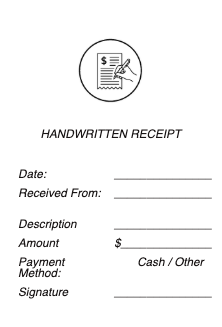
A handwritten receipt is the classic written proof of payment — the kind filled in by hand from a carbon-copy receipt book for rent, a cash sale, or a service. Its format is simple and has barely changed in decades. A complete handwritten receipt includes:
Receipt number (pre-printed and sequential in a receipt book)
Date of the payment
"Received from" — the name of the person who paid
Amount in figures (e.g. $250.00) and the amount written out in words
"For" — the purpose (rent, deposit, labor, goods)
Payment method — cash, check, or money order
Amount paid and balance due, if it's a partial payment
"Received by" — the signature of the person accepting the money
The Classic "Received Of" Receipt-Book Format
Most handwritten receipts come from a bound carbon-copy receipt book (brands like Adams or TOPS), where every slip is pre-numbered and backed by a duplicate or triplicate carbon so both parties keep a copy. The wording follows a fixed pattern — "Received of [name] the sum of [amount]" — and the amount is entered twice: once in figures and once spelled out in words. Writing the amount in words is not decoration; it prevents a "$50" from being altered to "$150." That built-in fraud protection, the running receipt number, and the signature are what make the handwritten format a trusted record.
What actually makes a hand written receipt hold up is not neatness — it's completeness plus the signature line. A dated note stating who paid whom, how much (in numbers and words), for what, with the payee's signature, does the same legal work as a printed slip. Courts and tax offices accept them routinely; what they reject is vagueness — 'received $500, thanks' with no payer, purpose, or date is a note, not a record.
Rent, Cash Sales, and Services — Where Handwritten Receipts Are Used
Handwritten receipts are still everywhere money changes hands without a register. Landlords give tenants a rent receipt showing the month covered and any balance. Small cash businesses, market and fair vendors, and pop-ups write them for each sale. Service providers — cleaners, tutors, babysitters, handymen, contractors taking a deposit — hand one over as proof of payment. In each case the tenant, customer, or client relies on that slip for their own records, a reimbursement, a tax deduction, or simply proof the payment was made. That's why the details need to be complete and legible.
Why Handwritten Receipts Fade — and How to Keep a Clean Copy
The weakness of a handwritten receipt is the paper. Carbon-copy slips smudge, ink fades, and the flimsy second copy is easy to lose or crush at the bottom of a drawer — so the one record you need for a deposit dispute or a tax claim is often unreadable a year later. Rewriting the details into a clean, typed copy — same receipt number, date, names, amount, and purpose — preserves a legible version that still reflects the original handwritten transaction. It's the difference between having proof and having a faded scrap.
Related receipt template receipts: see also our Generic receipt guide and our Receipt Book guide.
Generate a Handwritten-Style Receipt — Free, No Login
Our handwritten receipt template lays out every field of the classic receipt-book slip: receipt number, date, received-from, amount in figures and in words, purpose, payment method, balance due, and a signature line. Fill it in and download a clean, legible file in PDF, PNG, or JPG in under a minute — no account required. It's ideal for reconstructing a faded or lost handwritten receipt you actually issued or received, giving a tenant or customer a readable copy, or keeping an organized record of cash payments.
Legal note: Any Receipt Generator does not validate or certify the authenticity of any generated document. This template is for legitimate record-keeping and bookkeeping — for example, reconstructing a receipt for a payment that genuinely took place. Creating a receipt for a payment that never happened, altering an amount, or using a document to commit fraud is prohibited; users assume full responsibility for the accuracy and intended use of the files they generate.
Frequently asked questions
Everything you need to know about the product and billing.
What is a handwritten receipt?
A handwritten receipt is a written proof of payment, usually filled in by hand from a carbon-copy receipt book, showing the date, who paid, the amount, the purpose, the payment method, and a signature.
What should a handwritten receipt include?
A receipt number, the date, a "received from" name, the amount in both figures and words, the purpose, the payment method (cash, check, or money order), any balance due, and the signature of the person accepting payment.
How do I write a receipt for rent or a cash payment?
Enter the date, the payer's name after "received from," the amount in figures and spelled out in words, "for" the purpose (e.g. June rent), the payment method, any balance due, and sign it. Keep a copy for your own records.
Why is the amount written twice — in numbers and in words?
Writing the amount in words as well as figures prevents it from being altered — a "$50" cannot easily be changed to "$150." It is a simple, long-standing fraud protection.
Is a handwritten receipt valid proof of payment?
A handwritten receipt is widely accepted as proof of payment when it is complete and legible — showing the date, both parties, the amount, the purpose, and a signature. For specific legal or tax requirements, check the rules that apply to your situation. Validity comes from completeness, not printing — date, both parties, amount twice, purpose, signature. Vague notes fail as records; complete ones hold up like any printed slip.
What formats can I download, and is it free?
You can export handwritten-style receipts as PDF, PNG, or JPG for free, with no login. Watermark-free downloads are available with a paid upgrade.