A Harry Winston receipt documents jewellery whose replacement value moves independently of its price. This guide explains why important pieces need appraisals as well as receipts, and how insurance scheduling works.
Harry Winston Receipt
Add custom logo
Edit line items
Choose payment method
Add/remove elements
Customize business information
Choose font
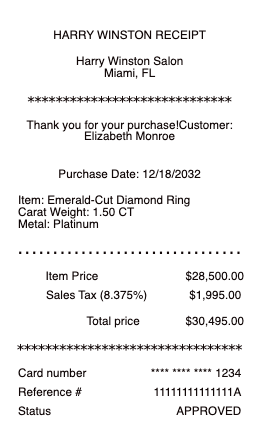
The King of Diamonds, and the paperwork of important pieces
Harry Winston — the New York jeweller whose founder was called the King of Diamonds, who handled the Hope Diamond and donated it to the Smithsonian in 1958, and whose house has been part of the Swatch Group since 2013 — sells at the tier where jewellery stops being a purchase and becomes an asset with paperwork.
At that tier, the receipt's job changes. It still proves the transaction — salon, date, piece, price — but it becomes the first document in a valuation chain, because what an important jewel is worth starts moving independently of what it cost from the day it leaves the salon.
Price and value part company — the appraisal bridges them
The number on the receipt is fixed history; replacement value is a living figure that moves with diamond markets, brand pricing, and the piece's own scarcity. Insurance runs on the living figure, which is why important jewellery is scheduled — listed individually on a policy at an appraised replacement value, rather than lumped under general contents limits.
The appraisal is the bridging document: a qualified valuation stating what replacing the piece would cost today. The receipt feeds it (identity, provenance, original price), the appraisal states current value, and the schedule insures it. Skip the middle step and a claim pays against an outdated number — the commonest and most expensive documentation failure in jewellery ownership.
The salon purchase and its records
A Harry Winston purchase is salon retail: advisor-led, documented in the house's client systems, and accompanied by the house's own certificates and, for significant stones, independent laboratory reports. The purchase file assembles the same way as all high jewellery — receipt, certificates, house documentation, photographs — with the client relationship itself as a living record the house maintains.
That house record matters practically: known clients can have sales confirmed, documentation reissued, and pieces serviced with their history intact. The receipt in your drawer and the record in their system are two copies of the same fact, and the second one survives house fires.
Important pieces change hands across generations, which gives the paperwork one more job: the chain of ownership. A receipt in a parent's name, an estate document, a gift letter — each link the file preserves is a question an heir or executor never has to reconstruct. Jewels outlive their owners; the file should be built to outlive them too.
Scheduling, claims, and the update cycle
Schedule promptly — an important piece between purchase and scheduling is insured, at best, under general limits far below its value.
Update the appraisal periodically — every few years, or after significant market moves; brand-piece replacement costs ratchet upward.
A claim runs on the file — the schedule entry, the appraisal behind it, the receipt and certificates behind that, and photographs tying them to the physical piece.
Estates run on the same file: executors valuing important jewellery start from the appraisals and certificates, and the completeness of the paperwork directly affects both the valuation and the sale options.
Travel adds a wrinkle: an important jewel worn abroad may need its paperwork twice — once for the insurer, whose policy may require notification for travel, and once at customs, where proof the piece was owned before the trip is what separates a personal effect from a dutiable import on the way home.
Keeping the Winston file
Keep the receipt, certificates, appraisals, and photographs together, stored apart from the jewellery itself, with digital copies distributed. Refresh the appraisal on its cycle and file each version — the sequence of appraisals is itself a record of the piece's market history.
The house and the laboratories are the recovery routes for their respective documents. If a receipt is missing while the purchase genuinely happened, your bank record establishes the payment, and a clear reconstructed record documents that real payment for your files, matching it exactly — while the appraisal, which only a qualified valuer can issue, and the house's client record remain the documents insurance and the market rely on.
Frequently asked questions
Everything you need to know about the product and billing.
Why do important jewels need an appraisal as well as a receipt?
Because replacement value moves independently of purchase price from day one. The receipt is fixed history; the appraisal states what replacement costs today — and insurance pays on the appraised, scheduled figure.
What does scheduling jewellery mean?
Listing a piece individually on an insurance policy at its appraised replacement value, rather than under general contents limits. Unscheduled important pieces are underinsured almost by definition. Travel is the other trigger — some policies want notification before an important piece leaves the country, and customs may want proof it was owned before the trip.
How often should appraisals be updated?
Every few years, or after significant market moves — brand replacement costs ratchet upward, and a claim against an outdated appraisal pays the outdated number.
What belongs in the purchase file?
The salon receipt, the house's certificates, independent laboratory reports for significant stones, photographs of the piece, and the appraisal sequence — stored apart from the jewellery itself. Estate and gift documents belong there too — the chain of ownership the file preserves is what heirs and executors would otherwise have to reconstruct.
Can Harry Winston confirm an old purchase?
Salon retail is documented in the house's client systems — known clients can have sales confirmed and documentation reissued, which is the recovery route beyond your own records.
Why does the Hope Diamond matter to this?
As the emblem of the house's history with important stones — Harry Winston donated it to the Smithsonian in 1958 — it stands for the tier of jewellery where paperwork, provenance, and valuation are inseparable from the piece.