An H&M receipt ties into the retailer’s membership programme more than most fashion slips: whether you shopped as an H&M Member changes how the receipt is stored, how long you have to return, and whether the return is free. This page covers what the receipt shows and how membership and the 30-day window shape returns and refunds.
H&M Receipt
Add custom logo
Edit line items
Choose payment method
Add/remove elements
Customize business information
Choose font
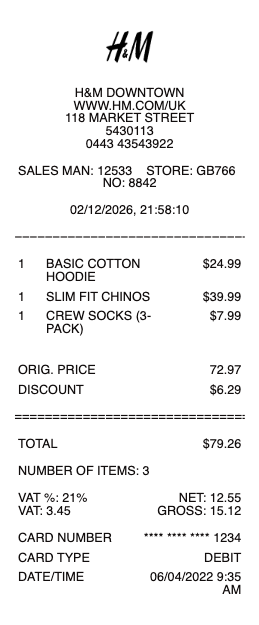
What’s on an H&M Receipt
Store or online order details — branch and register, or the order number for hm.com
Date — the start of the return window
Each item with article number, size, and price
H&M Member number or points earned, when you shopped as a member
Any member offers or discounts applied
Subtotal, tax, and total, with payment method
The header details do quiet work later: the branch and register identify which store's stock the item came from, and the order number is the key every hm.com support conversation starts with. Treat the top three lines of an H&M receipt as the item's address — everything below them describes the purchase, but those lines locate it.
H&M Membership Changes the Receipt
H&M’s free Member programme is woven through the receipt. Scan your membership at checkout and you earn points toward rewards and vouchers, and the receipt records the member number and points — the same programme that unlocks member prices you’ll see applied on the slip. Membership also creates a digital receipt archive: member purchases are saved in the H&M app and account, so a lost paper slip is not a problem — the itemised digital receipt is there to view or show at returns. Shop without scanning membership and you fall back on the paper receipt alone, with no account copy to retrieve. For anyone who returns or expenses regularly, being a member is the difference between a searchable receipt history and a shoebox.
H&M Returns: 30 Days, Members, and the Online-Return Fee
H&M accepts returns within 30 days of purchase in original condition with tags and proof of purchase. The membership angle recurs here: in-store returns are free, and H&M Members generally get free online returns, while non-member online returns by mail can carry a fee deducted from the refund — so, as with several fast-fashion chains, returning an online order to a store is the reliable way to avoid a charge. The receipt or the digital member receipt is required, and refunds go to the original payment method. Because the window and the fee both depend on the purchase date and whether you’re a member, those are the receipt fields that decide your options.
Expenses, Exchanges, and Getting a Copy
For a documented clothing purchase — a reimbursed work item, a uniform piece — the itemised H&M receipt is the record, and the article numbers identify exact products where a card statement’s single “H&M” line cannot. Exchanges run on the same 30-day rule and the same receipt. To retrieve a lost receipt, the H&M app and account order history cover member and online purchases; for a non-member in-store buy, the paper slip is the only proof, so photograph it promptly. Keep the receipt until the return window closes and any refund clears — and if you returned an online order by mail as a non-member, confirm the return fee was applied correctly.
Related fashion retailer receipts: see also our Zara receipt guide and our Uniqlo receipt guide.
Member purchases get the strongest receipt lookup: because each scanned checkout is recorded against the account, the app's purchase history doubles as a receipt archive that survives faded thermal paper, lost emails, and cleared inboxes. For guest purchases the paper slip is the only record — which is the practical argument for scanning the membership even on small buys.
Create an H&M-Style Receipt
Our generator rebuilds a fashion-retail receipt in the H&M style — store or order header, itemised lines with article numbers, any member discount, tax, and total — as a clean PDF for records when the original is gone.
Use it responsibly: recreate only real purchases at their true amounts. Fabricating receipts for returns, exchanges, or reimbursements is fraud — and H&M’s membership records are the authoritative proof it checks. H&M is a trademark of its owner; this tool is not affiliated with the company.
Frequently asked questions
Everything you need to know about the product and billing.
Does H&M keep a digital copy of my receipt?
If you shopped as an H&M Member, yes — member and online purchases are saved in the app and account order history to view or show at returns. Non-member in-store purchases have only the paper receipt. Only for member purchases — scanned checkouts build a purchase history in the app that works as a receipt lookup; guest purchases live only on the paper slip.
What is H&M’s return window?
30 days from purchase, in original condition with tags and proof of purchase. The date on the receipt starts the clock, and the receipt or digital member receipt is required.
Does H&M charge for returns?
In-store returns are free, and H&M Members generally get free online returns. Non-member online returns by mail can carry a fee deducted from the refund, so returning to a store avoids it.
How do H&M membership points show on the receipt?
When you scan your membership at checkout, the receipt records your member number and the points earned toward rewards, alongside any member prices applied.
How do I get a copy of a lost H&M receipt?
Member and online purchases are in the H&M app and account order history. For a non-member in-store purchase, the paper slip is the only proof of purchase — photograph it. If the purchase was scanned to your membership, the app's purchase history is the fastest copy — faded paper and lost emails stop mattering.
Can I return an H&M online order to a store?
Yes, and in-store returns are free — the reliable way for non-members to avoid the mail-return fee. Bring the receipt or the digital member receipt within the 30-day window.