An HOA fee receipt documents payment of homeowners association dues or a special assessment. This guide explains what the receipt should show, why unpaid dues can become a lien, and what an estoppel letter is for at closing.
HOA Fee Receipt
Add custom logo
Edit line items
Choose payment method
Add/remove elements
Customize business information
Choose font
HOA dues are not a bill you can safely ignore
A homeowners association assessment behaves differently from most household bills, and the difference is legal rather than financial. Utilities can chase you; an HOA, in most jurisdictions, can place a lien on your home for unpaid dues — and in some circumstances pursue foreclosure on that lien.
That is the reason to keep every payment receipt. The consequence of an unproven payment is not a late fee and a phone call; it is a cloud on the title of your property, which surfaces at the worst possible moment — when you are trying to sell.
Regular dues versus a special assessment
Two different charges arrive from the same association, and they are worth separating on your records:
Regular assessments — the recurring dues (monthly, quarterly, or annual) covering shared costs: landscaping, insurance for common areas, management, and contributions to the reserve fund.
Special assessments — one-off charges levied for a specific major expense the reserves cannot cover: a new roof, repaving, structural repairs, a legal settlement.
Special assessments are the ones that hurt, arriving without notice and sometimes running to thousands. The receipt for one should say explicitly what it is for and what period or project it covers, because at resale a buyer will want to know whether an assessment is paid, pending, or approved but not yet levied.
What the receipt should show
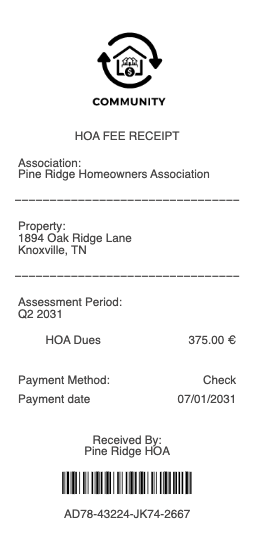
The association name and the property address or unit number the payment applies to.
The period covered — the months or quarter, not merely the date received.
What the payment is — regular assessment, special assessment, fine, or late fee.
The amount, and how it was applied against your account.
The remaining balance, if any, so the record is self-checking.
The allocation matters more than people expect. Where an owner is behind, associations commonly apply a payment to the oldest debt, or to fines and legal costs before current dues — which can leave you still "delinquent" on current assessments despite having paid. The receipt is where you check.
The estoppel letter at closing
When a property in an association is sold, the closing requires an estoppel certificate (sometimes called a status letter): a document from the HOA stating exactly what is owed on that unit — dues, unpaid assessments, fines, and any pending special assessments.
It exists because HOA debt travels with the property. A buyer who fails to check can inherit a previous owner's arrears, and the estoppel letter is what prevents that. As a seller, your payment receipts are what you use to challenge an estoppel letter that overstates the balance — which does happen, and is far easier to fix before closing than after.
Keeping HOA records
Keep receipts for as long as you own the property, and hand the record over cleanly when you sell. Most associations or their management companies maintain an owner portal with a payment history — that is the first place to look for a missing record, and it is usually authoritative.
If a receipt is gone while the payment genuinely happened, your bank statement establishes the date, amount, and payee, and a clear reconstructed record documents that real payment for your files. It must match the bank record exactly — and where the association's ledger disagrees with you, their account statement and your bank's record are the two documents that will actually settle it, so request both rather than relying on a reconstruction.
Frequently asked questions
Everything you need to know about the product and billing.
What happens if I do not pay HOA dues?
In most jurisdictions an association can place a lien on the property for unpaid assessments, and in some circumstances pursue foreclosure on that lien. Unlike an ordinary bill, the consequence attaches to the home itself.
What is a special assessment?
A one-off charge levied for a major expense the association's reserves cannot cover — a roof, repaving, structural repairs, or a legal settlement — as opposed to the regular recurring dues.
What should an HOA receipt show?
The association name, the property or unit, the period covered, what the payment is (regular assessment, special assessment, fine, or late fee), the amount, how it was applied, and the remaining balance.
Why does it matter how my payment was applied?
Associations often apply payments to the oldest debt, or to fines and legal costs before current dues — which can leave you recorded as delinquent on current assessments despite having paid. The receipt is where you verify the allocation.
What is an estoppel letter?
A document from the HOA, required at closing, stating exactly what is owed on a unit — dues, unpaid assessments, fines, and pending special assessments. It exists because HOA debt travels with the property to the new owner.
How long should I keep HOA receipts?
For as long as you own the property. They are what you use to challenge an estoppel letter that overstates your balance at closing — a problem far easier to fix before completion than after.