A house rent receipt is the tenant's proof that rent was paid for a period. This guide covers which US states legally require landlords to issue one, why cash payments make it essential, and how tenants use rent receipts as evidence.
House Rent Receipt
Add custom logo
Edit line items
Choose payment method
Add/remove elements
Customize business information
Choose font
In several states, a rent receipt is not a courtesy — it's the law
Most tenants assume a rent receipt is something a landlord provides if they feel like it. In a number of US states, that is wrong: issuing one is a legal obligation, and it usually turns on how the rent was paid.
Massachusetts requires landlords to provide a receipt for rent paid by cash or money order.
New York requires a written receipt when rent is paid in cash or by money order.
Washington and Maryland also require receipts for cash payments, with Maryland additionally requiring one when the tenant asks.
The common thread is cash. A bank transfer leaves its own trail; cash leaves none — so the receipt is the only evidence the payment ever happened, and the law recognises that asymmetry.
Why paying rent in cash is the risky case
If you pay rent in cash and receive nothing back, you have no proof you paid. That is not a theoretical problem: it is the fact pattern behind a large share of eviction disputes, where a landlord claims non-payment and the tenant has only their word to offer.
The practical rules for cash-paying tenants are simple and worth following without exception:
Never hand over cash without getting a receipt in return — at the moment of payment, not later.
Check the receipt states the period the payment covers, not just the date it was handed over. "$1,400 received" is far weaker than "$1,400 for rent, 1–31 July".
Keep them in order. A run of receipts is what demonstrates a payment history.
Electronic receipts are equally valid
A rent receipt does not have to be a paper slip. Electronic rent receipts are legally valid across all 50 states under the federal ESIGN Act and state UETA legislation — an emailed or app-generated receipt carries the same weight as a handwritten one.
For landlords this is the easy modernisation: issuing receipts automatically on payment removes an administrative task and produces a defensible record without a filing cabinet. For tenants, an emailed receipt is also self-archiving — it sits in your inbox, timestamped, in a way a shoebox of paper does not.
What tenants actually use rent receipts for
The eviction defence is the dramatic use, but rent receipts do quieter work all year:
Proving payment history when a landlord's ledger disagrees with yours, or when a property changes hands and the new owner's records start blank.
Security deposit disputes at move-out, where the payment record establishes what was and was not paid.
Rental applications — a prospective landlord asking for evidence of on-time payment at your last address.
Benefit and assistance claims, and any programme that verifies housing costs.
Home-office deductions for the self-employed, where rent is a component of the claim.
If your landlord will not give you one
Where the law requires a receipt, ask in writing — an email creates its own record of the request, and that record is useful even if the receipt never arrives. Where the law does not require one, you can still build your own trail: pay by a traceable method (transfer, cheque, or a rent-payment app) so the payment is independently evidenced by your bank.
If a receipt is missing for a payment that genuinely happened, your bank statement establishes the date, amount, and recipient, and a clear reconstructed record of your own payment documents that real transaction for your files. It should match the bank record exactly — and where a state requires the landlord to issue a receipt, a reconstruction is your record, not a substitute for the document the landlord owes you.
Frequently asked questions
Everything you need to know about the product and billing.
Does my landlord have to give me a rent receipt?
It depends on the state and how you paid. Massachusetts requires a receipt for cash or money-order rent. New York requires a written receipt for cash or money order. Washington and Maryland also require them for cash payments, and Maryland requires one on request.
Why do rent receipt laws focus on cash?
Because cash leaves no independent trail. A bank transfer evidences itself; a cash payment with no receipt is unprovable, which is why the law steps in specifically for cash and money orders.
Is an emailed rent receipt legally valid?
Yes. Electronic rent receipts are valid in all 50 states under the federal ESIGN Act and state UETA laws, and carry the same weight as a paper receipt.
What should a house rent receipt include?
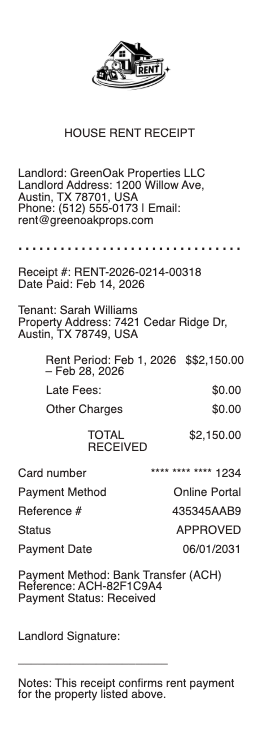
The amount paid, the exact period it covers, the property address, the tenant and landlord names, the date received, the payment method, and the landlord's signature. The period covered is the field disputes most often turn on.
What can I use rent receipts for?
Proving payment history in a dispute or eviction, resolving security-deposit disagreements, supporting a rental application, verifying housing costs for assistance programmes, and supporting a home-office deduction.
What if my landlord refuses to give a receipt?
Ask in writing, so the request itself is documented, and pay by a traceable method — transfer, cheque, or a rent app — so your bank independently evidences the payment.