An import duty receipt documents customs duty paid on goods entering the country. This guide covers the 2025 end of the $800 de minimis exemption, how duty is calculated, and what the entry paperwork must show.
Import Duty Receipt
Add custom logo
Edit line items
Choose payment method
Add/remove elements
Customize business information
Choose font
The $800 duty-free rule is gone
For years, the practical rule of small imports into the US was simple: shipments valued at $800 or less entered duty-free under the de minimis exemption, with minimal paperwork. That rule no longer exists.
Effective 29 August 2025, de minimis treatment was suspended for all countries — imports from China and Hong Kong had already lost it that May. Now every shipment, regardless of value, is subject to applicable duties, taxes, and entry requirements. For postal shipments there was a transition: a flat per-package duty ($80–$200) could be used instead of percentage-based duty, but from 28 February 2026 only the ad valorem (percentage) method applies.
The practical effect: the $40 gadget that used to arrive with no paperwork now generates a duty calculation and a receipt — and consumers are seeing customs charges for the first time on purchases that never used to carry them.
How the duty on your receipt was calculated
Import duty is not one rate — it is a lookup. Three inputs decide the figure:
The HTS classification — every product maps to a code in the Harmonized Tariff Schedule, and the code carries the duty rate. Getting the classification right (or wrong) changes the bill.
The customs value — generally the price paid, which is why the commercial invoice accompanies the shipment and why undervaluing it is fraud.
The country of origin — trade agreements, and in recent years additional tariffs, apply by origin. Origin is where the goods were made, not where they were shipped from.
An ad valorem duty is a percentage of that customs value. Your receipt should let you reconstruct the arithmetic: value × rate = duty, plus any additional tariffs, fees, and taxes itemised separately.
Who actually owes the duty
Duty is owed by the importer of record — and for a consumer purchase from abroad, that is usually you, not the seller. The seller's price did not include US duty unless the terms said so explicitly (delivered-duty-paid, often shown as DDP at checkout).
This is why the carrier's message asking for payment before delivery is usually legitimate: the carrier or broker advanced or calculated the duty, and the goods will not be released until it is paid. It is also why the paperwork matters — a payment demand should reconcile to a duty calculation you can see, not just a total.
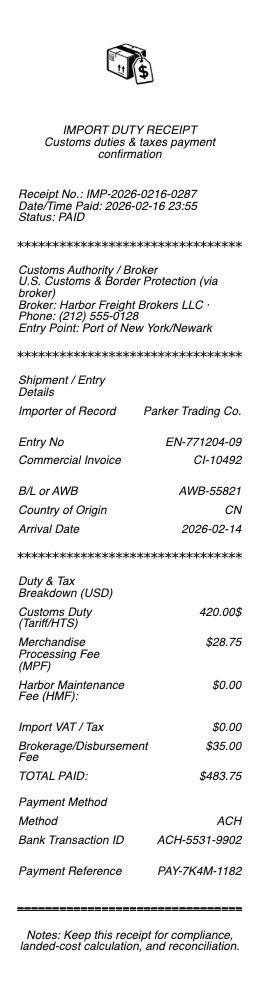
What the import duty receipt should show
The entry or reference number — the identifier for the customs entry itself.
The customs value declared, and the HTS code(s) applied.
The duty rate and amount, with any additional tariffs shown separately.
Taxes (where applicable) and fees, each named.
The shipment identifier — tracking or waybill number — tying the payment to the goods.
Keep it with the commercial invoice and the order confirmation: together they show what was bought, what was declared, and what was paid — the complete story a dispute or an audit needs.
Why businesses keep these receipts carefully
For a business, import duty is part of the landed cost of goods — it belongs in inventory cost and margins, not lost in a shipping-expenses line. The duty receipts are also the audit trail: customs authorities can and do review entries after the fact, and reclassification or revaluation disputes are argued from exactly these documents.
Duty overpayments can sometimes be recovered — refund claims for overpaid duty run on the entry number and the original receipts. If a record is missing while the payment genuinely happened, the carrier or broker can reissue their invoice and the entry documentation, and your card or bank statement establishes what you paid; a clear reconstructed record documents that real payment for your files, matching it exactly, while the entry paperwork remains the document customs itself recognises.
Frequently asked questions
Everything you need to know about the product and billing.
Is the $800 duty-free import rule still in effect?
No. De minimis treatment was suspended for all countries effective 29 August 2025 — China and Hong Kong lost it earlier, that May. Every shipment is now subject to applicable duties and entry requirements regardless of value.
What happened to postal shipments after de minimis ended?
A transition applied: low-value postal shipments could use a flat per-package duty of $80–$200 instead of a percentage. From 28 February 2026, only the ad valorem (percentage of value) method applies.
How is import duty calculated?
From three inputs: the HTS classification (which carries the rate), the customs value (generally the price paid), and the country of origin (which determines trade-agreement treatment and additional tariffs). Duty = value × rate, plus any separate tariffs and fees.
Who pays import duty on an online order from abroad?
The importer of record — for consumer purchases, usually the buyer, unless the seller sold delivered-duty-paid (DDP). That is why a carrier's payment request before delivery is normally legitimate.
What should an import duty receipt show?
The entry or reference number, the declared customs value, the HTS code(s), the duty rate and amount with any additional tariffs separate, each tax and fee named, and the tracking or waybill number tying it to the shipment.
Can overpaid duty be recovered?
Sometimes — refund claims for overpaid or misclassified entries run on the entry number and original receipts, which is one of the practical reasons businesses keep import paperwork carefully.