An inspection fee pays for the inspection itself — not for a pass. This guide explains why failed inspections still cost money, how re-inspection fees work, and what inspection receipts prove later.
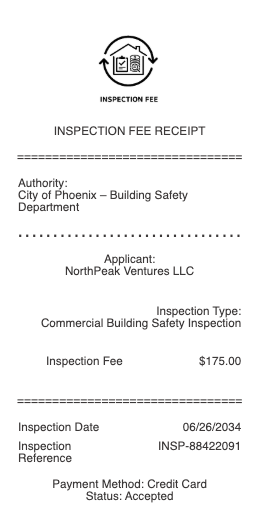
Inspection Fee Receipt
Add custom logo
Edit line items
Choose payment method
Add/remove elements
Customize business information
Choose font
You are paying for the inspection, not the result
The premise of every inspection fee, and the one people argue about at the counter: the fee buys the inspector's time and judgment, not a favourable outcome. A vehicle that fails its safety inspection, a building stage that fails code review, a restaurant that fails a health check — all still owe the fee, because the inspection happened.
That premise also explains re-inspection fees: fixing the defects and coming back means another inspection, and usually another (often reduced) fee. The receipts stack — inspection, fail, repair, re-inspection, pass — and the stack itself becomes the record that the defect was found and corrected, which is frequently worth more than a clean first pass.
The inspection report and the fee receipt are two documents
Every inspection produces both, and they do different work:
The fee receipt proves the inspection was commissioned and paid for, and on what date.
The report or certificate records what the inspector found — the pass, the failure items, the conditions.
Keep them together. The receipt without the report proves you paid for something unspecified; the report without the receipt invites questions about who commissioned it and when. Together they establish the timeline — which matters enormously when the question later becomes what was known, and when.
Home-purchase inspections: the fee that prices a negotiation
The buyer's home inspection is the most consequential inspection fee most people ever pay — a few hundred dollars that routinely moves thousands. Three fee facts worth knowing:
The buyer pays, and pays even if the deal dies. The fee is owed to the inspector regardless of whether the purchase completes — it is a cost of deciding, not of buying.
Specialist inspections stack — sewer scope, radon, termite, roof — each with its own fee and report.
The report is the negotiation document: repair credits and price reductions are argued from its findings, which is why the inspection contingency period exists in the contract.
Attending the inspection changes what the paperwork is worth: a buyer who joins the walk-through hears context the written report compresses — which findings are urgent, which are cosmetic, what the inspector would fix first. The report plus your own notes from the walk-through is a negotiation file; the report alone is a list.
Vehicle and compliance inspections: the recurring kind
Recurring inspections — vehicle safety and emissions, elevator, fire systems, backflow, boiler — share a pattern: the inspection is a condition of continued operation, on a fixed cycle, and the receipt-plus-certificate is what proves currency.
The practical fields: the identifier of the thing inspected (VIN, equipment serial, premises), the date and expiry, the standard inspected against, and the result. Fleet operators and building managers live by these files, because an expired inspection discovered after an incident converts a routine compliance lapse into liability — and the receipts are how currency is demonstrated across dozens of assets.
Scheduling is the quiet cost driver on the recurring kind: compliance inspections booked ahead of deadline run at standard rates, while the same inspection booked after a notice or lapse often carries expedite fees, re-registration costs, or fines that dwarf the fee itself. The dates on the receipts document whether the schedule — or the scramble — is what you have been paying for.
Keeping inspection records
Keep the fee receipt stapled to its report, and keep the pair for the life of the thing inspected: a vehicle's inspection history supports its resale, a property's inspection file supports its next transaction, a business's compliance inspections support its licence.
Inspection bodies keep records by identifier and can reissue certificates, which is the recovery route for a missing report. If a fee record is lost while the payment genuinely happened, your bank record establishes the amount, date, and payee, and a clear reconstructed record documents that real payment for your files, matching it exactly — while the report itself, which only the inspecting body can reissue, remains the document that evidences what was actually found.
Frequently asked questions
Everything you need to know about the product and billing.
Do I still pay if the inspection fails?
Yes. The fee buys the inspector's time and judgment, not a favourable result — a failed vehicle, building stage, or premises still owes the fee because the inspection happened.
What is a re-inspection fee?
The charge for coming back after defects are fixed — usually smaller than the original fee. The resulting stack of receipts (inspection, fail, repair, re-inspection, pass) documents that the defect was found and corrected.
Who pays for a home inspection if the sale falls through?
The buyer — the fee is owed to the inspector regardless of whether the purchase completes. It is the cost of deciding, not of buying, and it is why the inspection contingency period exists. Attend the walk-through if you can — the inspector's spoken context turns the written report from a list into a negotiation file.
What is the difference between the inspection receipt and the report?
The receipt proves the inspection was commissioned, paid for, and when; the report records what was found. Together they establish what was known and when — keep them as a pair.
What should a recurring inspection record show?
The identifier of the thing inspected (VIN, serial, premises), the date and expiry, the standard inspected against, and the result. For fleets and buildings, these files are how compliance currency is demonstrated across many assets. The booking dates tell their own story — inspections booked ahead of deadline run at standard rates, while post-lapse scrambles add expedite fees and fines.
How do I replace a lost inspection certificate?
From the inspecting body, which keeps records by identifier and can reissue. Your bank record can evidence the fee payment, but only the inspector's reissued report evidences what was found.