A lunch receipt supports a per diem or a business meal deduction. This guide explains the FY2026 lunch rate, the 50% business meal rule, and the two conditions a meal must meet to be deductible at all.
Lunch Receipt
Add custom logo
Edit line items
Choose payment method
Add/remove elements
Customize business information
Choose font
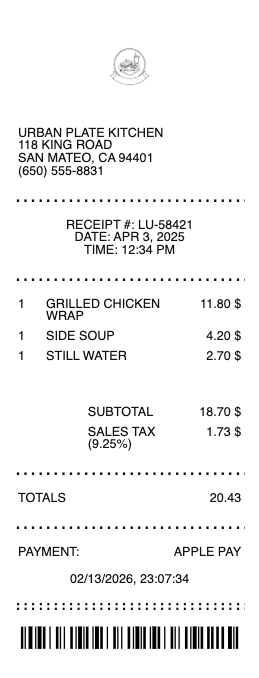
Two very different lunches, two very different rules
A lunch receipt does one of two jobs, and confusing them is the most common expense error there is:
A travel lunch — you are away from home on business and eating. This is reimbursed under per diem or actual expense, and for FY2026 the standard CONUS per diem allots $19 to lunch out of a $68 daily M&IE.
A business meal — you are taking a client, a supplier, or a prospect to lunch. This is a tax-deductible business expense governed by an entirely separate set of rules.
The receipt looks identical in both cases. What it must prove does not.
The 50% rule, and the two conditions behind it
A qualifying business meal is generally 50% deductible. But it only qualifies if it clears two tests set out in the tax code, and both are easy to fail:
The expense must not be lavish or extravagant under the circumstances.
The taxpayer, or an employee of the taxpayer, must be present when the food or beverages are furnished.
That second condition surprises people. Buying lunch for a client and having it delivered to them while you are elsewhere is not a deductible business meal — your presence is a statutory requirement, not a formality. Paying for a meal you did not attend fails the test regardless of how genuine the business purpose was.
What the receipt alone does not prove
An itemised lunch receipt establishes what was bought and for how much. It does not establish why — and the business purpose is precisely what a deduction rests on.
The substantiation a business meal actually requires is:
Who was present, by name, and their business relationship to you.
Where — the venue and location.
When — the date.
How much — the itemised amount.
Why — the business purpose or the topic discussed.
The habit that makes this painless is to write the names and the purpose on the receipt itself, at the table, before it goes into your pocket. Reconstructing who you had lunch with eight months later, at audit, is not a task anyone performs well.
Alcohol, tips, and the itemisation that matters
Alcohol is deductible on the same 50% basis when it is part of a qualifying business meal — but many employers' internal policies reimburse food while excluding alcohol, which is a stricter rule than the tax code's. Only an itemised receipt lets the two be separated; a card slip showing a total cannot.
Tips form part of the deductible cost of the meal, so the receipt should show the tip and the final total, not just the pre-tip subtotal. Keep the itemised receipt and the card slip where you get both: the first shows what was bought, the second shows what was actually paid.
Keeping lunch receipts usable
Lunch receipts are the ones that pile up, fade, and get thrown away — and they are individually small, which is exactly why they go unrecorded and quietly cost their owner money across a year.
Photograph each one the day you get it, with the names and purpose already written on. If a receipt is lost while the meal genuinely happened, a clear reconstructed record from your card statement documents that real payment for your files — matching the actual charge exactly. It records a meal you truly bought; it does not invent an attendee, a purpose, or an amount, and a business-meal deduction still requires the underlying substantiation to be true.
Frequently asked questions
Everything you need to know about the product and billing.
Are business lunches tax deductible?
A qualifying business meal is generally 50% deductible. It must not be lavish or extravagant, and the taxpayer or an employee must be present when the food is furnished — buying a client lunch you do not attend does not qualify.
What is the per diem for lunch in 2026?
Under the FY2026 standard CONUS rate, lunch is allotted $19 of the $68 daily M&IE (breakfast $16, dinner $28, incidentals $5). Higher-cost locations use higher tiers.
What do I need to substantiate a business meal?
Who was present and their business relationship, where, when, how much, and the business purpose. The receipt proves the amount but not the reason — write the names and purpose on it at the table.
Is alcohol deductible on a business lunch?
Alcohol is deductible on the same 50% basis when part of a qualifying business meal. But many employers' own policies reimburse food and exclude alcohol, which is stricter than the tax rule — and only an itemised receipt lets the two be separated.
Is the tip deductible?
Yes, tips form part of the deductible cost of the meal. The receipt should therefore show the tip and the final total, not just the pre-tip subtotal.
Is a card slip enough for a business lunch?
Usually not. The card slip shows a total; the itemised receipt shows what was actually bought and separates alcohol from food. Keep both where you get both.