A luxury boutique receipt anchors a document set — authenticity card, box, dust bag — born at purchase. This guide explains appointment retail, personalisation and final sale, and turning the receipt into an insurance appraisal.
Luxury Boutique Receipt
Add custom logo
Edit line items
Choose payment method
Add/remove elements
Customize business information
Choose font
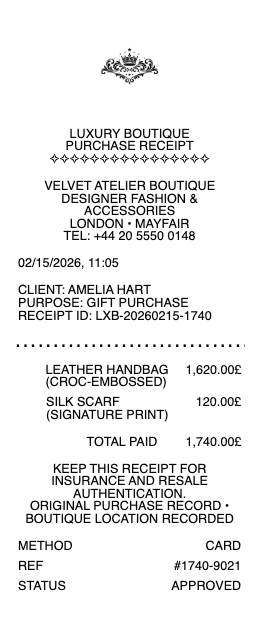
The boutique purchase creates a document set, not a slip
At a luxury boutique — a maison's own store, not a multi-brand retailer — the receipt is issued as part of a set: the sales receipt, the authenticity or warranty card, the box, the dust bag, the care booklet. Together they are the item's birth certificate, and the market treats them as a unit: full set is a resale term of art, and its absence is a discount.
The receipt's role in the set is the one part only you can lose: cards and boxes travel with the item, but the dated proof of purchase from the boutique is the document that anchors when and where the item entered the world — and it is the piece resale buyers, insurers, and the brand's own after-sales service ask about first.
Appointment retail and the client book
High-demand luxury runs on appointment retail: private appointments, client advisors, waitlists for sought-after pieces, and purchase histories that determine what a client is offered. The receipt trail is the client book's raw material — houses allocate scarce pieces to established clients, and established means documented.
Practical consequences: purchases concentrate value in the relationship as well as the item (the client account should be in your correct name and contact), and the boutique's record of your history is retrievable — which makes lost-receipt recovery genuinely workable at this tier of retail, in exchange for the privacy trade of being remembered.
Personalisation is a one-way door
Boutiques offer engraving, embossing, hot-stamping of initials — free or paid, and always final: personalised items do not return. The monogram that makes a piece yours makes it no one else's, and the receipt should record the personalisation and the final-sale consequence at the moment it is ordered.
The same logic covers special orders and made-to-order pieces: deposits are commonly non-refundable once production begins, the balance is due at delivery, and the receipt structure (deposit slip, balance receipt) documents a purchase that was never returnable. Decide first; personalise second.
From receipt to insurance appraisal
A boutique receipt is the starting document for insuring a valuable item, but it is not the finish: insurers scheduling jewellery, watches, and high-value bags typically want an appraisal or valuation — and the receipt feeds it. The purchase price establishes initial value; the receipt's item description (model, material, serial where present) identifies the piece; the appraisal then states replacement value, which for luxury goods can move well above the paid price over time.
The practical sequence: photograph the full set on purchase day, schedule valuable items promptly, and revisit valuations periodically — price-list inflation in luxury means a years-old receipt can understate replacement cost substantially, and under-scheduled items are underpaid at claim time.
Keeping the boutique file
Keep the receipt with photographs of the item, its serial or date code, and the full set — permanently. The file serves resale (full set plus receipt is the strongest provenance), insurance (identity and value), and after-sales service (authorised repairs often begin with purchase verification).
Boutiques retrieve client purchase records readily, which is the recovery route for a missing receipt. If a record is missing while the purchase genuinely happened, your card statement establishes the date, amount, and boutique, and a clear reconstructed record documents that real payment for your files, matching the charge exactly — while the boutique's own retrieved record, and the authenticity card only the brand issues, remain the documents the luxury market actually trusts.
Frequently asked questions
Everything you need to know about the product and billing.
What is a full set in luxury purchases?
The item plus everything issued with it: receipt, authenticity or warranty card, box, dust bag, booklets. Resale treats the set as a unit — full set is a pricing term, and missing pieces are a discount.
Can I return a personalised luxury item?
No — engraving, embossing, and monogramming are final sale from the moment of order, as are special orders once production begins. The receipt should record the personalisation and its consequence when ordered.
What is appointment retail?
The luxury model of private appointments, client advisors, and allocation by purchase history. The client book runs on documented purchases — which also makes boutiques unusually able to retrieve lost-receipt records for known clients.
Is a boutique receipt enough to insure an item?
It is the start: it establishes purchase price and identity. Insurers scheduling valuables typically want an appraisal stating replacement value — which luxury price inflation can push well above what you paid.
Why does the receipt matter for after-sales service?
Authorised repair and service often begins with purchase verification — when and where the item entered the world. The receipt, or the boutique's retrieved record, answers it.
What should I do on the day of a boutique purchase?
Photograph the full set — item, serial or date code, receipt, card, box — and store the images together. That one habit builds the provenance, insurance, and service file in five minutes.