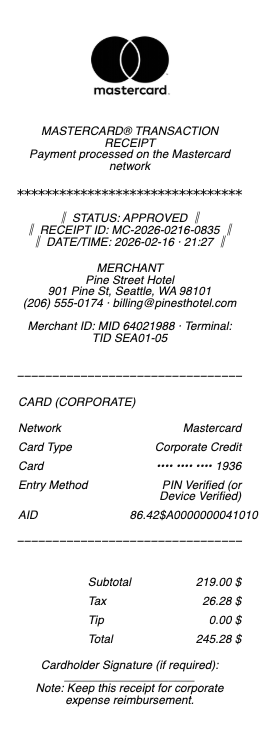
A Mastercard transaction receipt records a card payment on the Mastercard network. This guide explains its identifiers, Mastercard's four-digit dispute reason codes such as 4837 and 4853, and the 45-day merchant response window.
Mastercard Transaction Receipt
Add custom logo
Edit line items
Choose payment method
Add/remove elements
Customize business information
Choose font
How Mastercard's paperwork differs from Visa's
A Mastercard receipt carries the same practical fields as any card receipt — authorization code, masked card number, merchant identifiers, amount, entry method. The difference appears when something goes wrong, because Mastercard runs its own dispute system with its own vocabulary and its own clock.
If you are a merchant accepting both networks, this is the trap: the receipt looks the same, so the process feels the same, and it is not. The reason codes are formatted differently, and the response deadlines are different. Treating a Mastercard dispute like a Visa one is a good way to miss a deadline.
Mastercard's four-digit reason codes
Where Visa uses a dotted format (10.4, 13.1), Mastercard uses four-digit codes. The two you will meet most often:
4837 — No Cardholder Authorisation. The cardholder says they did not authorise the transaction. This is the fraud code.
4853 — Cardholder Dispute. The broad consumer-dispute code, covering goods not received, not as described, and cancelled recurring billing.
The structure mirrors Visa's four families — fraud, authorization, processing errors, and cardholder disputes — but the codes are not interchangeable, and a defence written against the wrong code is a defence that does not land.
The 45-day response window
Here is the operational difference that matters most. Merchants have 45 days to respond to a Mastercard chargeback, regardless of reason code — a single, uniform deadline. Visa instead gives merchants 30 days at each phase of its dispute process.
Cardholders, meanwhile, generally have 120 days to file, counted from the transaction or from the expected delivery date — that second option matters for goods that never arrive, because the clock starts when delivery was promised rather than when the card was charged.
A merchant running both networks needs a system that knows which deadline applies to which case. Missing the response window forfeits the dispute regardless of how strong the underlying evidence was.
What evidence actually wins a dispute
Representment succeeds on documentation, not on argument. The strongest file usually contains:
The transaction receipt, with the authorization code and the entry method.
Proof of delivery to the cardholder's verified address, for goods.
Evidence of cardholder engagement — account activity, prior undisputed purchases, communications.
The terms the cardholder agreed to, for recurring billing and cancellations.
Almost all of this must exist before the dispute arrives. A merchant who starts assembling evidence after a chargeback notice is already at a disadvantage, which is the real argument for keeping clean, legible, digital records of every sale.
The evidence file starts before any dispute exists. A clear statement descriptor — the merchant name as it prints on cardholder statements — plus an itemised receipt prevents the commonest dispute of all: the honest cardholder who simply does not recognise the charge. Merchants who match their descriptor to their storefront name see fewer fraud-coded disputes for the unglamorous reason that fewer customers are confused.
For cardholders: what your receipt is worth
The receipt is what lets you answer the question a dispute turns on: what was this charge, and did I authorise it? It names the merchant behind an unrecognisable statement descriptor, evidences what you bought, and — where a merchant has failed to deliver — it establishes what was promised and when.
Keep the digital copy where it is offered. If a paper original is lost and the payment genuinely happened, a clear reconstructed record of your own transaction, built from your statement's date, amount, and merchant, documents that real payment for your files — matching the actual charge exactly, and never substituting for the issuer's or acquirer's records in a formal dispute.
The same fact, read from the cardholder's side: before calling the bank about an unrecognised charge, match the statement descriptor against your receipts for that date and amount. A legal or parent-company name behind a familiar store explains most mystery charges — and a dispute filed over a purchase you actually made is a cycle everyone loses.
Frequently asked questions
Everything you need to know about the product and billing.
What is Mastercard reason code 4837?
'No Cardholder Authorisation' — the fraud code, used when a cardholder states they did not authorise the transaction. In practice a share of these are descriptor confusion rather than actual fraud — a legitimate charge under an unfamiliar legal name.
What is Mastercard reason code 4853?
'Cardholder Dispute' — the broad consumer-dispute code covering goods not received, goods not as described, and cancelled recurring billing. It is the family covering paid-for-but-wrong: goods not received, not as described, or defective — disputes about the product rather than about who used the card.
How long does a merchant have to respond to a Mastercard chargeback?
45 days, regardless of the reason code. Visa instead gives merchants 30 days at each phase of its dispute process, which is why the two cannot be handled with the same workflow.
How long does a cardholder have to file a Mastercard dispute?
Generally 120 days, counted from the transaction date or from the expected delivery date. The delivery-date option matters for goods that never arrive.
How do Mastercard and Visa reason codes differ?
Mastercard uses four-digit codes (4837, 4853); Visa uses a dotted format (10.4, 13.1). The categories are broadly parallel, but the codes are not interchangeable and a defence must address the correct one.
What evidence wins a card dispute?
The transaction receipt with its authorization code and entry method, proof of delivery to the verified address, evidence of cardholder engagement, and the agreed terms for recurring billing. Nearly all of it must exist before the dispute arrives.