A membership fee receipt documents annual dues paid to a warehouse club, association, or subscription service. This guide covers Costco and Sam's Club pricing, renewal proof, and when membership dues are actually tax deductible.
Membership Fee Receipt
Add custom logo
Edit line items
Choose payment method
Add/remove elements
Customize business information
Choose font
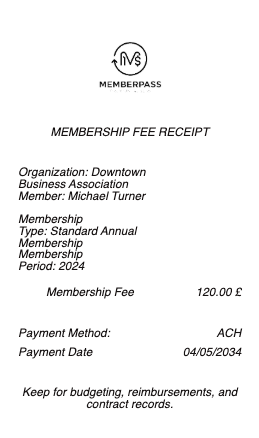
What a membership fee receipt documents
A membership fee receipt records the payment of dues — an access fee, not a purchase. That distinction shapes everything about how the document is used. You are not proving you bought goods; you are proving you paid for the right to buy them, or to use a facility, or to belong to an organization for a defined period.
The three fields that matter most on a dues receipt are therefore the membership tier, the coverage period (the exact 12 months your payment buys), and the membership number that ties the payment to your account. Amount alone is rarely enough — a renewal dispute is almost always about which year you paid for.
What the major memberships actually cost
Warehouse club and subscription dues are the most commonly documented memberships, and the tiers matter because the receipt should state which one you bought:
Costco Gold Star: $65 per year. Standard individual membership.
Costco Executive: $130 per year — includes a 2% annual reward on qualifying purchases, capped at $1,250 per 12-month period. Costco will refund the difference if the reward does not cover the $65 upgrade.
Costco Business: $65 per year, includes a free household card and is valid at Costco locations worldwide.
Sam's Club and Amazon Prime run similar tiered structures, with a base tier and a premium tier carrying cashback or extra services.
Because these fees renew automatically, the receipt is often the only artifact confirming which tier was active in a given year — worth keeping if you ever dispute a renewal charge or claim a business deduction.
When membership dues are tax deductible
This is where most people get it wrong, so be precise. Personal membership fees — a family Costco card, a gym, a shopping club used for household groceries — are not deductible. The IRS does not treat a shopping privilege as a business expense just because you sometimes buy business supplies with it.
Where dues can become deductible is when the membership is genuinely ordinary and necessary for a trade or business: a Costco Business membership used to buy inventory or supplies for a company, professional association dues, or trade-organization memberships. Clubs organized for pleasure, recreation, or social purposes are explicitly excluded — country clubs and athletic clubs do not qualify.
If you are claiming dues, the receipt needs to show the organization, the amount, the period covered, and ideally the business purpose. When in doubt, ask a tax professional rather than guessing — the deduction hinges on facts about your business, not on the receipt format.
Renewal, proration, and cancellation
Membership dues create three situations where documentation saves real money:
Double-charged renewals. Auto-renew plus a manual payment at the counter is a common error. Your receipt with its coverage period is what resolves it.
Mid-term cancellation. Some memberships refund unused dues prorated to the month; the original receipt establishes the start date the proration is calculated from.
Tier upgrades. Upgrading mid-year is typically prorated against your existing term, and the upgrade receipt should show the credit applied.
Recreating a dues record you have lost
Most membership providers keep dues history in your online account — Costco.com, Sam's Club, and Amazon all show membership charges in account or order history, and a renewal charge appears on your card statement with a recognizable descriptor.
If the original is gone and you need documentation of a fee you genuinely paid — for a business deduction, an expense claim, or a reimbursement from an employer who covers professional dues — you can reconstruct a clear record from your card statement, which carries the date, amount, and merchant. The recreated record documents a real payment; it does not invent one, and every field should match the underlying charge.
Frequently asked questions
Everything you need to know about the product and billing.
How much is a Costco membership in 2026?
Gold Star is $65 per year and Executive is $130 per year. Executive adds a 2% annual reward on qualifying purchases, capped at $1,250 per 12-month period. A Costco Business membership is $65 per year.
Are membership fees tax deductible?
Personal memberships (household warehouse clubs, gyms) are not. Dues can be deductible when the membership is ordinary and necessary for a trade or business — such as professional association dues or a business warehouse membership. Clubs for pleasure, recreation, or social purposes are specifically excluded.
What should a membership fee receipt show?
The organization, the membership tier, the amount paid, the exact period the payment covers, the membership number, and the payment method. The coverage period is the field most disputes turn on.
Do I get a refund if I cancel a membership early?
Many providers prorate unused dues or offer a satisfaction refund; policies vary by organization. The original receipt establishes the start date any proration is calculated from.
Where can I find my Costco membership renewal receipt?
In your Costco.com account under membership details, or on the card statement showing the renewal charge. The warehouse membership desk can also look up the payment against your membership number.
Is a membership fee the same as a purchase receipt?
No. A membership fee receipt documents dues that grant access for a period; a purchase receipt documents goods bought. They serve different purposes in bookkeeping and are treated differently for tax.