A merchant payout statement shows the net of sales minus fees — not a receipt of revenue. This guide explains gross versus net settlement, reconciling deposits to sales, and the restored $20,000/200 threshold for 1099-K.
Merchant Payout Receipt
Add custom logo
Edit line items
Choose payment method
Add/remove elements
Customize business information
Choose font
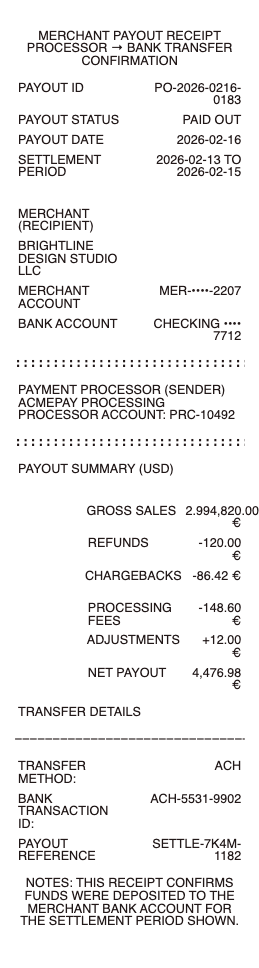
The deposit is not your revenue
The most consequential misunderstanding in small-business bookkeeping: treating the processor's deposit as the day's sales. It is not — it is the net settlement: gross sales, minus processing fees, minus refunds and chargebacks, sometimes minus reserves. The payout statement is the document that shows the arithmetic.
Booking net deposits as revenue understates both sales and fees — making margins look better and revenue look worse than reality, and breaking the match against the sales system's own totals. The correct pattern: record gross sales from the sales records, record fees as expenses from the payout statements, and let the deposit be what it is — the cash movement that reconciles the two.
Reading a payout statement
Whatever the processor, the statement decomposes the same way:
Gross transactions — the sales in the settlement batch, by date.
Processing fees — the percentage-plus-fixed per transaction, and any monthly or incidental fees.
Refunds — returned to customers out of the batch.
Chargebacks and their fees — disputed transactions pulled back, each with a penalty fee.
Reserves — amounts held back by the processor against risk, released on their schedule.
Net payout — what actually lands in the bank, tying to the statement line.
The reconciliation discipline is weekly, not annual: sales system totals → payout statements → bank deposits, with every gap named. Gaps are usually timing (batches settle across days) — and occasionally they are errors or unnoticed chargebacks, which is the point of looking.
The 1099-K: the $20,000 rule is back
US payment processors and marketplaces report merchant volumes to the IRS on Form 1099-K — and the threshold question has finally settled. After years of a scheduled drop to $600 (repeatedly delayed), the One Big Beautiful Bill Act restored the threshold to $20,000 in gross payments AND more than 200 transactions, retroactively — the $600 rule never took effect.
Two facts every merchant should internalise: the 1099-K reports gross volume — before fees, refunds, and chargebacks — which is precisely why your own gross-versus-net records matter (the deductions are yours to document); and the threshold governs reporting, not taxability — income is taxable whether or not a form was issued.
Chargebacks and reserves on the statement
The payout statement is also where disputes and risk-holds surface financially: a chargeback appears as a clawback plus a fee, and a reserve (rolling or fixed) appears as money earned but held. Both need tracking against their eventual resolutions — a won dispute returns the funds in a later batch; a released reserve arrives weeks or months on.
The failure mode is silent: clawbacks and holds absorbed into "the deposit was a bit low" without anyone tying them to cases. Each chargeback line should map to a dispute file; each reserve movement to the processor's reserve terms. The statement names them — the bookkeeping should too.
Keeping settlement records
Keep payout statements for the full tax retention period — they are the fee-expense documentation and the gross-to-net bridge the 1099-K makes necessary. Processors provide downloadable statement history, which is the recovery route; export monthly rather than trusting portal access years later.
If a statement is missing while the payouts genuinely happened, the processor's portal can regenerate it, and your bank statement establishes the deposits; a clear reconstructed record documents those real deposits for your files, matching them exactly — while the gross/fee/refund decomposition, which only the processor's statement carries, is the part worth actually retrieving.
Frequently asked questions
Everything you need to know about the product and billing.
Why doesn't my deposit match my sales?
Because deposits are net settlements: gross sales minus processing fees, refunds, chargebacks, and any reserves. The payout statement shows the arithmetic — and booking the net as revenue breaks your books.
What is the 1099-K threshold now?
Restored to $20,000 in gross payments AND more than 200 transactions — the One Big Beautiful Bill Act reversed the scheduled $600 threshold retroactively, so it never took effect. Reporting thresholds do not change what is taxable.
Why does the 1099-K show more than I received?
It reports gross volume — before fees, refunds, and chargebacks. Your payout statements document the deductions between that gross figure and your actual net, which is why they are tax records.
What is a reserve?
Money the processor holds back against risk — rolling or fixed — released on their schedule. It is earned but not yet paid, and it should be tracked against the reserve terms rather than absorbed as a low deposit.
How should merchants reconcile payouts?
Weekly: sales-system totals to payout statements to bank deposits, naming every gap. Most gaps are batch timing; the rest are errors and unnoticed chargebacks, which is the point of looking.
How do chargebacks appear in payouts?
As a clawback of the disputed amount plus a fee, in the batch where the dispute lands. Each should map to a dispute file — won cases return funds in a later batch.