Metro systems have largely replaced paper tickets with contactless tap payments and fare capping. This guide explains where the receipt lives now, how daily and weekly caps work, and what an incomplete journey costs.
Metro Ticket Receipt
Add custom logo
Edit line items
Choose payment method
Add/remove elements
Customize business information
Choose font
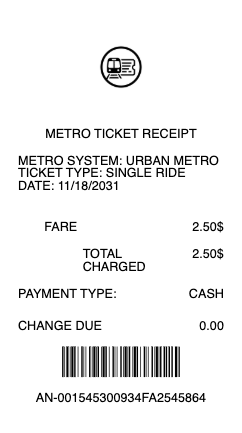
The metro receipt has dissolved into your card statement
On modern metro systems, the paper ticket is disappearing: you tap a contactless bank card or phone at the gate, and the system charges the fare — often aggregating a whole day's travel into one consolidated charge that settles overnight.
That changes where the record lives. There is no slip to keep; the "receipt" is the charge on your card statement plus, crucially, the journey history in the transit system's app or website once you register the card you tap with. Registering matters: unregistered cards still work at the gate, but the journey-level detail — where you tapped, what each trip cost — is only retrievable for a registered card, and it is exactly what an expense claim or a fare dispute needs.
Fare capping: the meter that stops itself
The economic feature of tap-to-pay transit is fare capping: the system counts your travel and stops charging once you hit the cost of a day pass (and, on many systems, a weekly cap). You get pay-as-you-go flexibility with pass-level pricing — automatically, without buying anything in advance.
Two practical consequences:
Use the same card all day. Capping only works if the system can see all your journeys — switching between a phone and a physical card splits your travel across two identities and can cost you the cap.
The daily charge is a computed figure. The statement shows one amount; the journey history shows the trips and the cap arithmetic behind it, which is where errors are found.
The incomplete journey: transit's version of a penalty fare
Tap-in/tap-out systems charge by where you entered and exited. Forget to tap out — or tap in — and the system cannot compute the fare, so it charges the maximum fare for an incomplete journey.
These charges are correctable: the journey history shows the incomplete trip, and operators provide a claim route to adjust it to what the journey actually was. It is worth doing — maximum fares are deliberately unattractive — and it is only possible with a registered card, which is the recurring theme of tap-to-pay transit: registration converts anonymous taps into an account with history, disputes, and receipts.
What transit records show for expenses
For business travel, the useful export is the journey statement from the registered account: date, time, origin, destination, and fare per trip, with caps applied. That substantiates work travel in a way a bare card-statement line ("Transit Authority — $8.40") cannot.
Commuters claiming pre-tax transit benefits route the spend through employer programs — transit passes share the qualified transportation fringe benefit treatment, with its monthly cap.
Occasional business trips are claimed from the journey history export.
Visitors without a registered card should keep the day's statement line and note the trips — or buy through the system's app, which generates receipts natively.
Keeping and recovering transit records
The registered account holds journey history for months and exports statements — that is the recovery route, and the reason to register the card you tap with before you need the history.
If a record is missing while the travel genuinely happened, your card statement establishes the aggregated daily charge, and a clear reconstructed record documents that real payment for your files, matching the charge exactly. The per-journey detail lives only in the operator's system — retrievable for registered cards, gone for anonymous ones, which is the single best argument for the thirty seconds registration takes.
Frequently asked questions
Everything you need to know about the product and billing.
Where is my receipt for a contactless metro journey?
There is no paper — the record is the consolidated charge on your card statement plus the journey history in the operator's app or site, retrievable if you register the card you tap with. Registration is what converts anonymous taps into an account with receipts.
What is fare capping?
The system counts your tap-to-pay travel and stops charging once you reach the day-pass cost (and often a weekly cap). You get pass pricing automatically — but only if all journeys are on the same card or device.
Why was I charged a maximum fare?
An incomplete journey — a missing tap-in or tap-out — means the system cannot compute the fare and charges the maximum. It is correctable through the operator's claim route, using the journey history of a registered card.
Can I claim metro travel as a business expense?
Yes — export the journey statement from your registered account: date, time, origin, destination, and fare per trip. That substantiates work travel in a way a bare statement line cannot.
Does switching between phone and card cost me money?
It can. Capping works per card identity — splitting the day's travel between a phone and a physical card divides your journeys across two identities and can cost you the cap.
How do commuter pre-tax benefits apply to transit?
Transit passes qualify for the pre-tax transportation fringe benefit up to the monthly cap, routed through employer programs — the same framework that covers qualified parking.