A mini market or corner shop receipt often comes from a simple till or a handwritten pad. This guide explains what a small-store receipt should still contain, why it matters for expenses, and how to get one when none is offered.
Mini Market Receipt
Add custom logo
Edit line items
Choose payment method
Add/remove elements
Customize business information
Choose font
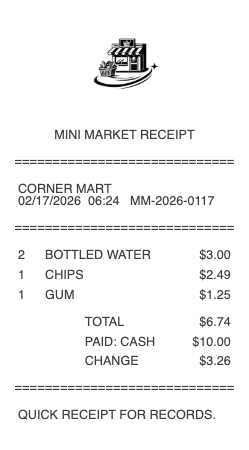
Small shops, simple systems — and often no receipt at all
The independent corner shop is where the receipt habit most often breaks down. Many operate on a basic till, some on a handwritten pad, and plenty hand over change without offering anything at all unless asked.
That is a practical problem rather than a moral one. Small independents run on thin margins and simple systems, and printing is an overhead. But the consequence lands on the customer: if you need that purchase for an expense claim, a reimbursement, or your own records, no receipt means no evidence — and the moment to fix it is at the counter, not afterwards.
Ask. It is a normal request, and virtually every shop can produce something, even if it is written by hand.
What a small-store receipt should still contain
A basic till slip is not exempt from being useful. Even a minimal receipt should carry:
The shop's name and address — a slip with a total and nothing else identifies nobody.
The date of the purchase.
What was bought, at least in outline, and the amount.
The tax treatment, where the shop is registered for sales tax or VAT — including the registration number, without which the tax on the purchase cannot be reclaimed by a business customer.
A receipt showing only a figure is nearly worthless in an expense file, because it does not establish who was paid or for what. If the printed slip is that bare, ask for the shop's stamp or a handwritten note of the item on it.
Handwritten receipts from a small shop are perfectly valid
Where there is no till, a handwritten receipt from a numbered pad is a complete and legitimate document — this is how a great many small businesses have always issued them. It holds up provided it is legible, gives the shop's name, the date, the items, the amount, and ideally a signature or stamp.
For the shopkeeper, the duplicate book is also the sales ledger, which is why the bound copies matter as much as the one handed over. For the customer, a handwritten receipt is worth exactly as much as a printed one — with the single caveat that faint pencil and an illegible scrawl prove nothing, so check you can read it before you leave.
Cash, cards, and the disappearing trail
Small shops are disproportionately cash businesses, and cash is the payment method that leaves no independent trace. A card payment at least appears on your statement with a merchant name and a date, which is a partial record even when no receipt was issued.
Pay by card where the purchase matters and the shop accepts it, and be aware of two common frictions at independents: a minimum spend for card payments, and — where lawful — a small surcharge. Both are legitimate business decisions on the shop's part, but they nudge customers back toward cash, which is precisely when the receipt becomes the only record that will ever exist.
Keeping small purchases straight
The individually trivial purchases are the ones that vanish from an expense file — a few items from a corner shop, unrecorded, adding up quietly over a year. If small purchases genuinely form part of a business's costs, the discipline is to capture them at the moment: photograph the slip before it goes into a pocket, because those thin thermal slips fade faster than most.
If a slip is lost for a purchase that genuinely happened and it was paid by card, your statement establishes the date, amount, and shop, and a clear reconstructed record documents that real payment for your files — matching the charge exactly. Where it was cash and no receipt was issued, there is nothing to reconstruct from, which is the honest reason to ask for the receipt at the counter.
Frequently asked questions
Everything you need to know about the product and billing.
Does a small shop have to give me a receipt?
Practice varies by jurisdiction, but virtually every shop can produce one if asked — it is a normal request. The time to ask is at the counter, because after the fact there may be no record to recreate one from.
Is a handwritten receipt from a corner shop valid?
Yes. A handwritten receipt from a numbered pad is a complete document provided it is legible and shows the shop's name, the date, the items, the amount, and ideally a signature or stamp.
What should a mini market receipt include?
The shop's name and address, the date, what was bought, the amount, and — where the shop is tax-registered — the tax treatment and registration number. A slip showing only a total identifies nobody and is nearly worthless for an expense claim.
Why do small shops have card minimums or surcharges?
Card processing has fixed costs that make very small transactions uneconomic, so minimums and (where lawful) surcharges are common at independents. They do push customers toward cash — which is exactly when the paper receipt becomes the only record.
Can I claim a corner shop purchase as a business expense?
Yes, if it is a genuine business cost — but you need a receipt that identifies the shop and what was bought. A bare total with no shop name will not support the claim.
What if I paid cash and got no receipt?
There is no independent record to work from, which is the honest limitation of cash. This is why asking at the counter matters: a card payment at least leaves a statement line, but cash without a receipt leaves nothing at all.