A monthly parking receipt documents a recurring parking permit or garage space. This guide covers what the receipt should show, the 2026 pre-tax commuter parking limit of $340 a month, and how to claim or reimburse parking correctly.
Monthly Parking Receipt
Add custom logo
Edit line items
Choose payment method
Add/remove elements
Customize business information
Choose font
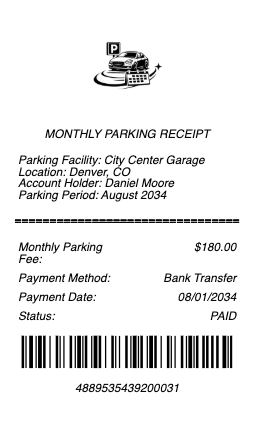
Monthly parking is a subscription, not a transaction
A monthly parking receipt is fundamentally different from the ticket you get leaving an hourly garage. You are not paying for a single stay — you are paying for access over a period, usually a calendar month, under a permit, a licence, or a space lease.
That changes which fields matter. On an hourly receipt, the entry and exit times are the whole story. On a monthly receipt, the critical fields are the period covered, the space or permit number, and the facility address — because the document's job is to prove which month you paid for, at which location, under which permit.
The pre-tax commuter benefit is the reason this receipt matters
Most people documenting monthly parking are doing it for one reason: the money can be taken out of their salary before tax. Qualified parking is a qualified transportation fringe benefit, which means an employee can pay for it with pre-tax dollars up to a monthly cap.
For 2026, the monthly exclusion for qualified parking is $340 — up from $325 in 2025. Transit passes and commuter highway vehicle benefits carry the same $340 monthly limit, and an employee with both kinds of expense can use both. Anything above the monthly limit has to be included in taxable wages.
To qualify, the parking must be on or near the business premises, or at a location from which the employee commutes (a park-and-ride or transit hub, for example). Parking at your own home does not qualify. Both employee pre-tax salary deferrals and any employer-paid portion count toward the same cap.
What a monthly parking receipt should show
Whether you are claiming a commuter benefit, expensing it to a business, or simply proving your space is paid for:
The facility name and address — the location determines whether the benefit qualifies.
The period covered — the specific month or date range, not just the payment date.
The permit, space, or account number.
The amount, with any tax shown separately.
The payment method and date.
The vehicle or licence plate, where the permit is tied to a specific car.
The period is the field most often missing and the one most often needed — a receipt that proves you paid $340 but not which month it covered is close to useless in a benefits audit.
Permits, garages, and residential spaces
Monthly parking arrives in several forms, and the paperwork differs:
Commercial garage or lot permits — usually auto-renewing, billed monthly or annually, with a permit number and often a physical hangtag or transponder.
Employer-provided parking — sometimes payroll-deducted, in which case the pay stub is part of the record.
Residential or HOA parking spaces — rent for a deeded or assigned space, which can be part of a lease rather than a separate receipt.
Municipal residential permits — issued by a city, typically annual, and generally not a commuter benefit because they cover parking at home.
Reconstructing a missing record
Because monthly parking recurs, the paper trail is usually recoverable: the garage operator or permit office keeps a billing history, most commercial operators email a monthly statement, and a recurring charge appears on your card statement with a consistent merchant descriptor and amount.
If a specific month's receipt is lost and the payment genuinely happened, your card or bank statement establishes the date, amount, and operator, and a clean reconstructed record from those details documents a real payment you made. Match it to the underlying charge exactly, and note the period it covers — for a benefits claim, the operator's own statement remains the authoritative document, so request a reissue when the claim is significant.
Frequently asked questions
Everything you need to know about the product and billing.
How much monthly parking can I pay for pre-tax in 2026?
The 2026 monthly exclusion for qualified parking is $340, up from $325 in 2025. Transit passes carry the same $340 monthly limit, and an employee with both types of expense can use both. Anything above the cap is included in taxable wages.
What parking qualifies for the pre-tax commuter benefit?
Parking on or near the business premises, or at a location from which you commute to work, such as a park-and-ride or transit hub. Parking at your own home does not qualify.
What should a monthly parking receipt show?
The facility name and address, the exact period covered, the permit or space number, the amount and any tax, the payment method and date, and the vehicle or plate where the permit is tied to a car. The period covered is the field most often missing.
How is a monthly parking receipt different from an hourly one?
An hourly receipt records a single stay with entry and exit times. A monthly receipt documents access over a period — so the coverage dates, permit number, and facility matter far more than any timestamp.
Do employer payroll deductions for parking count toward the limit?
Yes. Both employee pre-tax salary deferrals and any employer-paid portion count toward the same monthly maximum.
How do I get a copy of a lost monthly parking receipt?
Ask the garage operator or permit office for a billing history — most commercial operators keep one and email monthly statements. The recurring charge also appears on your card statement with a consistent descriptor.