A monthly rent receipt is one entry in a payment history. This guide explains why the run matters more than any single receipt, how grace periods and late fees work, and how partial payments get applied.
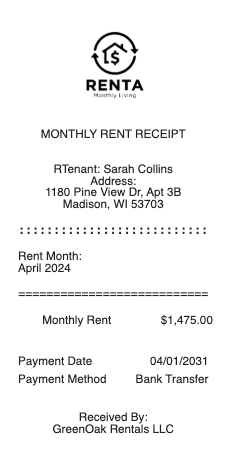
Monthly Rent Receipt
Add custom logo
Edit line items
Choose payment method
Add/remove elements
Customize business information
Choose font
One receipt proves a month — the run proves you
A single rent receipt answers a narrow question: was July paid? A sequence of them answers a much more valuable one: are you a reliable tenant?
That second question is the one that gets asked when it matters — by a landlord deciding whether to renew, by the next landlord assessing an application, by a court weighing an eviction claim, by an underwriter looking at whether you meet your obligations. None of them are satisfied by one receipt. They want the run.
So the discipline that pays is not keeping a receipt. It is keeping them in order, unbroken, month after month — because a payment history with a hole in it invites exactly the question you cannot answer.
The grace period is not extra time
Most leases name a day rent is due — typically the first — and then allow a short grace period, often three to five days, before a late fee attaches. Tenants routinely misread this as the real deadline. It is not.
Rent is due on the due date. The grace period only postpones the penalty, not the obligation. In many jurisdictions a tenant paying within the grace period is still technically late, which can matter for a lease that counts late payments, or a landlord deciding on renewal.
Late fees themselves are frequently capped by state law — as a fixed sum or a percentage of rent — and a fee above the statutory cap is not enforceable simply because the lease says so. If your receipts show fees you were charged, they are what you would use to challenge them.
Partial payments and how they get applied
This is the mechanism that quietly ruins tenants who are catching up after a hard month. If you owe arrears and make a payment, the landlord generally decides what it pays off — and it often goes to the oldest debt, or to fees and costs, before current rent.
The consequence is counterintuitive and severe: you can pay this month's rent in full and still be recorded as delinquent for this month, because the money was applied to last month's shortfall and a late fee.
Two protections: state clearly in the payment reference what the payment is for, and check the receipt shows it applied that way. Where a receipt shows a different allocation than you intended, raise it immediately — a month later it has become a payment history.
What each monthly receipt must show
The period it covers — the specific month, not merely the date it was paid.
The amount, and whether it is full or partial.
How it was applied, where you are in arrears.
Any late fee charged, shown separately from rent.
The remaining balance, if any — a receipt that ends with a balance is self-checking.
The property, the tenant, the landlord, and the date received.
Rent increases and the record
When rent changes, your receipts become the evidence of what you were paying and from when. A rent increase generally requires proper written notice with a defined period, and in rent-regulated jurisdictions may be capped outright — and the question "what was I paying before, and when did it change?" is answered by your receipt run, not by memory.
Keep the receipts with the lease and any notices. If a receipt is missing for a payment that genuinely happened, your bank record establishes the date, amount, and payee, and a clear reconstructed record documents that real payment for your files, matching the bank record exactly. Where the landlord's ledger disagrees with you, their statement and your bank records are what settle it — so ask for a rent statement covering the tenancy rather than relying on a reconstruction.
Frequently asked questions
Everything you need to know about the product and billing.
Why does a run of rent receipts matter more than one?
Because a single receipt proves one month was paid, while an unbroken sequence proves reliability — which is what a renewing landlord, a future landlord, a court, or an underwriter actually wants to see. A history with a gap in it invites the question you cannot answer.
Is rent late if I pay within the grace period?
Often yes, technically. Rent is due on the due date; the grace period postpones the late fee, not the obligation. That can still matter for a lease that counts late payments or a landlord considering renewal.
Can a landlord charge any late fee they want?
No. Late fees are frequently capped by state law, as a fixed amount or a percentage of rent, and a fee above the statutory cap is not enforceable just because the lease states it. Your receipts are what you would use to challenge one.
How are partial rent payments applied?
Generally at the landlord's discretion — often to the oldest debt, or to fees and costs, before current rent. This is how a tenant can pay this month in full and still be recorded as delinquent for this month.
What should a monthly rent receipt show?
The period covered, the amount and whether it is full or partial, how it was applied if you are in arrears, any late fee shown separately, the remaining balance, and the property, tenant, landlord, and date received.
How do receipts help with a rent increase?
They evidence what you were paying and from when. Increases generally require proper written notice and may be capped in regulated jurisdictions — and your receipt run, not your memory, is what establishes the previous rent.